




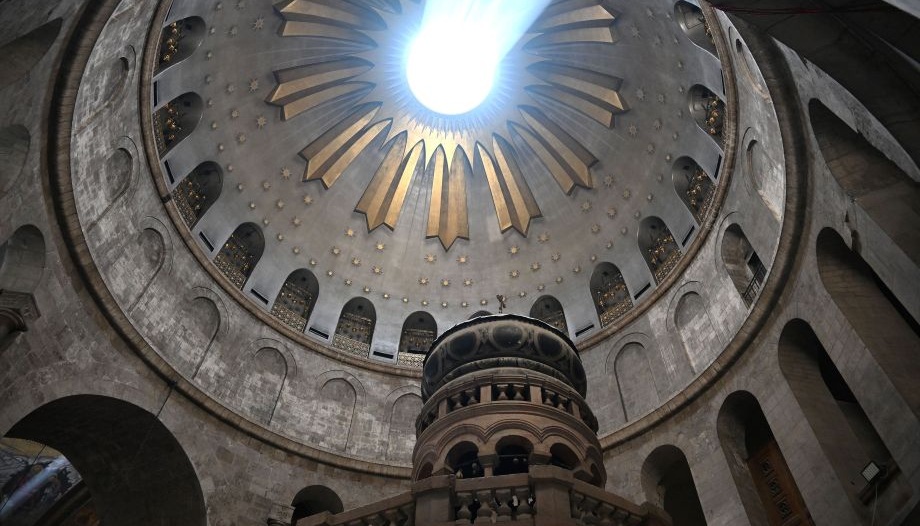
 "Celebrating the Resurrection is essential."
When the other day I read the same headline you just clicked on to get here, my finger struggled not to fall into the cyber-bait, but the fear of missing some relevant information that everyone would later talk about, made me fall for it. After paragraphs and paragraphs of AI-generated bluster explaining truisms about how each Gospel narrates the mystery of the Resurrection in a different way and dozens of ads, at the bottom, I found the heart of the information: the fact that really changes the perspective from which one faces the historical event of the Resurrection of Christ and that not everyone knows. I managed to find it, but it was hard.
The news
In journalism school they taught us about the inverted pyramid, which said that a good piece of information should concentrate the most important data at the beginning - the answers to the questions of the famous five double v's «Who», «What», «When», «Where» and «Why» (who, what, when, where and why). In this way, as soon as the reader begins to read, without wasting time, he/she will be able to have the fundamental data of what has happened to move on, little by little, to more secondary aspects that would include the sixth double V, the «How», which only the most interested reader or the reader with more time available would be able to read.
But the inverted pyramid has passed to a better life because what is important now is that you get to the end of the information by staying as long as possible within the link, generating traffic and ad impressions, which is what digital media live on. The feeling of boredom, however, caused by the new «right pyramid» or «disinverted pyramid», where the least important is at the top and the core is at the bottom, makes one increasingly distrustful of certain digital media, especially the more attractive the headline.
And what happens with ordinary news I think that, to a certain extent, also happens with the greatest news ever told, the «Good News», which is what the word “gospel” means etymologically. Do people find the Good News in the Church when they meet her, or how deep do we have to go to find this treasure that we carry in earthen vessels? The deposit of faith that the Church guards is often buried in tons of rubbish that only serves to confuse and discourage those who might be truly curious about the person of Jesus or believe that God can be the answer to their great questions about the meaning of life.
Kerygma
At times, we bore with our insistence on proposing Christian morality (absolutely incomprehensible without faith because it is a consequence of it); at others, we insist on giving an image of perfection that falls like a house of cards as soon as scandals put us in our reality as sinners; we preach more with words than with works; we get along badly among ourselves, we administer sacraments to people who have not been initiated in the mystery making them believe that this is what it means to be Christians; we get involved in politics more than necessary or we keep silent when we should be shouting, confusing belonging to the Christian community with this or that ideological affiliation; we scare people with hell, when so many already live in it; we encourage people to visit our churches as if they were only works of art, without explaining to them what motivates them and what they are shouting to the world; we invite them to liturgies assuming that people understand what is being celebrated, and below, below all, we are left with the announcement of the good news, the «kerygma", the "kerygma".", The first announcement that made many of us discover one day that Christianity is not an ascription, not an ethical decision or a great idea but, fundamentally, the real and certain encounter with an event, with a Person: Jesus Christ, dead and risen.
You have a lot of resources in "Evangelii Gaudium”Pope Francis explained that the “kerygma” “must be at the center of evangelizing activity and of every attempt at ecclesial renewal” because, he said, “there is nothing more solid, more profound, more certain, more dense and wiser than this proclamation. Every Christian formation is above all the deepening of the ‘kerygma’”. And, like the central theme of a great symphony, the “kerygma” should be present and repeated in one way or another throughout the whole of Christian action.
At the gates of the Easter Triduum, when we are preparing to celebrate the core of faith: the Passion, Death and Resurrection of Jesus, let us recover that center, that message of salvation that gives meaning to our Church because the Church exists to evangelize, to announce the “kerygma”. Then everything else will follow. Let's put first, what is important, the five double v's (what, who, when, where, where, and why). That is to say, that Jesus of Nazareth, God made man, in the year 33, in Jerusalem, He gave his life for love and rose again; and let us leave everything else for the end (morals, doctrine, sacraments, social involvement...) because only those who have really found interest in the central proclamation and want to know more should arrive there.
And if you have come all the way down here because you are still wondering what is this piece of information about the Resurrection that, as the headline promised, would change the way you see everything, here it is: all this about a God who becomes man, who dies and rises again, is only for you. Not «for humanity» or «for all men», that too, but especially for you. And the fact is that knowing that we are loved «exclusively» by God - as a mother loves each of her children, even if she has many - really changes life, the way we see everything. So, congratulations for being so loved, so loved, and happy Easter.
Journalist. Graduate in Communication Sciences and Bachelor in Religious Sciences. He works in the Diocesan Delegation of Media in Malaga. His numerous "threads" on Twitter about faith and daily life have a great popularity.




 Español
  English
  Italiano