




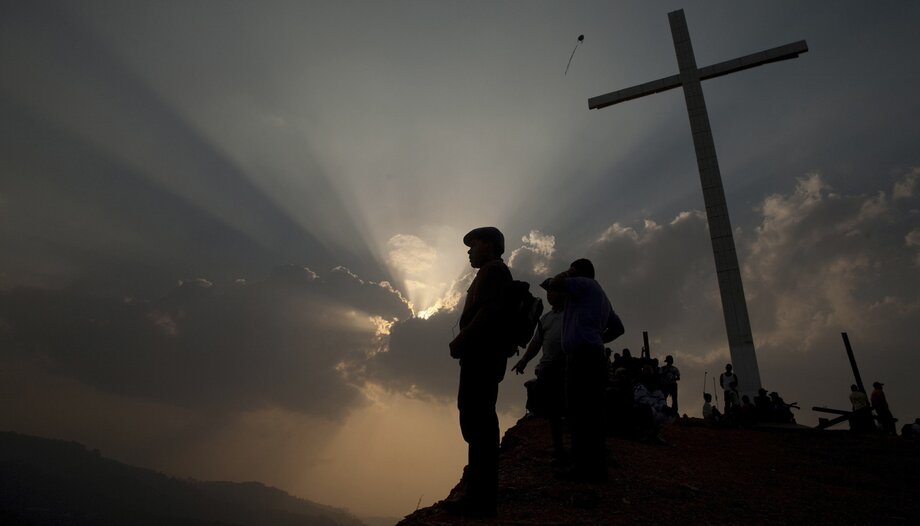
 Changing the world requires a change of direction, Pope writes for Stations of the CrossThe history of the Stations of the Cross in the Roman Colosseum
"Wounds that heal”is the latest book by Erik Varden. It is based on a poem by St. Arnulf of Louvain about the wounds of Christ, which has a healing effect on the reader's soul. In a similar way, a custom of long tradition, on the night of Holy Thursday to Good Friday, which also has a restorative action and is a sign of correspondence to the Love of Christ, is to visit the seven Monuments.
The Eucharistic Monument is the name given to Jesus, made Eucharist, after the celebration of the Last Supper, in the offices of Holy Thursday. That is to say that Jesus Christ, with the appearance of bread, is exposed in a place prepared with floral and ornamental decorations, very careful. On that day the institution of the Eucharist, the Priestly Order and the commandment of love, which is manifested by the washing of the feet, are commemorated. All this happened during the commemoration of the Jewish Passover in Jerusalem, at the Passover supper, which Jesus and his apostles did, the night before his death.
Origin of the custom
The origin of the custom of visiting Eucharistic Monuments is in the comings and goings of Herod to Pilate, after Jesus was imprisoned in Gethsemane, which is popularly called “bringing you from Herod to Pilate”. These seven moments appear in the Gospel, are:
- Jesus' prayer and agony in the Garden of Olives.
- Jesus is seized and taken to the house of Annas.
- From the house of Annas he is transferred to the court of Caiaphas.
- Caiaphas orders him to be brought before Pilate to the Praetorium.
- Pilate in turn sends him to Herod's palace.
- From Herod he is brought back to Pilate, after being scourged, to be crucified.
- Jesus carries the Cross on the road to Calvary.
There is also talk of the seven moments in which Jesus had effluvia of blood, throughout this agonizing process. But the custom crystallized in Eucharistic visits to monuments exposed in seven churches. St. Philip Neri, in the 16th century, made it fashionable in Rome to visit the seven monuments of the seven historic churches, recalling those seven moments of “bringing you from Herod to Pilate”. These are the four main Basilicas (St. Peter's, St. Mary Major, St. Paul Outside the Walls and St. John Lateran), and the churches of San Lorenzo, Santa Croce and San Sebastiano.
The custom of the Monument is a way to compensate for what the 12 apostles did not know how to do: to be awake praying with Him, the night before His death. What they failed to do, that is, to pray and accompany Jesus so that the will of his Father be done, is what we do. So these visits to the Monuments serve to accompany Him, to speak to Him with intensity, to increase our love for Him and to heal our wounds.
What is the custom of the Stations of the Cross?
The Way of the Cross consists of remembering the fourteen moments of the Passion of Christ, which took place in specific places in the Holy Land (where Jesus lived, died and resurrected), more than two thousand years ago. We know them, almost all of them, thanks to the Christians who have been saving the location of these holy places. Especially thanks to the Franciscans, religious who since the thirteenth century have kept these sites.
Since it was not always possible to visit these places, they began to draw and make sculptures of what happened in these holy places. At first, these images were placed in the churches of Jerusalem. Later, they took them to other countries. The first to start this pious custom was Spain in 1419, thanks to Blessed Alvaro de Cordoba, who after visiting the Holy Land and being impressed by seeing the holy places and churches there, decided to bring the images to his country. He then moved on to Sardinia (now Italy) and then to the rest of Europe. Later, St. Leonard of Port Maurice, between 1731 and 1751, took it upon himself to put up many Stations of the Cross. And how many is many? He put up five hundred and seventy Stations of the Cross in Italy!
These fourteen moments of Jesus“ journey, from his condemnation to death until his burial, are called ”stations". In the following, we will indicate what happens in each of the stations, naming them with their usual title.
- 1st Station: Jesus is condemned to death
- Station II: Jesus carries the cross
- III Station: Jesus falls for the first time
- Station IV: Jesus meets Mary, his Blessed Mother
- V Station: Simon helps to carry Jesus' cross
- Station VI: A pious woman wipes Jesus' face
- Seventh Station: Jesus falls for the second time
- Station VIII: Jesus consoles the daughters of Jerusalem
- IX Station: Jesus falls for the third time
- X Station: Jesus is stripped of his garments
- XI Station: Jesus is nailed to the cross
- XII Station: Death of Jesus on the Cross
- XIII Station: Jesus is unclothed and handed over to his Mother
- XIV Station: Jesus' body is buried
To contemplate the Stations of the Cross
Books have been written about these scenes to contemplate the Passion, in a church or anywhere else, to increase our knowledge of God's love for us and to increase our appreciation of Jesus Christ. One of them is the one written by St. Josemaría. It is in text and audio, free of charge on the internet, on the Opus Dei website. There is also a paper version available from Rialp Publishers. In addition, the text of St. Josemaría's Way of the Cross with images of Mel Gibson's Passion is on Eduardo Ares' Youtube channel. https://www.youtube.com/watch?v=TiGVQcbf3LI&list=PLTTqO7YWK8G1vq_D_pvPf2HXzUoiSII66&ab_channel=EduardoAresMateos
On the other hand, for children over 10 years old and teenagers, there is the book from Casablanca publishing house: “The top moments of the biggest influencer in history”.” https://libreria.sanpablo.es/libro/los-momentos-top-del-mayor-influencer-de-la-historia_233920
Both customs, the seven monuments and the Stations of the Cross, are two very good ways of living Holy Week, uniting ourselves to the cross, healing our wounds and making up for what the apostles did not do.





 Español
  English
  Italiano