




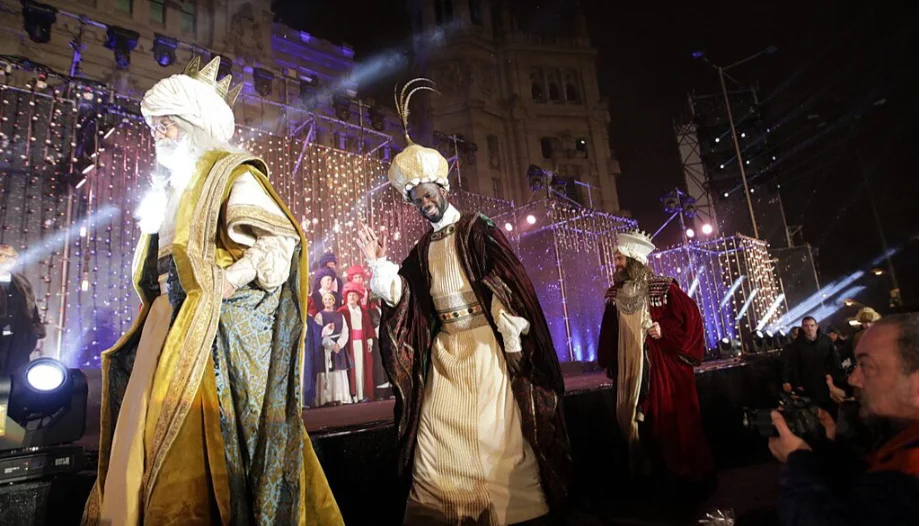
On January 6—or the first Sunday of the year—the arrival of the Three Wise Men at the cave in Bethlehem is celebrated. These wise men from the East embody the archetype—the figure, symbol, and permanent model—of all those who seek the truth wherever it may be found.
The eternal Truth had been dwelling in our history for only a few days. First, it was revealed to some humble shepherds who slept in the open and who, without effort or searching, found themselves unexpectedly enveloped in Glory (Lk 2:8). But today's solemnity reminds us that, for most people, the encounter with truth is not simply received: it requires a laborious search, a determined advance, and, often, a long journey.
The Three Wise Men symbolize the desire for knowledge and the innate need to attain the object of intelligence: truth. «All men by nature desire to know» (Aristotle, Metaphysics, I, 1, 980a1) and that truth may be known by all who seek it with righteousness.
Saint Matthew presents us with some restless men, capable of looking at the sky with an openness of soul that allows them to see beyond what ordinary mortals perceive: «We saw his star in the East and have come to worship him» (Mt 2:2). What set them on their long journey was not a fleeting curiosity, but a shared experience that gave rise to a bold hypothesis. In their case, it was a star; in ours, it may be an unexpected event, an inner question, a wound, a joy... anything capable of awakening the desire for meaning.
Jordan Peterson has accurately described this dynamic of thought: «A question that does not address a sufficiently difficult problem will not attract the attention of researchers... The question must exist on the frontier between order and chaos; it must contain a mixture of the truly unknown.».
Magicians dare to cross precisely that boundary. They set out on their journey: they accept the risk of leaving the known behind to venture into the unknown, with all the effort, vulnerability, and hope that this entails. Every true quest is a pilgrimage, and every pilgrimage is always twofold: external and internal.
Once the question had been posed and the journey begun, they arrived in Jerusalem (Matthew 2:1-4). There they gathered information and consulted Herod, the chief priests, and the scribes. This gesture teaches a decisive lesson: no authentic discovery can disregard tradition. Truth is not invented; it is recognized. Only those who rely on what others have understood before can see further. Ignoring the legacy of humanity would be as absurd as setting out on a journey without knowing the map.
These characters do not seek rewards or favors; on the contrary, they arrive offering gifts. Because the truth is, in itself, the greatest reward: it is worth more than all the riches symbolized by gold, more than the sacrifices evoked by myrrh, and more than the humility of incense, which reminds us that we are not the measure of things, but rather that it is the truth that measures us and reveals itself to us.
The scene that crowns his journey—the Child with Mary, his Mother—occurs in the most concrete reality, in direct contact with the real. «Intellectual joy occurs when a new understanding emerges... I know well where to look for it: in unknown territory.» No representation, however elaborate, can replace the power of direct encounter: «It's not the same to see it as to have it told to you.».
When the wise men from the East arrive at their destination, they experience a profound joy: their intuition is confirmed, their search is illuminated, their hypothesis leads to an encounter. Entering the house, seeing the Child, adoring him... each gesture marks the transition from restless reason to humble wonder, from thought to adoration.
The story ends by saying: “They returned to their country by another route” (Mt 2:12). Those who discover the truth cannot retrace their steps, but their lives are transformed. Epiphany celebrates these great seekers, seekers of truth who were not afraid to risk everything to follow a faint but true light.




 Español
  English
  Italiano