



In 1907 Robert Hugh Benson wrote his best known novel, Lord of the world. It is a fictional dystopia in the style of 1984 or Brave New World, in which the author enters with great intuition into the world he was living in. When one reads this book one cannot help but feel that one is before a prophetic tale that is a great denunciation and a terrible warning about the future. About our present.
The book narrates the advent of a secular messiah, Julian Felsenburgh, a diplomat, a sage, a charismatic and powerful leader who manages to bring peace to the world at a time of great tension and who establishes a humanitarian philosophy in politics. I don't want to reveal the plot, but it is overwhelming to see how, step by step, many of the predictions made by the author are fulfilled. From the general apostasy and a secularization that leaves religion in a corner of social life, to the euthanasia laws or the creation of the European Union and the emerging power of China. In the end, only the Church remains as the last redoubt of a transcendent vision that Julian Felsenburgh wants to destroy.
I was reminded of this suggestive novel when I saw the debate that has arisen in recent days the atheist funeral, secular tribute they call it, that the Socialist Government of Pedro Sanchez wanted to celebrate after the victims of the train accident in Adamuz in which 46 people died.
In the novel the Government promoted by Felsenburgh promotes new festivities, that of Paternity and Maternity and establishes the worship that the citizens must render. Francis, a former apostate priest, is presented on behalf of a group of former clergymen to organize the whole liturgy, because he and the Government know that men need rites and faith, and that the liturgy has a special relevance in it. No one knows this better than he, a former Catholic priest.
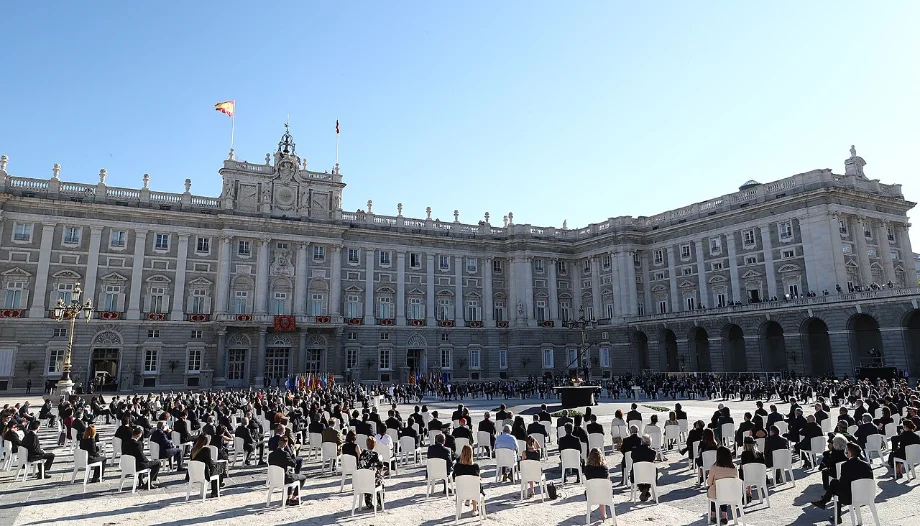
For some time now, the Government has been trying to replace Catholic State funerals with secular tributes, with a liturgy that partly reminds us of the liturgy that religions have created to worship God. We saw it for the first time in the pandemic that caused the COVID-19, we saw it again in the tribute after the floods in Valencia, and they have also wanted to do it now, before the terrible railway accident.
But this time the victims have refused to play the government's game and finally the Sanchez administration has postponed its proposal. sine die. A Catholic funeral was indeed held, attended by the King and Queen of Spain and many civil authorities. Only the President of the Government was absent... for agenda reasons, they said.
Liliana Alvarez, daughter of one of the victims, took the floor at the beginning of the ceremony and was clear about this: «Thanks to our diocese for this funeral, the only funeral that could fit in this farewell, because the only presidency we want at our side is that of the God who has made himself present in bread and wine».
Why is the government so determined to organize funerals that leave aside any allusion to transcendence, to religion, to God? Who wants an atheist funeral at the most tragic and painful moment of life? «Only God can console us now,» said one of the victims of the accident at the beginning of the funeral.
When a government decrees that a religious ceremony must be replaced by an atheist one, it is imposing its own vision of life, which in this case is the denial of God, and it is entering a sphere that does not correspond to it, which is that of consciences and religiosity. And it does so by substituting one rite for another, a religious liturgy for an atheist rite - as in Benson's novel - because they know that men need liturgies and rites.
The excuse is a half-truth-half-lie. According to this Government there are people of different confessions or without any confession and a State funeral should not be offered in the rite of a specific confession. As it can be seen, we are in the so many times used misunderstanding between the non-confessional State and the atheist State. It is true that the State in our country has no official religion, but it must be a State that welcomes and respects the life of its citizens, especially with regard to the practice of their deepest convictions such as religious ones. The State is non-denominational, its citizens have beliefs and faith. The way to respect the plurality that exists in society is not to impose silence on everyone, but to generate a public space where everyone can be himself in freedom.
In reality, what is intended with this type of tributes as a substitute for religious funerals is to offer a materialistic vision of the meaning of life, without any reference to the spiritual, much less to life after death. But why should the State assume this position of offering the meaning of life and transcendence that corresponds to religions? Would it not be more normal for the authorities to accompany the victims and their relatives to the funeral that corresponds to their religious convictions? Let us imagine that by a fateful misfortune those who died in an accident were all Muslims: wouldn't it make sense that our rulers accompany them in that moment of pain in a funeral that is in accordance with their religious experience?
But the problem is that it is not a question of respect for the faith of all citizens, but of imposing their atheistic vision of reality, in which the State replaces God himself. Benedict XVI speaks of this temptation when he analyzes how Jesus was tempted in the desert at the beginning of his mission in his book Jesus of Nazareth.
Here the core of all temptation becomes clear: to set God aside, who, before everything that seems most urgent in our lives, becomes something secondary, or even superfluous and annoying. To put order in our world on our own, without God, relying solely on our own abilities, to recognize as true only political and material realities, and to set God aside as something illusory, this is the temptation that threatens us in many ways.
The State has its function, without a doubt. It has to solve and manage the concrete problems of citizens' lives, including the maintenance of proper infrastructures. But it must never go beyond the limits that lead it to invade areas of the life of the conscience of the people. This pretension is dangerous and leads, sooner or later, to totalitarianism, more or less covert.
The victims of the Adamuz accident have understood this and have conveyed it with dignity and courage to the Government. I already tell them that the postponed state funeral will take a long time and will not be held. Because in the end, also in this type of acts, for them political calculation counts more than showing closeness to the victims. The President of the Government was not at the Catholic funeral because he feared the booing at the entrance or exit and he will only call an event of any kind if it has some political gain or if he can introduce his particular and personal vision of life.
The victims of Adamuz have given an example of dignity and faith. When I heard the words of Liliana Alvarez at the funeral I was moved and cried, and I understood, with pride, that faith in God fills with light even the darkest moments of our lives. That no State or Government can offer us the comfort that God gives us at the hour of death.
Teaching Delegate in the Diocese of Getafe since the 2010-2011 academic year, he has previously exercised this service in the Archbishopric of Pamplona and Tudela, for seven years (2003-2009). He currently combines this work with his dedication to youth ministry directing the Public Association of the Faithful 'Milicia de Santa Maria' and the educational association 'VEN Y VERÁS. EDUCATION', of which he is President.




 Español
  English
  Italiano