


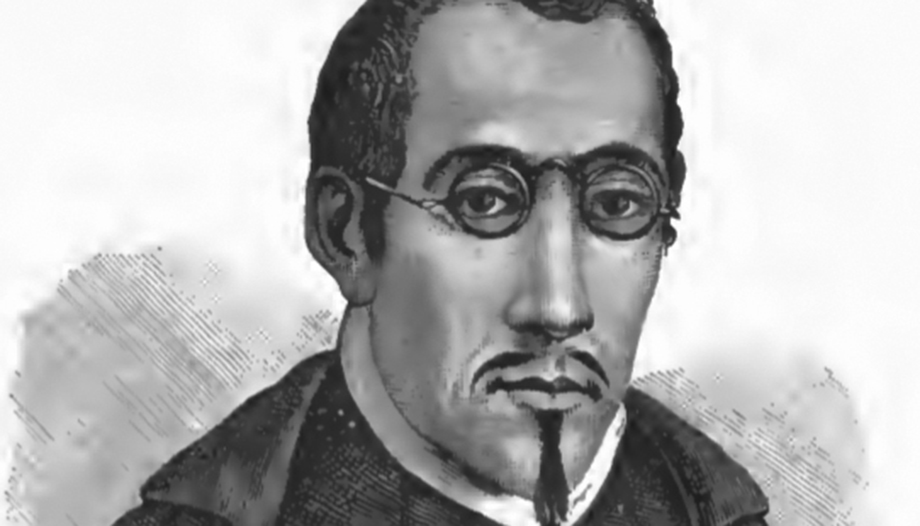
Carlos de Sigüenza y Góngora (Mexico City, 1645–1700) is one of the most representative figures of the union between the Catholic faith and modern science in the Spanish-speaking world.
Coming from a family in which his father had served as a tutor to the royal family in Madrid, he studied with the Jesuits in Tepotzotlán and Puebla, although he was expelled for indiscipline in 1667. However, he never strayed from Ignatian spirituality or the Catholic faith. In 1668, he published his first work, Indian Spring, dedicated to Our Lady of Guadalupe, and in 1673 he was ordained a secular priest.
Before being ordained a priest, he had already studied at the Royal and Pontifical University of Mexico, where he distinguished himself to the point of being appointed to the chair of mathematics and astrology (1672), a position he held for twenty years.
He also served as chaplain at the Hospital del Amor de Dios and as royal cosmographer to Charles II, for whom he drew up the first general map of Mexico City and various plans and hydraulic projects for the lagoon and the valley, intended to prevent flooding. He also took part in scientific expeditions, such as the 1693 expedition to the Gulf of Mexico and Florida, where he drew up nautical charts of Pensacola and the Mississippi.
Sigüenza y Góngora was also noted for his efforts to separate superstition from science. When a great comet appeared in 1680, he wrote his A Philosophical Manifesto Against Comets (1681), a work in which he sought to allay public fears and explain the phenomenon scientifically. Later, he wrote his greatest work: Astronomical and Philosophical Libra (1690), which contributed to astronomy and astrology and helped establish science in the Hispanic world.
In 1675, he also led the first documented excavations at Teotihuacán and founded the first newspaper in New Spain, Flying Mercury, and wrote various literary works. To top it off, he became a hero during the 1692 popular uprising in Mexico City, where he risked his life to save the City Council’s archives from a fire. In his later years, he compiled materials for a history of ancient Mexico, as part of an effort to reclaim the region’s Indigenous past, though his death cut the project short.
Public University of Navarra. SCS-Spain.






 Español
  English
  Italiano