



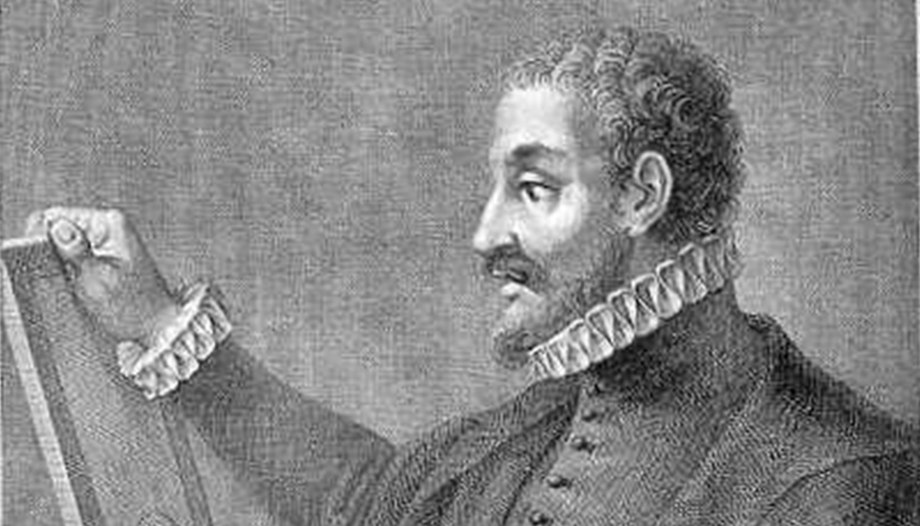
Juan de Herrera (1530-1597) is one of the leading figures of the Spanish Renaissance.
His name is known worldwide for being the author of El Escorial, probably the best architectural work of the Golden Age. To this we can add the Royal Palace of Aranjuez and the Cathedral of Our Lady of the Assumption in Valladolid, unfinished but a reference for the cathedrals of Mexico and Lima. All these constructions were built under the patronage of Philip II.
But he also excelled in fields other than architecture. One of them was military, as he participated in several campaigns of Charles V in Germany, Flanders and Italy. The other was scientific. In the field of geometry and mathematics, we can highlight his Speech on the cubic figure. In addition, Herrera became the first director of the Academia de Matemáticas y Delineación, founded in 1582 in Madrid and officially named Academia Real Mathematica. It was one of the first scientific institutions in Europe and was the predecessor of the Royal Academy of Exact, Physical and Natural Sciences.
Herrera also promoted various scientific enterprises for the king, from the invention of navigational instruments, so necessary in those times of great maritime relations with the Indies, to the practical application of geometry and mathematics in the planning of his works and the optimization of construction processes. He also contributed to the field of astronomy through the elaboration of illustrations for the treatise titled Book of Armellas at the University of Alcalá de Henares.
Herrera was a convinced Catholic, and his faith is reflected in the monumentality and sacredness of his works. The best example is El Escorial, dedicated to San Lorenzo and conceived by Philip II to celebrate the victory of San Quintín, which took place on August 10, the saint's feast day. In this way, his life combines science and technology in an exemplary manner with a deep commitment to faith and service to the Spanish monarchy.
Public University of Navarra.
Society of Catholic Scientists of Spain






 Español
  English
  Italiano
  Français
  Deutsch
  Polski