


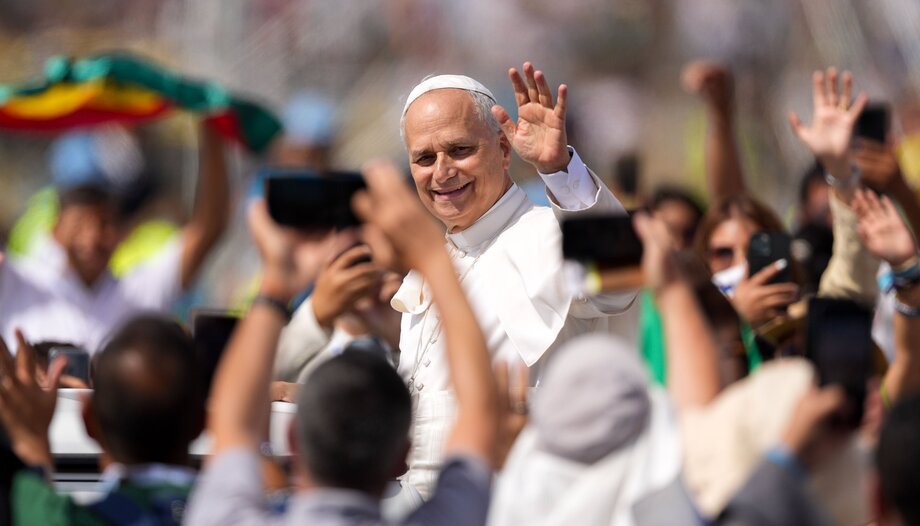
Madrid, Barcelona and the Canary Islands are the venues of the Pope Leo XIV's seventh apostolic journey. A journey through which the Pontiff will meet with the Spanish Cortes, young people, families and faithful, visit the Sagrada Familia, the temple that could become the first to be designed by a saint and will hold a special meeting with migrants arriving in the islands. Canary Islands.
Spain has been one of the nations most visited by recent pontiffs.
Since 1981, the Spanish nation has received all the Popes, with the exception of Francis. Although there was much speculation about a possible trip of the Argentine Pope to the Canary Islands, focused on the migration issue, the reality is that such a trip never took place.
Leo XIV, in fact, in this trip, picks up the baton of that intention of his immediate predecessor with the visit to the Canary Islands. It was the first visit of a Pontiff to this part of Spain.
Leo XIV's first great voyage to a Catholic nation
Leo XIV's visit to Spain is considered the “first of the great papal visits” of Pope Prevost. The Pope's previous trips have either been shorter, as in the case of European Catholic nations like Monaco or, on the contrary, have been developed in interreligious environments, as in the case of its recent trip to Algeria and Tunisia or the important trip to Turkey and Lebanon.
In these countries where the Church had a minority role, the meetings and events presided over by the Pope have been marked by the idiosyncrasies and limitations of the host nations.
In the case of Spain, Leo XIV knew the country and its idiosyncrasies, perhaps in a much deeper way than his predecessors. By family roots, His mother, Mildred Martinez, is of Spanish descent and in his youth, in the summer of 1982, before being sent as a missionary, he traveled the north and northwest of Spain by van with a group of Augustinian students.
Later, as Prior General of the Augustinians, he visited the different communities of Spain on several occasions, the last one being Cardinal, in 2024.
Spain, land of missionaries
Prevost is also familiar with the deep missionary imprint of many Spaniards in Latin America. During his missionary work in Chulucanas and, later, as bishop of Chiclayo (Peru), Robert Prevost maintained a close and direct relationship with numerous Spanish religious.
Shortly before his election, as President of the Pontifical Commission for Latin America as well as Prefect of the Dicastery for Bishops, he addressed these “Spanish missionaries who give their lives for the Gospel in Latin America”.
Spain, historically a bastion of historic Catholicism, is currently undergoing a profound process of secularization, but continues to be a world leader in sending missionaries, with some 9,650 active in more than 140 countries.
Migration: the challenge of the 21st century
The last stop of the papal trip, the Canary Islands, is the most symbolic and political point of the trip. Not in vain, the events planned in the islands are totally unprecedented in any of the previous papal trips.
Of the Pope's six major events in the islands, half are directed at or centered on the migration issue.
In this sense, the Pope wants to reinforce the Church's message on this issue and the need to continue working on the reception and promotion of those who must leave their land and, fundamentally, on the elimination of the causes that lead people to flee their places of origin.
In this sense, the Pope defends that States have the right to control their borders and establish migratory rules, but demands that migrants be treated with human dignity and respect at all times, avoiding the “stigma of discrimination” and any treatment that undermines the dignity of these people.
The new Catholic generation
Another of the key points of this papal visit will be the youth and families as key axes of the life of the Church.
The multitudinous meetings planned in the three venues: Madrid, Barcelona and the Canary Islands will serve to address head-on some of the problems of today's western youth that the Pope has repeatedly mentioned in his speeches, most recently in the encyclical Magnifica Humanitas.
In this regard, it is expected that the Pontiff will not avoid issues such as polarization, social exclusion, the impact of AI or the loss of faith.
Spain receives the Pope in a social context that some have called “a social context".“of Catholic turn”.”, The active presence of Catholics, especially young Catholics, in social life has been normalized.
Politics in times of polarization
One of the most eagerly awaited events of Pope Leo's trip to Spain is the speech that the pontiff will deliver at the Spanish Parliament on Monday, June 8. It will be the first time that a Pontiff will speak to Spanish politicians.
Although the subject has not come up, Leo XIV has made it clear in his first year of pontificate that he is not a politician, but speaks of Jesus Christ.
Even so, the Vatican head of state, in his first encyclical, denounced how “politics easily resorts to disinformation, to the ridiculing of the adversary and to the systematic building up of fears and resentments” and made repeated calls for responsibility to those who occupy positions of responsibility in the government of nations.






 Español
  English
  Italiano
  Français
  Deutsch
  Polski