


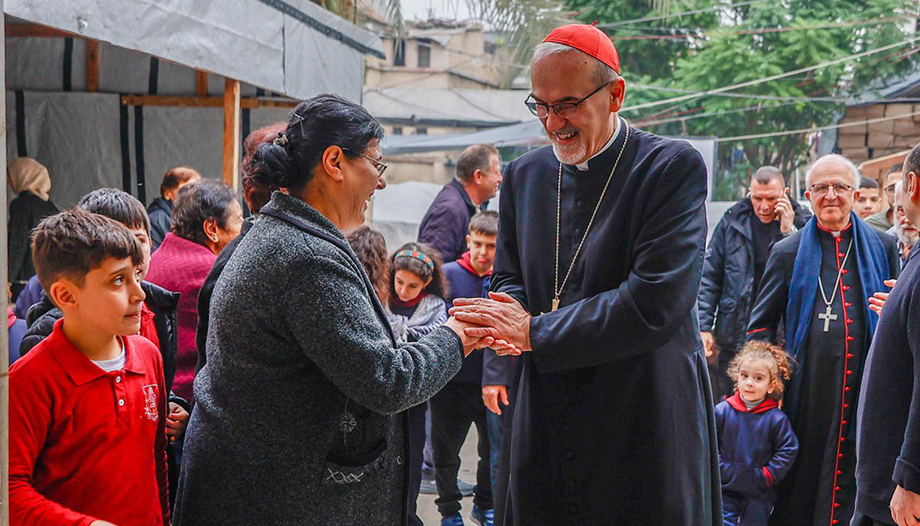
Among his teachings in recent weeks, in the wake of the Jubilee of Hope, we focus on his message for the 59th World Day of Peace, which marks the beginning of the year 2026, and his apostolic letter Loyalty that generates future, on the occasion of the 60th anniversary of the conciliar decrees Optatam totius y Presbyterorum ordinis.
The revolution of a disarming peace
Leo XIV's message for the World Day of Peace (1-I-2026) is entitled: Peace be with you all: Towards a ‘disarmed and disarming’ peace’. It is a direct and extended echo of the first words he pronounced when he stepped out onto the balcony of St. Peter's Basilica in the Vatican (May 8, 2025).
The peace brought by the risen Christ,“ he observes in the introduction, "is not a mere wish, but "... the peace of the Risen Christ.“The result is a definitive change in the person who receives it and, thus, in the whole of reality.”(cf. Eph 2:14). The Christian mission, which involves peace with its luminous aspect in the face of the darkness and obscurity of conflicts, continues to move forward. With the proclamation of the successors of the Apostles and the impetus of so many of Christ's disciples, it is “a mission of peace" (Eph 2:14).“the quietest revolution".
An unarmed “struggle
Christ brings “an unarmed peace” because, in the face of conflict and violence, He brings a different path. "Sheathe your sword.", he says to Peter (Jn 18:11; cf. Mt 26:52).
"The peace of the resurrected Jesus is disarmed -The Pope affirms, because their struggle was unarmed, within specific historical, political and social circumstances. Christians, together, must prophetically bear witness to this newness, remembering the tragedies in which they have so often been complicit.".
Jesus proposes, instead, the way - the protocol, Pope Francis called it - of mercy (cf. Mt 25:31-46).
Paradoxically, today, “in the relationship between citizens and rulers, the fact that we are not sufficiently prepared for war, to react to attacks, to respond to aggressions, is considered to be a fault.".
But this is just the tip of the iceberg of a deeper and more widespread global problem: the widespread lThe logic justifying fear and domination. “Indeed, the deterrent force of power, and in particular nuclear deterrence, embodies the irrationality of a relationship between peoples based not on law, justice and trust, but on fear and the dominance of force.".
Let ethics prevail over economic interests
It is not a question, says Leo XIV, of denying the dangers that loom over us because of the domination of others. It is a question, first, of the cost of rearmament, with the economic and financial interests it entails. Secondly, and more fundamentally, there is a major cultural problem affecting educational policies. The path of listening, encounter and dialogue, as advised by the Second Vatican Council (cf. Gaudium et spes, 80).
Hence, it becomes necessary, on the one hand, to “denouncing the enormous concentrations of private economic and financial interests that are pushing states in this direction”. And, at the same time, encourage “the awakening of consciences and critical thinking" (cfr. Fratelli tutti, 4).
Pope calls for united efforts “to contribute reciprocally to a disarming peace, a peace that is born of openness and evangelical humility.”. And all this, attention, not only as an ethical response, but also with attention to the Christian faith, which promotes unity.
Promoting mutual trust
First of all, in the Christian perspective goodness is disarming. "Perhaps that is why God became a child”. God wanted to assume our fragility; while we, as Pope Francis pointed out, “we often tend to deny boundaries and avoid the fragile and wounded people who have the power to question the direction we have taken, as individuals and as a community.” (Francisco, Letter to the editor of “Corriere della Sera”, 14-III-2025).
In his magna carta of Christian thought on peace (the encyclical Pacem in terris, 1963), St. John XXIII introduced the proposal of an “integral disarmament”, based on “a renewal of the heart and intelligence”.”. To this end, Leo XIV now confirms, the logic of fear and war must be replaced by mutual trust between peoples and nations; without giving in to the tendency to “transform even thoughts and words into weapons.”.
Religions, says Pope Leo XIV, must help to take this step and not the other way around: to substitute faith for political combat until - he clairvoyantly denounces - “...".“blessing nationalism and religiously justifying violence and armed struggle".
For this reason, and it is addressed first and foremost to believers, he proposes: “together with action, it is increasingly necessary to cultivate prayer, spirituality, ecumenical and interreligious dialogue as ways of peace and languages of encounter between traditions and cultures”.”.
And this has an educational translation: that every Christian community becomes a house of peace and a school of peace, “where we learn to defuse hostility through dialogue, where justice is practiced and forgiveness is preserved.”; "today, more than ever, it is necessary to show that peace is not a utopia, through attentive and generative pastoral creativity.".
Clearly, adds the successor of Peter, this corresponds in a special way to politicians: “It is the disarming path of diplomacy, mediation and international law, sadly belied by the increasingly frequent violations of international law. agreements reached with great effort, in a context that would require not the delegitimization, but rather the strengthening of supranational institutions.".
Disarming the heart, mind and life
In continuity with his predecessors, Leo XIV denounces the desire to dominate and to advance without limits, by sowing despair and arousing distrust, even disguised behind the defense of certain values.
"To this strategy -proposes as a fruit of the Jubilee of Hope. the development of conscious civil societies, of responsible forms of associationism, of experiences of non-violent participation, of small and large-scale restorative justice practices must be opposed.”. All this, based on both anthropological and theological reasons, in the horizon of human fraternity (cfr. Leo XIII, Rerum novarum, 35).
This, the Pope concludes, requires, first and foremost for believers, “to rediscover themselves as pilgrims and to begin within themselves that disarmament of heart, mind and life to which God will soon respond.r -with the gift of peace- delivering on their promises” (cf. Is 2:4-5).
Fruitful priestly fidelity
The apostolic letter Loyalty that generates future, The new Constitution, signed by Leo XIV on December 8, 2025, was published at the end of December.
The title already contains the proposal addressed to priests and specified at the beginning: “...".“Persevering in the apostolic mission offers us the possibility to question ourselves about the future of the ministry and to help others to perceive the joy of the priestly vocation.” (n. 1). Fruitful fidelity“ is a gift to be understood and received in the context of the Church and her mission. At the same time, the priestly ministry has an important role to play in the longed-for renewal of the Church (cf. Optatam totius, Proem).
Hence Leo XIV's invitation to reread the conciliar decrees Optatam totius y Presbyterorum ordinis, where it was desired to reaffirm the priestly identity and, at the same time, to open the ministry to new perspectives of doctrinal deepening. A rereading that should be enlightened by the fact that, after the Council, “the Church has been led by the Holy Spirit to develop the Council's teaching on its communional nature according to the synodal and missionary form." (n. 4).
Keeping God's gift alive and caring for the fraternity
In the face of painful phenomena, such as abuse or the abandonment of the ministry by some priests, the Pope stresses the need for a generous response to the gift received (cf. 2 Tim 1:6). The basis must be the “following of Christ", with the support of integral and ongoing formation. In this formation, from the seminary stage, the “affective” aspect (learning to love like Jesus), human maturity and spiritual soundness stand out. “Communion, synodality and mission cannot be realized, in fact, if in the hearts of priests the temptation of self-referentiality does not give way to the logic of listening and service.” (n. 13). In this way they will be effective in their “service” to God and to the people entrusted to them.
Within the fundamental “fraternity” that arises in Christians as a result of Baptism, there is in priests, through the sacrament of Orders, a particular fraternal bond, which is a gift and a task. This is how the Council expresses it: “Each one is united with the other members of this presbytery by special bonds of apostolic charity, ministry and fraternity.” (Presbyterorum ordinis 8).
The Pope says that this means, in the first place, on the part of each one, “overcoming the temptation of individualism”(n. 15) and a call to fraternity, whose roots are in unity around the bishop. Institutionally, it is necessary to promote economic equality, provision for sickness and old age, reciprocal care, and also “... to promote the development of a fraternity of brothers and sisters" (n. 15).“possible ways of living together”The "spiritual and intellectual life, avoiding the possible dangers of loneliness (cfr. Presbyterorum ordinis 8).
Priesthood and synodality for mission
Encourages priests to participate in the synodal processes underway, referring to the Final document of the synod on synodality: “The Synod on Synodality: "It seems essential that, in all the particular Churches, appropriate initiatives be undertaken so that priests can familiarize themselves with the guidelines of this Document and experience the fruitfulness of a synodal style of Church.” (n. 21 of the letter).
As for priests, this must be manifested in their spirit of service and closeness, welcoming and listening. They must reject a “unique leadership”Instead, choosing the path of collegiality and cooperation with the other ordained ministers and the entire People of God. It is necessary, he points out, to avoid identifying sacramental authority with power, which would lead to placing the priest above all others (cf. Evangelii gaudium, 104).
Regarding the mission: “The identity of priests is constituted around their ‘being for’ and is inseparable from their mission.” (n. 23 of the letter).
Pope warns priests about the danger of two temptations: activism (giving priority to what one does over what one is) and quietism (linked to laziness and defeatism). He points to pastoral charity as the unifying principle of priestly life (cf. Pastores dabo vobis, 23). Thus “each priest can find a balance in daily life and know how to discern what is beneficial and what is proprium of the ministry, according to the indications of the Church." (n. 24).
In this way, too, he will be able to find harmony between contemplation and action, and the wisdom to disappear when and how it suits him, in the midst of a culture that exalts media exposure. It will be able to promote unity with God and fraternity and the commitment of people in the service of cultural, social and political activities, as proposed in the Final Document of the Synod (cf. nn. 20, 50, 59 and 117).
With reference to the “future” and in the face of the scarcity of vocations, Leo XIV proposes prayer and the revision of pastoral praxis, so as to renew both the care for existing vocations and the call in the youth and family contexts.






 Español
  English
  Italiano