


Despite wars and strife, Lent runs its course until Easter. It is a time for reflection. Secularization continues, but glimmers of hope are appearing, a new religious consciousness is making inroads among young people, there is a hunger for a Gospel in fullness.
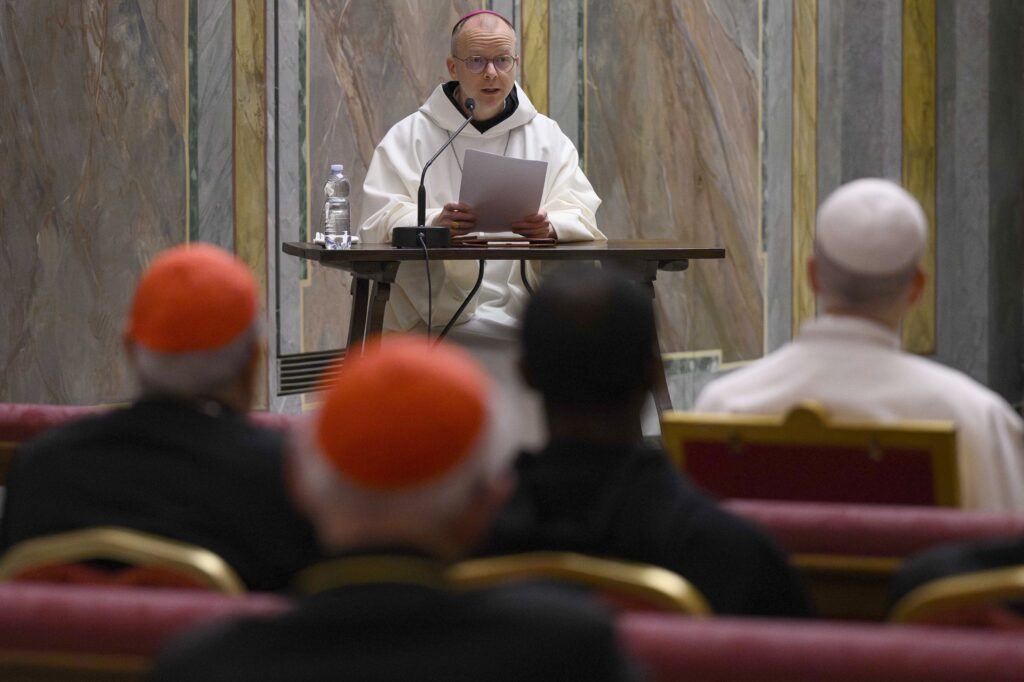
The following are summarized today new messages by Norwegian Bishop Erik Varden during the “Week of Spiritual Exercises and Retreat” of the Pope and the Roman Curia. Actually it is an and 2, that is, some ideas corresponding to the last 8 meditations, until completing the 11 preached by Bishop Varden.
Pope's gratitude: “especially invited to reflect”.”
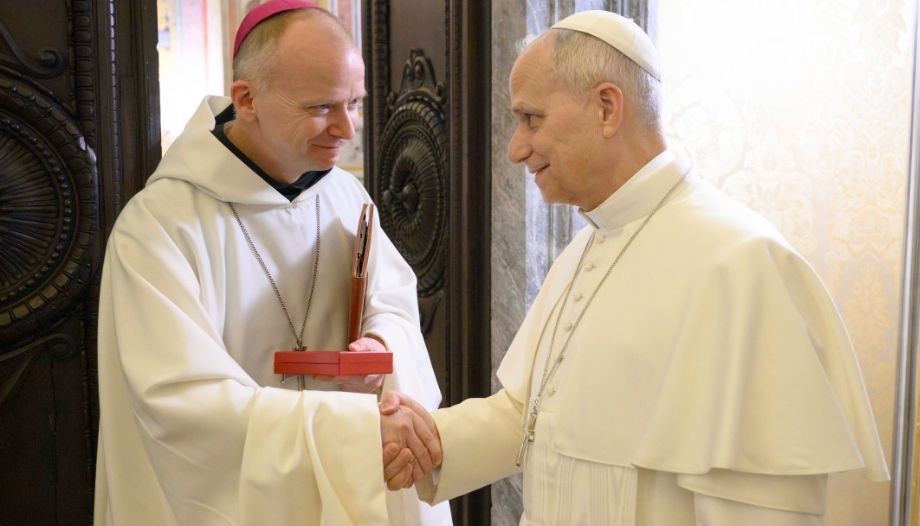
At the conclusion of the Exercises, Pope Leo XIV gave a word of thanks to the preacher Monsignor Varden for the “week of spiritual exercises and retreat, a moment of blessing” (and also to the participants).
“I am pleased to be able to thank,” the Holy Father added, “especially our preacher, who has accompanied and helped us during these days to live a profound, spiritual and very important experience in our Lenten journey, beginning on Sunday with ‘The Temptations’ and reflecting on the example and witness of St. Bernard, the monastic life and many other elements of the life of the Church.”.
“I must admit that, personally, at some moments I have felt especially invited to reflect. For example, this morning, when I was speaking of the election of Pope Eugene III and St. Bernard said: ‘What have you done? May God have mercy on you,’” said Leo XIV.
Some ideas and messages: freedom, truth
Let us quote, then, the Norwegian bishop in his meditations, with ideas from Varden himself in his blog, of which he has been reporting Vatican News. The selection is our own, but rigorous. You can complete it. Here are some of them.
1. “Becoming free” (Becoming free). "From a Christian perspective, no oppressive policy can be redeemed by invoking ideological “freedom”. The only meaningful freedom is the staff; and the freedom of one person cannot override the freedom of another”.
“To adhere to a Christian idea of freedom is to consent to pain. (...) Sometimes justice is best served by suffering for it, by refusing to respond to force with force” (Varden).
2. Splendor of truth. “What is truth? The people of our time ask it earnestly, often with remarkable good will, in spite of their confusion, their fear and the hurry in which they always find themselves; we cannot leave it unanswered.” (Varden).
“Christ, who is The Church, a slow-moving organism, will always run the risk of appearing old-fashioned. But if she speaks well her own language, that of the Scriptures and the liturgy, that of her fathers, mothers, poets and saints, past and present, she will be original and fresh (...).
“The universal call to holiness, i.e., the call to incarnate truth, it was perhaps the strongest note in the Vatican Council II” (Varden).
3. The fall of thousands. “Falls can humble us when we become puffed up, thus showing the saving power of God.” “However, not all falls end in elation; there are falls that stink hellishly, bringing destruction to the guilty and leaving ruin in their wake. That wake is often wide and long, dragging down many innocent people.”.
“The worst crisis in the Church has not been caused by secular opposition, but by ecclesiastical corruption. The wounds inflicted will take time to heal. They cry for justice and for tears.” (Varden)
Hidden glory and guardian angels of sanctity
4. Gloria. “A ‘hidden glory’ is perceptible even now. St. Augustine was fond of saying that we bear the image of glory in a “dark form.” Once we have passed through this life, the form will be revealed explicit and ‘luminous’. It will be fit to stand before God.
The Church manifests the radiance of the ‘hidden glory’ in her saints, and “communicates the ‘hidden glory’ in her sacraments. Every priest, every Catholic knows the light that can burst into the confessional, during an anointing, an ordination or a marriage. The most splendid, and in a certain sense the most veiled, is the glory of the Holy Eucharist”. (Varden, in Vatican News).
5. The angels of God. “In a popular prayer that goes back to Reginald of Canterbury, a contemporary of Bernard, we ask our guardian angel to enlighten, guard, rule and guide us. These are strong verbs. An angel is a guardian of holiness.” (Varden)
6. Bernardo the Realist. “The more Bernard recognized the cry for mercy in human hearts, in bitter tears, in worldly conflicts, in misbegotten campaigns against decency and truth, and in the rustling of the trees in the forest, the more aware he became of God's merciful response. He heard it in the holy name of Jesus, which became unspeakably dear to him.” (Varden).
“Bernard considered Jesus the incarnation of truth (...) He interpreted situations, persons and relationships resolutely in the light of Jesus. This perspective has won him firm admirers beyond Catholicism, from Martin Luther to John Wesley”. (Varden).
If you love the burden, it will be light (St. Augustine)
7. Consideration. “Although the pastoral burden has a fearful aspect, it is only fearful if we do not realize who places it on our shoulders. It does not cease to be a participation in the sweet yoke of Christ, who enables us to discover that the cross entrusted to us is luminous and light, and that sharing it is joyful.”.
“Augustine wrote : “Perduc sarcinam tuam quia levis est si diligis gravis si odisti”, i.e. “Carry your own burden to the end. If you love it, it will be light. If you hate it, it will be heavy.” (Varden)
8. To communicate hope. “All around us, the aisles of ancient cathedrals, overshadowed by the cross, become miniature golf courses; shrines are used for secular skits designed, desperately, to show their relevance. Meanwhile, just a stone's throw away, in the secular realm, young people rock disconsolately, singing under their breath that life is an open wound and there is no balm in Gilead.”.
“Christ is the light of the nations, Lumen Gentium (...) In him we place our trust, not in passing stratagems (...) The times in which we live are hungry to hear this hope proclaimed. We have considered some of the signs that surround us: new religious awareness among young people; the return of the category of truth to public discourse; a search for roots. (...). Tired of building their lives on sand, they are looking for solid rock”.
“Our time cries out for the Gospel in fullness. The young people who mourn in our parks mournfully long for its fullness.” (Varden).






 Español
  English
  Italiano
  Français
  Deutsch
  Polski