


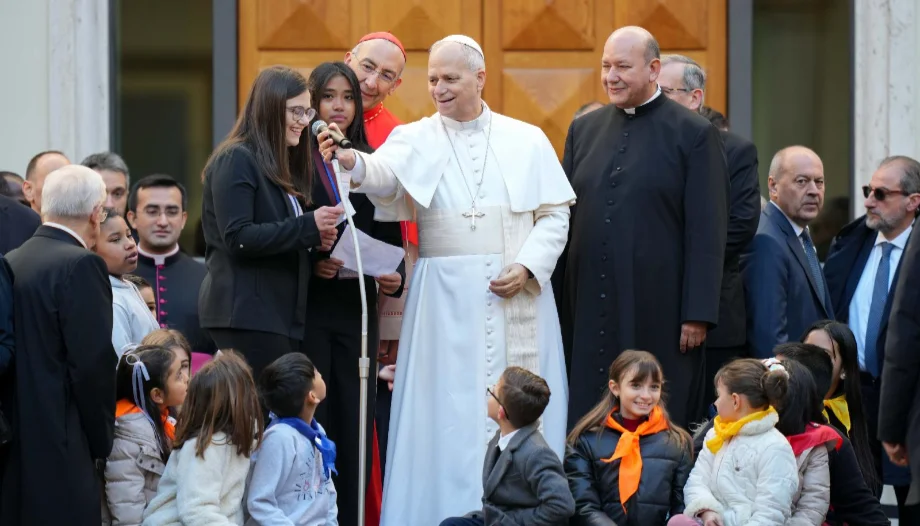
The Synod on Synodality's Study Group No. 5, dedicated to the participation of women in the life and governance of the Church, has presented its long-awaited final report on women's participation in ecclesial life and leadership.
This document, which arose from a mandate of Pope Francis in 2024 and has been continued under the guidance of Pope Leo XIV, represents one of the boldest theological and canonical reflections of the post-conciliar era.
The text is not definitive, but as María García-Nieto, professor of Canon Law at the University of Navarre and author of The presence of women in Church governance, summarizes the journey that the Church has made in recent years regarding the role of women in the Church.
The reflection group echoes the discrimination that sometimes exists in the Church, either for reasons of gender (machismo), or for not belonging to the clerical state (clericalism), the professor explains, adding that to overcome it, the Church is trying to develop a renewed theological anthropology based on the complementarity of man and woman.
A roadmap for reform: The general outline of the document
The first part reconstructs the history of the group, underlining a fundamental methodological change: the work was done «from below», giving priority to listening to the concrete experiences of women, including those working in the Vatican Curia.
The second part goes into the heart of the debate, analyzing the «discomfort» felt by many women due to persistent structures of clericalism and machismo that limit their vocation. The document proposes that the Church must move from viewing female participation as a «concession» from the hierarchy to recognizing it as an intrinsic right that derives from Baptism. To support this, the report develops a framework where reciprocity between men and women is not a competition for power, but a necessity for the fullness of the evangelizing mission.
Finally, the report is supported by six extensive appendices that range from female figures in the Bible and history (such as abbesses with quasi-episcopal jurisdiction), to the current challenges of the «Marian principle» and the origin of ecclesial power.
Group 5 does not respond to the question of power directly, but it does recall the context of recent years, in which the distinction between the power of order vs. the power of government has been established: the document clarifies that, while the power to sanctify (sacraments) always requires the sacrament of order, this is not the case with the power of government». It is argued that the government of the bishops is a service that can rely on the collaboration of the laity.
The key is to understand that the power is vicarious. After the reform of the Roman Curia (Praedicate Evangelium), the power exercised by a head of office or dicastery is «vicarious», that is, it is exercised in the name of the Pope. Therefore, there would be no theological impediment for a woman to exercise offices with vicarious power in the Church.
To substantiate this thesis, the new document mentions the charismatic way, according to which the Holy Spirit gives charisms of leadership and counsel directly to women. When a bishop appoints a woman to a decision-making position, he is not «creating» her authority, but recognizing a gift that the Spirit has already given her through Baptism.
The most novel and relevant points
The 2026 report is notable for several milestones that mark a «before and after» in ecclesial practice: the document celebrates the arrival of women in previously unthinkable positions: Sister Simona Brambilla, appointed prefect of the dicastery for institutes of consecrated life in January 2025, the first woman to head a dicastery with full powers.
It also highlights the appointment of Sr. Raffaella Petrini, designated president of the Governatorato of Vatican City State in March 2025, and the presence of women with voting rights in the synod, a practice initiated in 2023.
The text gives as an example to follow what is already happening in dioceses in France, Belgium and Switzerland, where the bishops have created the figure of the Delegate General. These women take on diocesan coordination tasks traditionally performed by the Vicars General, suggesting that the administration of a local Church can be effectively led by lay people, whether they are men or women.
The document cites the conclusions of the Second Commission on the Female Diaconate (December 2025), where the need to expand women's access to instituted ministries was approved by an overwhelming majority of 9 votes to 1. It suggests the creation of specific ministries of «listening, consolation and accompaniment» that have public recognition and canonical stability.
A more credible Church
The final report concludes that the full appreciation of women is not an accessory, but a necessary service to make the Church «more beautiful, more credible and more faithful to its vocation» in the 21st century.





 Español
  English
  Italiano
  Français
  Deutsch
  Polski