


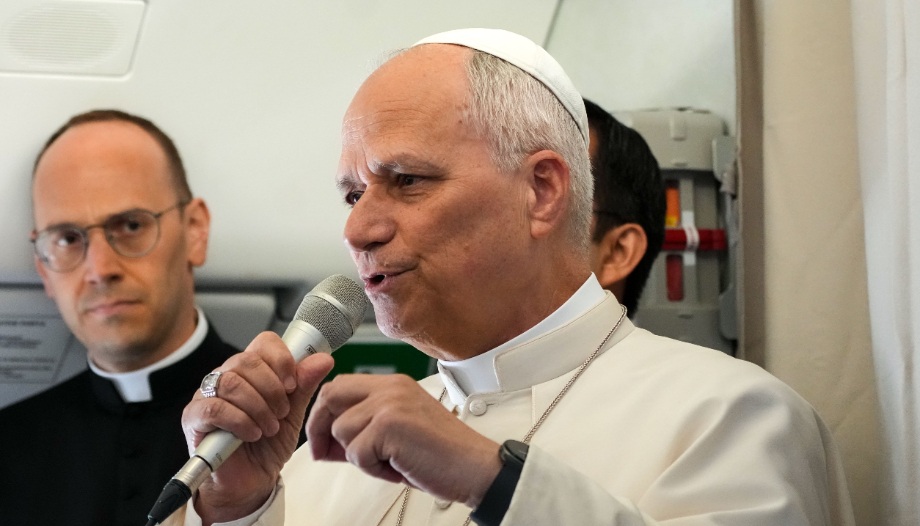
Pope Leo XIV said on the papal plane April 23 that the Holy See does not approve of formal blessings of same-sex couples, while stressing that the unity of the Church «must not revolve around sexual matters» and that all people are welcome in the Catholic Church.
The Pope made these remarks during an extensive press conference on the return flight from Malabo, Equatorial Guinea, to Rome, where the papal plane landed after 7:15 p.m. local time. Speaking in English, Spanish and Italian, the Pope answered five questions from journalists on topics ranging from regime change in Iran to the dignity of migrants, in which Leo XIV affirmed the right of countries to enforce their border laws, while stressing that migrants are human beings who should not be treated as «animals.».
The press conference ended an 11-day, 18-flight apostolic journey that covered more than 11,000 miles through Algeria, Cameroon, Angola and Equatorial Guinea, by far the longest trip of his pontificate.
Church unity «should not revolve around sexual issues.»
Pope Leo XIV was asked about the decision made the previous day by German Cardinal Reinhard Marx, Archbishop of Munich and Freising, to authorize the blessing of same-sex couples in his archdiocese, and how the Pope intended to preserve unity in the worldwide Church in light of that decision.
«First of all, I think it is very important to understand that the unity or division of the Church should not revolve around sexual issues,» Pope Leo XIV said. «We tend to think that when the Church speaks of morality, the only moral issue is the sexual issue, and in reality, I think there are much more important issues, such as justice, equality, the freedom of men and women, religious freedom, which should take precedence over that particular issue.».
The Pope affirmed that the Holy See had already communicated its position to the German bishops. “The Holy See has made clear that we do not agree with the formal blessing of couples, in this case homosexual couples, as you ask, or couples in irregular situations,” he said.
The Pope drew a distinction between those formalized blessings and the general blessings «allowed by Pope Francis when he said: ‘All people receive blessings'».
“When a priest imparts a blessing at the end of Mass, when the Pope imparts a blessing at the end of a great celebration, like the one we had today, there are blessings for all the people,” he explained, referring to the Mass celebrated that morning in Equatorial Guinea.
Pope Leo went on to say that Pope Francis“ ‘well-known expression of ’Tutti, tutti, tutti”“-meaning ”everyone, everyone, everyone“-is ”an expression of the Church's belief that everyone is welcome, everyone is invited.".
«All are invited to follow Jesus and to seek conversion in their lives,» Pope Leo XIV said. «However, I believe that this issue can generate more disunity than unity, and that we must seek ways to build our unity on Jesus Christ and his teachings.».
Countries should not treat migrants worse than «animals».»
The Pope also spoke out strongly on the issue of migration, stating that states have the right to enforce their borders, while insisting that the dignity of migrants must be respected.
«Personally, I believe that a state has the right to set rules for its borders,» he said. «I am not saying that everyone should be allowed indiscriminate entry, which sometimes creates even more unfair situations in the places of destination than in those from which they come.».
He went on to stress that migrants “are human beings, and we must treat them humanely, not treat them worse than pets or domestic animals”.
The Pope was responding to a question about African migration to Spain, a topic he is expected to address during his visit to the country, scheduled for June 6-12. That trip will conclude in the Canary Islands, the Spanish archipelago that serves as the main Atlantic entry point for migrants crossing from West Africa.
Pope Leo XIV urged wealthier nations to address the root causes of migration rather than focusing solely on border control.
“What is the Global North doing to help the Global South and those countries where young people today cannot find a future?” he asked. “For many people, Africa is seen as a place to go to extract minerals and exploit its resources for the benefit of other countries,” he said.
“Perhaps at the global level we need to do much more to promote greater justice and equality in the development of these African countries, so that there is no need to migrate to Spain, etc.,” he stressed.
Iran's war and the need to protect civilians
Regarding the war in Iran, Leo XIV called for continued dialogue and the protection of innocent civilians, sharing a personal detail to underscore the human cost of war. “I carry with me a photo of a Muslim boy who, during my visit to Lebanon, was waiting for me there with a sign saying ‘Welcome, Pope Leo’; he died in this last stage of the war,” he said.
“The Iran issue is clearly very complex,” Pope Leo XIV said. “In the very negotiations they are trying to conduct, one day Iran says yes, the United States says no, and vice versa, and we don't know where it will lead.”.
“It has created a chaotic and critical situation for the world economy, and then there is the entire population of Iran, innocent people who are suffering because of this war,” he added.
A journalist also pressed the Pope to condemn the ongoing executions of political opponents in Iran. According to the Associated Press, Iran executed another member of the exiled opposition group People's Mujahedeen-e-Khalq (Mujahedeen-e-Khalq) that morning, the ninth such execution since the fighting began.
According to the Abdorrahman Boroumand Center for Human Rights in Iran, Iranian authorities executed more than 2,000 people in 2025, the highest annual number since the late 1980s.
«I condemn all unjust actions. I condemn the killing of people. I condemn capital punishment,» the Pope said, adding that life must be protected from conception to natural death. «When a regime, when a country, makes decisions that take the lives of other people unjustly, then obviously that is something that must be condemned.».
Vatican diplomacy with authoritarian regimes
Leo XIV also defended the Holy See's practice of maintaining diplomatic relations with authoritarian governments, asserting that there is behind-the-scenes work that promotes justice and humanitarian efforts.
The issue arose in the context of his meetings during the trip with President Teodoro Obiang Nguema Mbasogo of Equatorial Guinea, who has ruled since he seized power in a 1979 coup d'état, and with President Paul Biya of Cameroon, 93 years old, who has governed for more than four decades.
“We don't always make big statements, criticizing, judging or condemning. But there is a lot of work that goes on behind the scenes to promote justice, to promote humanitarian causes, to look, at times, for situations where there may be political prisoners and find ways to free them,” Pope Leo said.
“The Holy See, by maintaining, so to speak, a neutrality ... (is) actually trying to find ways to apply the Gospel to concrete situations, so that people's lives can be improved,” he said.
Leaving Africa with a «treasure trove» of stories and faces
Before answering questions, the Pope reflected on the trip itself, noting that while interest in the trip tends to focus on political issues, the primary purpose of an apostolic journey is to be close to the people of God.
“This trip should be interpreted first of all as an expression of the desire to proclaim the Gospel, to proclaim the message of Jesus Christ, and it is a way of approaching people in their joy, in the depth of their faith, but also in their suffering,” he said.
At the end of his last Mass on the continent, celebrated that same day, the Pope offered a final reflection on what Africa had brought him. “I leave Africa with an incalculable treasure of faith, hope and charity: a great treasure made up of stories, faces and testimonies, both joyful and sad, that will greatly enrich my life and my ministry as the Successor of Peter,” he said.
“As in the first centuries of the Church, Africa is called today to make a decisive contribution to the holiness and missionary character of the Christian people.”






 Español
  English
  Italiano