



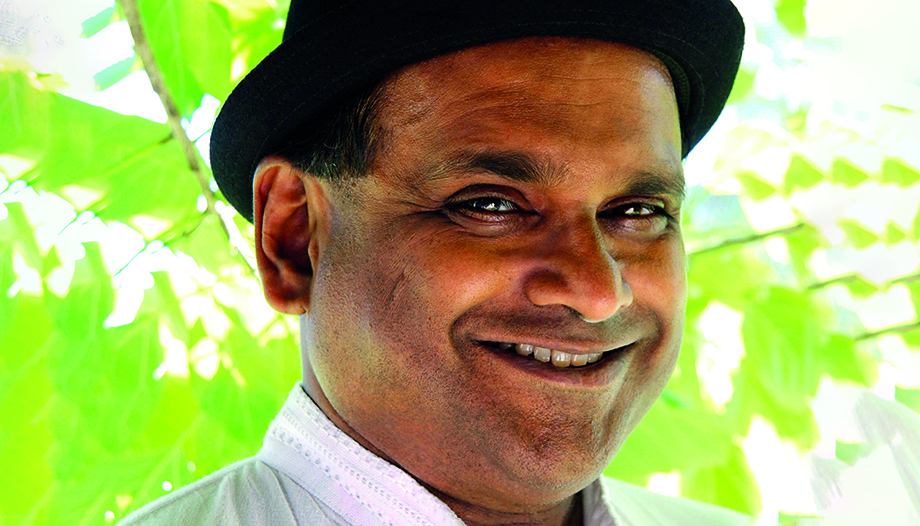
Although in many respects they are situated in different coordinates, the reading of Indran Amirthanayagam's poetry leads, almost naturally, to evoke Rubén Darío as one of the figures who inaugurated the cosmopolitan spirit in the Hispanic tradition. Of course, this is not a direct inheritance, but a mere resonance that allows us to situate the work of this author in a permanent cultural crossroads and in a clear opening to multiple poetic traditions, assimilated and reworked from his own voice.
For Amirthanayagam, the experience of his itinerant condition -geographic, linguistic and cultural- constitutes much more than a biographical fact: it is part of his identity and of his way of thinking, looking at and writing the world from diverse languages such as the ones he speaks: English, French, Portuguese and Haitian Creole. Thus, the fact of his wandering does not appear as a limitation but as a way of belonging to a wider and more diverse space than that delimited by a specific geographical territory.
This vital universe is undoubtedly at the center of his verses. The tension that runs through them is evidence of this: a sometimes broken syntax, emotionally charged punctuation marks and abrupt closings in many poems, resources capable of capturing the fractures, contradictions and fragilities of the globalized world in which he moves. However, his poetry is not limited to that dimension. It also beats with the rhythm of life and with the variety of voices that generate it.
The legacy of the poet Allen Ginsberg
Among others, the most outstanding is that of the generation's poet beat Allen Ginsberg, decisive both formally and conceptually. In fact, the centrality of rhythm and orality establishes a direct link with his poetic legacy. From him she inherits, in the first place, the confidence in long verse as a respiratory rather than metrical unit: a verse that expands following the flow of thought and breath, that resists closure and that conceives poetic creation as a bodily experience. Thus, the poem becomes a record of a lived experience in real time, where body, voice and consciousness are articulated in the same creative gesture.
But this influence is not limited to the formal aspects of his writing. It also extends to an ethical and spiritual dimension, which conceives poetry as an exercise of deep attention to the world and an opening of consciousness. Like Ginsberg, Amirthanayagam seeks to discover the sacred in the everyday and the revelatory in that which often remains on the margins, transforming his personal circumstance into a voice with the capacity for collective resonance. In this way, the poetic self ceases to be a closed realm and is transformed into a space of encounter between the intimate and the historical, between subjectivity and community.
Cosmopolitanism and music
From this perspective we can better understand his cosmopolitanism, which does not respond to a sum of influences, but is revealed as a way of being and being in the world, of linking himself, as I say, with other cultures and of conceiving the lyrical activity as a space of communion with music, the true engine of his lyrical work. His attention to rhythm, cadence, breathing and sound refers to the oral tradition as much as to the blues or singer-songwriters such as Bob Dylan or Leonard Cohen. The word, as he has said on occasion, not only communicates meanings: it vibrates, is perceived and experienced., reaching its maximum intensity in the reading aloud, something very frequent in many poets of all times but which is a priority for him.
No excuses: incarnation of its poetics
All of this is powerfully manifested in the poem No excuses that we bring to these pages. It is a text built on the back-and-forth between what is left behind and what is embraced, between renunciation and vital impulse. In it we find essential features of his writing: intense rhythm, repetitions that work like heartbeats, and a language that alternates languages, such as French “...".“désespoir”. This linguistic shift is not ornamental, but an expression of an identity that shifts naturally between languages, bringing different nuances to the emotional experience it conveys.
On the other hand, the protagonism of the present is decisive. The insistence on the “now”and in the “with you”places the poetic experience in the shared instant. There is no nostalgia or anticipation: what is important is presence. This “with you”is not limited to a loving addressee; it opens the poem to a communal dimension, where the other can also be the reader, the community, life itself.
The closing, with its call to travel and movement - “let's go”, “let's go”, “let's get there” - "let's go", "let's go", "let's get there". recovers the idea of transit as an essential condition. To travel is not only to move: it is to exist in constant transformation. Finally, the image of the cherry blossom also brings a note of renewal and hope. Even in a world marked by fragility, life retains its capacity to open up and start again.
No excuses does not only function as an example of Amirthanayagam's poetics: it synthesizes it, since it brings together his cosmopolitan vision, his organic relationship with music, his conception of the poem as a corporal experience and his commitment to a writing that is not limited to describing life, but that accompanies and celebrates it at the very moment it happens. It is worth approaching her.







 Español
  English
  Italiano
  Français
  Deutsch
  Polski