


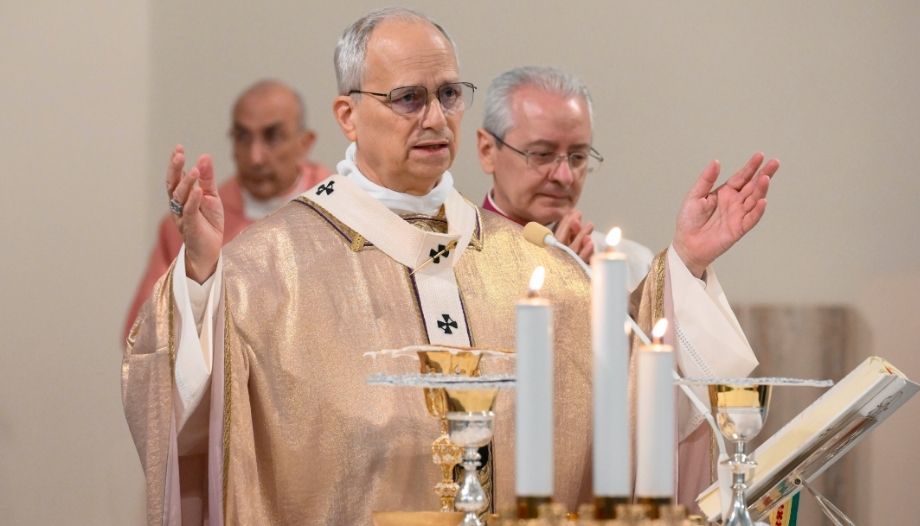
On the eve of the Solemnity of St. Joseph, to whom the Pope entrusted “the intentions and aspirations of everyone”, Leo XIV told the Arabic-speaking faithful, especially those from the Middle East, that “Christians are called to be instruments of peace, love and reconciliation”.
Moreover, reflecting on the Dogmatic Constitution «Lumen Gentium», he encouraged “the common mission that unites ordained ministers and the lay faithful” to spread and defend the faith, as true witnesses of Christ”.
“Every baptized person, an active subject of evangelization.”
In front of about twenty thousand people in St. Peter's Square, the Pontiff underlined in catechesis that “every baptized person is an active subject of evangelization, called to give a coherent witness to Christ according to the prophetic gift that the Lord instills in his whole Church”.
The Council Fathers teach, the Pope said, that the Lord Jesus instituted a kingdom of priests through the new and eternal Covenant, constituting his disciples into a ‘royal priesthood’.
“This common priesthood of the faithful is given to us in Baptism, which enables us to worship God in spirit and in truth and to ‘confess before men the faith which they have received from God through the Church’ (LG, 11).
Moreover, “through the sacrament of Confirmation, all the baptized «become more closely bound to the Church, are enriched with a special power of the Holy Spirit. And thereby they are more strictly bound to spread and defend the faith, as true witnesses of Christ, by word and deed” (ibid.).
“We all enter the Church as lay people.”
“This consecration is at the root of the common mission that unites ordained ministers and the lay faithful,” he noted. In this regard, he recalled that Pope Francis observed thus. “To look at the People of God is to remember that we all enter the Church as laity. The first sacrament, the one that forever seals our identity and of which we should always be proud is that of baptism (...)”.
“Through him and with the anointing of the Holy Spirit, (the faithful) “remain consecrated as a spiritual house and holy priesthood” (LG 10), then we all form the Holy Faithful People of God” (Letter to the President of the Pontifical Commission for Latin America, March 19, 2016).”.
To English and German speakers: participation in the Eucharist, the Holy Mass
The exercise of the royal priesthood takes place in many ways, all of them aimed at our sanctification, above all by participating in the offering of the Eucharist, the Pope continued.
Perhaps for this reason, in his words to pilgrims in various languages, he referred to the Eucharist, to the Holy Mass. For example, in greeting the English-speaking faithful: “Through the sacrament of baptism, each of us is called to share in the royal priesthood of Christ (1 Pet 2:9) and to worship him in spirit and in truth, especially through our participation in the Eucharist”.
And further on, to the German-speaking people: “Dear German-speaking brothers and sisters, let us live the common priesthood of the baptized through works of penance, charity towards our brothers and sisters and faithful and assiduous participation in Holy Mass”.
Spanish language: witness to Christ, according to the charisms and vocation received.
In his words to the Spanish-speaking faithful and pilgrims, the Successor of Peter emphasized the unity in the mission of the Church, and that “each baptized person bears witness to Christ, according to the charisms and vocation he or she has received”.
“Let us give thanks to God for the gifts and charisms with which he enriches, edifies and beautifies his people, and let us ask him not to cease to accompany them and guide them along paths of peace. May the Lord bless you”, he added.
Consecrated life and ecclesiastical associative forms
Earlier, in his catechesis, the Pope had referred to the Holy Spirit, who dispenses his gifts among the faithful. And he gave two examples of this action:
“The charismatic vitality” of the consecrated life, which continually springs forth and flourishes by the work of grace. And “even ecclesial associative forms are a shining example of the variety and fruitfulness of the spiritual fruits for the edification of the People of God”.
Poles: “the imagination of charity”.”
To Portuguese-speakers, the Pope asked them to “always be consistent witnesses of the Gospel”.
To the Poles he pointed out that “the season of Lent encourages us to express the meaning of faith also through the ‘imagination of charity’. May the charitable works, promoted in parishes by charitable associations and Caritas Poland, be an opportunity to practice almsgiving and the spiritual and corporal works of mercy. I bless you all!”.
In concluding, the Pope asked that we “awaken in ourselves the awareness and gratitude of having received the gift of being part of God's people; and also the responsibility that this entails”.





 Español
  English
  Italiano
  Français
  Deutsch
  Polski
  简体中文
简体中文