


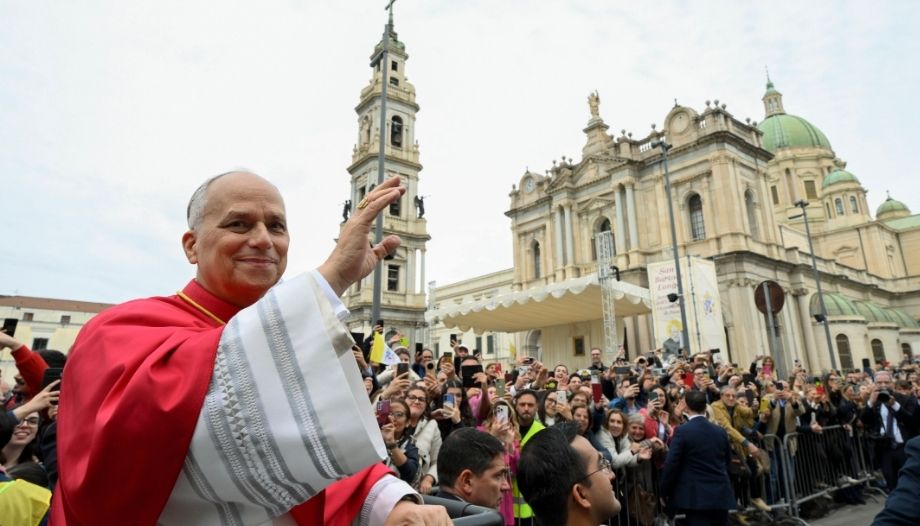
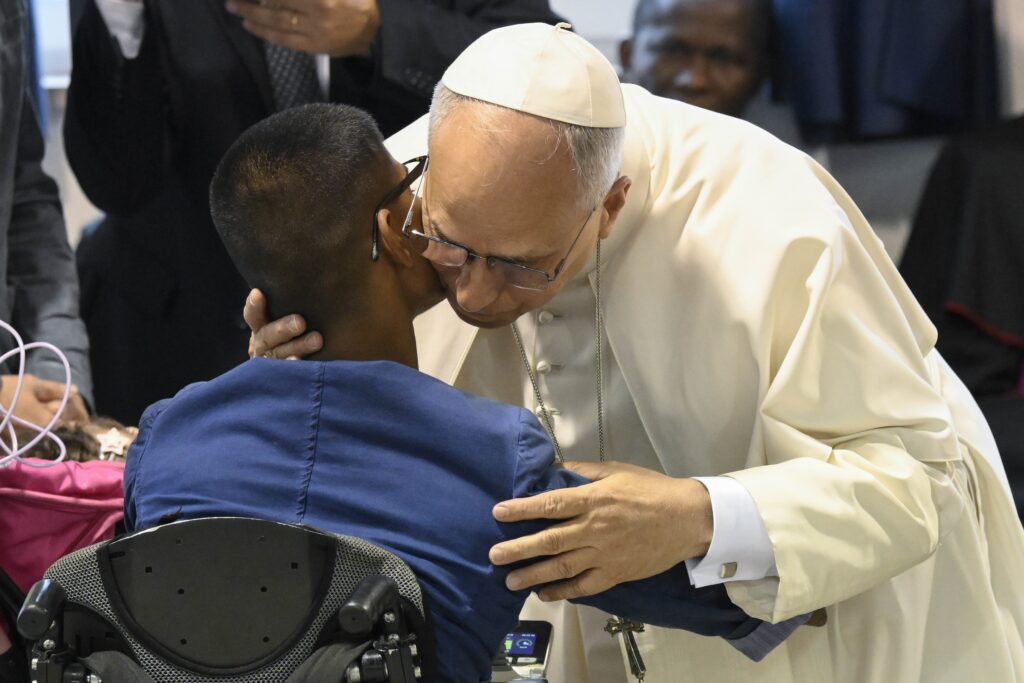
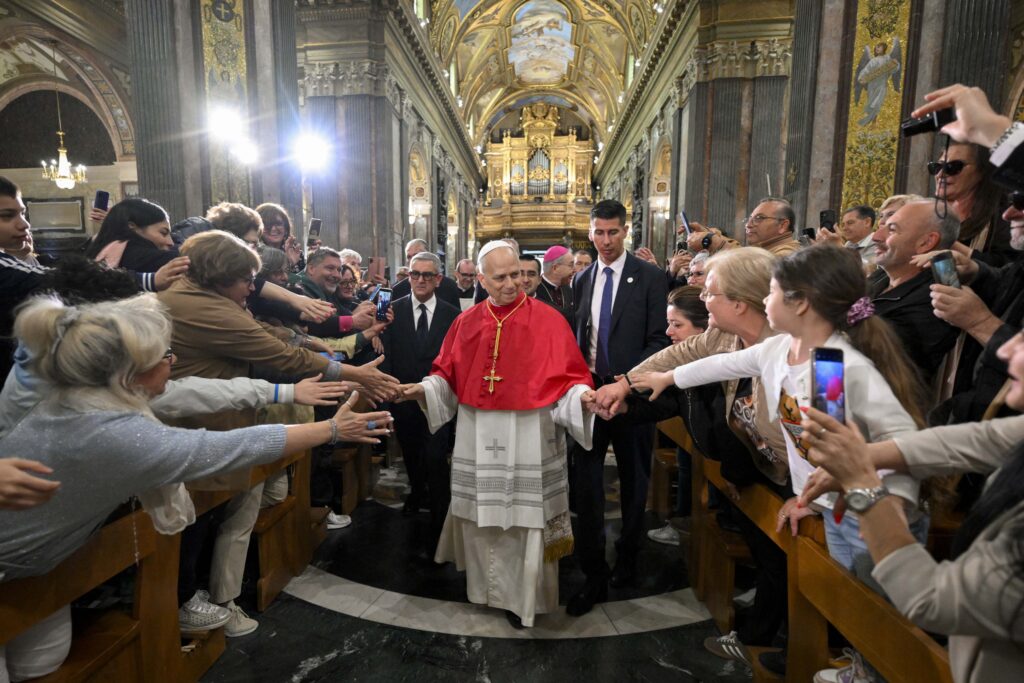
Leo XIV wanted to spend the first anniversary of his election as Pope at the feet of Our Lady of the Holy Rosary of Pompeii, and he made the Supplication to Our Lady before more than 20,000 faithful and four hundred sick and disabled people, to whom has greeted with great affection, almost one by one.
With resolute confidence in the “true Queen of peace and forgiveness” and “Mother of mercies!”, the Pope said that “the Rosario has a Marian physiognomy, but a Christological and Eucharistic heart. And the Hail Mary and the Holy Rosary are ”an act of love,“ and ”love works miracles,“ he said.
In addition, he prayed that “the God of peace may pour out an abundant outpouring of mercy, touching hearts, appeasing resentments and fratricidal hatreds, and enlightening those who have special responsibilities in government.”.
“This beautiful day of the Supplication to Our Lady of the Holy Rosary.”
It was “exactly one year ago, when I was entrusted with the ministry of Successor of Peter, it was precisely the day of the Supplication to Our Lady, this beautiful day of the Supplication to Our Lady of the Holy Rosary of Pompeii!”, the Pope confided in the homily pronounced in front of the Sanctuary of the Most Holy Virgin of the Holy Rosary of Pompeii.
Therefore, “I had to come here,” the Pontiff said, “to place my service under the protection of the Blessed Virgin. Having chosen the name Leo, I follow in the footsteps of Leo XIII, who had, among other merits, that of having developed an extensive Magisterium on the Holy Rosary. To all this must be added the recent canonization of St. Bartholomew Longo, Apostle of the Rosary”.
Hail Mary, Holy Rosary, “act of love”.”
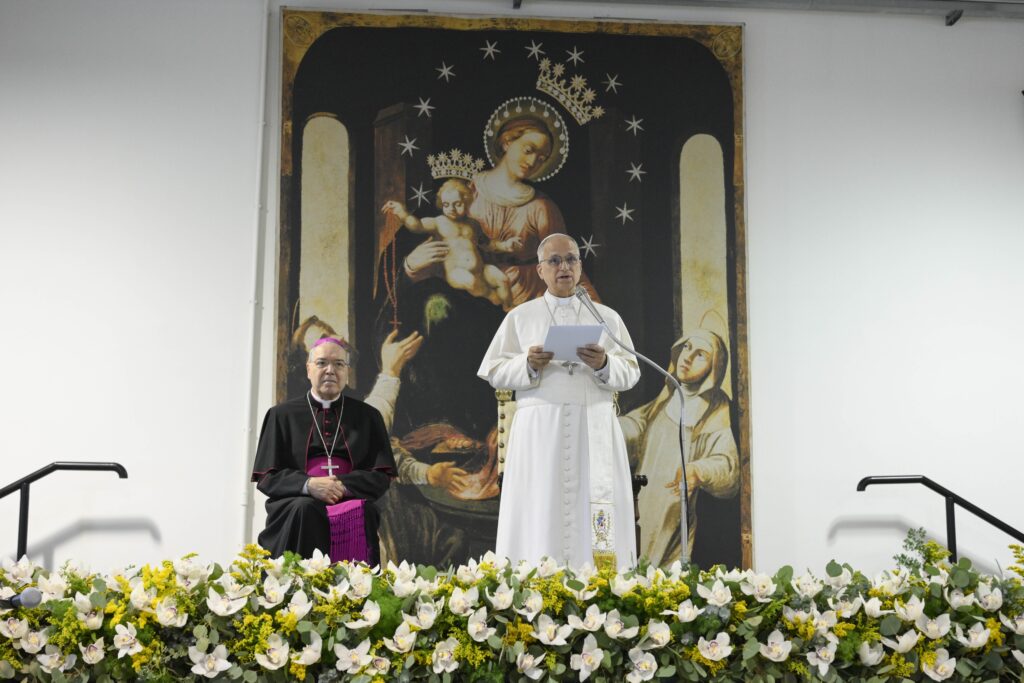
“The Hail Mary, repeated in the Holy Rosary, Is it not love to repeat untiringly: ‘I love you’? An act of love that, in the beads of the rosary, as is clearly seen in the Marian painting of this Shrine, leads us back to Jesus and leads us to the Eucharist, ‘the source and summit of all Christian life’”.
San Bartolo Longo was convinced of this, the Pope said, when he wrote: “The Eucharist is the living Rosary, and all the mysteries are found in the Holy Sacrament in an active and vital way”. He was right. In the Eucharist, the mysteries of Christ's life are, so to speak, concentrated in the memorial of his sacrifice and in his real presence. The Rosario has a Marian physiognomy, but a Christological and Eucharistic heart”.
San Bartolo Longo and his wife: a Marian city
Indeed, one hundred and fifty years ago, when laying the foundation stone of this Sanctuary, on the site where the eruption of Vesuvius in 79 A.D. had buried under ashes the vestiges of a great civilization, protecting them for centuries, ”San Bartolo Longo, Together with his wife, Countess Marianna Farnararo De Fusco, he laid the foundations not only of a temple, but of an entire Marian city,” the Pope emphasized.
Thus he expressed his understanding of God's plan, which St. John Paul II, speaking in this place of grace on October 7, 2003, at the conclusion of the Year of the Rosary, relaunched for the Third Millennium, from the perspective of the new evangelization. “Today,” he said, “as in the times of ancient Pompeii, it is necessary to proclaim Christ to a society that is moving away from Christian values and even losing its memory,” Pope Leo recalled.
“From this womb of Mary radiates the Light that gives full meaning to history and to the world.”
In his homily at Mass, the Pope commented on “the Gospel of the Annunciation,” which “introduces us to the moment when the Word of God became flesh in Mary's womb. From this womb radiates the Light that gives full meaning to history and to the world. The greeting that the Angel Gabriel addresses to the Virgin is an invitation to joy: ‘Hail, full of grace’. Yes, the Hail Mary is an invitation to joy”.
Great mystery,“ the Pope continued. "Everything happens through the work of the Holy Spirit, who covers Mary with his shadow and makes her virginal womb fruitful. This historical moment possesses a sweetness and a strength that draw the heart and raise it to those contemplative heights from which the prayer of the Holy Rosary".
The Rosary «has a Marian physiognomy, but a Christological and Eucharistic heart,» said the Pope, who recalled that in the Virgin's “let there be” “not only Jesus, but also the Church is born”.
"No resign ourselves to the images of death” in the news.
In concluding, Leo XIV stressed that “we cannot resign ourselves to the images of death that the news presents to us daily. From this Shrine, whose façade was conceived by St. Bartolo Longo as a monument to peace, today we raise our prayer in faith.
San Bartolo Longo, thinking of Mary's faith, called her ‘omnipotent through grace’. “Through her intercession,” the Successor of Peter has prayed that “the God of peace may pour out an abundant outpouring of mercy, touching hearts, appeasing resentments and fratricidal hatreds, and enlightening those who have special responsibilities in government.”.
Supplications to the Virgin Mary: have mercy on the world
In his prayer before Our Lady, after the Eucharist, the Holy Father made various petitions to the Virgin Mary, interspersed with the recitation of the Hail Mary.
For example, he asked the Virgin Mary that, “from that Throne of clemency where you sit as Queen, turn, O Mary, your merciful eyes to us, to our families, to Italy, to Europe, to the whole world, and have mercy on the sorrows and bitterness that afflict us”.
“Show yourself a true Queen of peace and forgiveness.”
“See, O Mother, how many dangers for soul and body surround us, (...), stop the arm of Justice of your offended Son, and with your goodness, subdue the hearts of sinners, for they are our brothers and your children”.
“Show yourself today to everyone a true Queen of peace and forgiveness,” he continued after the Hail Mary.
“We have crucified Jesus on our breast again, and pierced your most tender heart. Yes, we confess, we are deserving of the greatest punishments. But keep in mind, O Mother, that on the summit of Calvary, you received the last drops of that divine blood, and the last testament of the dying Redeemer”.
The Testament of Calvary: “Our Mother, Mother of sinners, our Advocate”.”
This testament “establishes you as our Mother, Mother of sinners, you are our Advocate and our hope. Therefore we, full of confidence, with groaning, lift up to you our hands in supplication, and cry out with loud voices: Mercy, O Mary, mercy”.
The Pope then prayed to Our Lady, our gracious Mother, to have “mercy” on our families, relatives, friends, the deceased, and above all on our enemies, «and on so many who call themselves Christians, yet tear at the kind Heart of your Son”.
“We implore for the nations gone astray and for the whole world.”
“Mercy, Lady, mercy. We implore for the nations gone astray, for all Europe and for the whole world, that it may be converted and return repentant to your maternal lap. Mercy to all, O Mother of mercies”.
“How hard it is for you to save us,” the Pope said to the Queen of the Rosary. “Did not your divine Son place in your hands the treasures of his graces and mercy? (...)”.
“Deliver us from the snares of the infernal enemy.”
“Your power, O Mary, reaches to the abysses, indeed, you can deliver us from the snares of the infernal enemy.”.
You, who are all-powerful, by grace, can save us (...).
Your Mother's heart will not allow your children to be lost.
The Divine Child and the Rosary in your hands inspire all our confidence, she said, and «with that confidence we prostrate ourselves at your feet, like weak children in the hands of the most tender of mothers”,
Finally, the Pope prayed to Our Lady to grant us, “in addition to a constant love for you, your maternal blessing” and the triumph of religion and the peace of hard-working humanity.
“We will never leave you,” Queen of the Rosary of Pompeii, our beloved Mother, Refuge of sinners, Sovereign consoler of the afflicted, be everywhere blessed today and always, on earth and in heaven, amen, said the Pope.
Napoli: “It is a blessing from God to be together”.”
After leaving Pompeii, the Pope departed by helicopter for Naples, where he was received by Cardinal Archbishop Domenico Battaglia, Archbishop of Naples, and by civil authorities, including the mayor of the city, Dr. Gaetano Manfredi, mayor of Naples.
Before the meeting in the cathedral with the bishops, priests, religious and religious men and women, Leo XIV said: “I came to Naples to experience this warmth that only Naples can offer! Thank you for this welcome! It is a blessing from God to be together, I am very happy to be here this afternoon: a very brief but very meaningful time. And this first stop right here in the Duomo, the cathedral of Naples, where I also want to pay this tribute to San Gennaro, so important to their devotion, their faith!”.
To priests: care of the interior life, fraternity, communion
Then, in his speech, Among other issues, he referred to the fact that “the human and pastoral burden (of priests) is undoubtedly heavy and runs the risk of weighing us down, wearing us out, exhausting our energies and, at times, can be aggravated by a certain loneliness and a sense of pastoral isolation.
“For this we need care,” he encouraged. “First of all, care for our interior and spiritual life, constantly nourishing our personal relationship with the Lord in prayer and cultivating the ability to listen to what stirs within us, to discern and allow ourselves to be enlightened by the Spirit.”.
Caring for our ministry, however, “also implies fraternity and communion,” he added. “A fraternity rooted in God, expressed in friendship and mutual accompaniment, as well as in the sharing of pastoral projects and initiatives.”.
Walking together, all involved in the mission
What I ask of you, then, is this: listen to one another, walk together, create a symphony of charisms and ministries, and thus find ways to move from a pastoral ministry of conservation to a missionary ministry capable of intervening in the concrete lives of people.
But the Pope did not refer only to the clergy, but also to the laity. “It is a mission that requires the contribution of everyone. In a city marked by inequality, youth unemployment, school dropouts and family fragility, the proclamation of the Gospel cannot exist without a concrete and supportive presence that involves all of us: priests, religious and laity. We are all active participants in the pastoral and life of the Church”, he affirmed.
Meeting with Neapolitans: “join forces, work together».»
Neapolitans cheered the Pope through the streets, and then welcomed him with joy in the afternoon, in a gathering in Piazza del Plebiscito, which included various testimonies, songs by various groups and dances.
In its Speech, Against the backdrop of the disciples of Emmaus, Leo XIV visualized the “yearning for life, justice and goodness (flowing in this city), which cannot be annihilated by evil, discouragement and resignation”.
Therefore, we must - not alone, but together - ask ourselves: what is truly important? What is necessary and important in order to resume our journey with the impetus of commitment instead of the weariness of indifference, with the courage to do good instead of the fear of evil, with the healing of wounds instead of indifference?”.
One of his main answers was, in reference to the educational Pact promoted by the Church and other issues: “go ahead with this Pact, join forces, work together, walk together - institutions, Church and civil society - to ennoble the city, protect its children from the traps of adversity and evil, and restore to Naples its vocation of being the capital of humanity and hope”.
Culture of peace and solidarity in welcoming migrants and refugees
Concluding his speech, the Pontiff noted that “the ecclesial community and the civil community are working together to make Naples a platform for intercultural and interreligious dialogue”.
“Through conferences, international awards and host programs for young people from conflict zones - such as Gaza - we can continue to give voice, from the grassroots, to a culture of peace, countering the logic of confrontation and the use of armed force as a supposed solution to conflicts.”.
In this sense, Naples continues to demonstrate “its deep solidarity in welcoming migrants and refugees, seeing them not as an emergency, but as an opportunity for encounter and mutual enrichment.” This is possible, above all, thanks to the work of the diocesan Caritas, which “has also transformed the Port of Naples from a simple disembarkation point into a living symbol of welcome, integration and hope.”.





 Español
  English
  Italiano
  Français
  Deutsch
  Polski
  简体中文
简体中文