



 Becciu's trial at the Vatican: three keys of interpretation
- Courtney Mares / OSV News
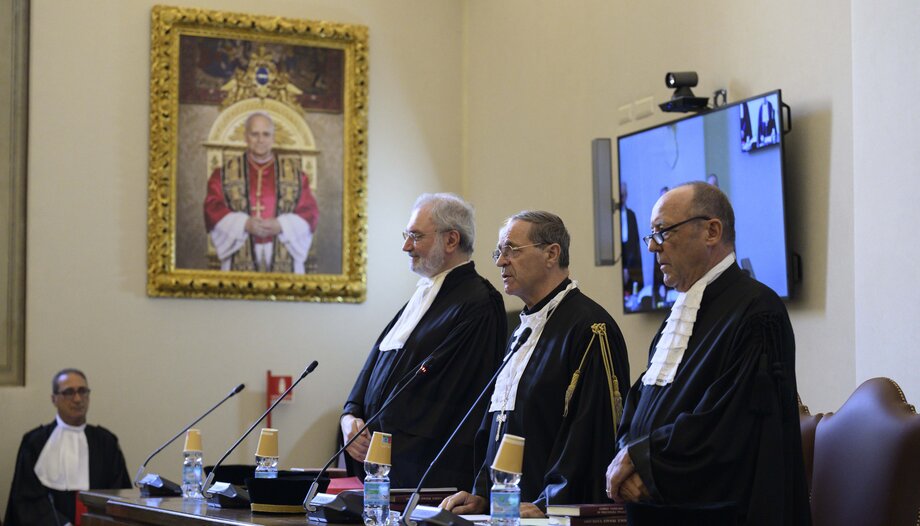
The Vatican appeals court declared a partial mistrial in the controversial financial misappropriation case involving Cardinal Angelo Becciu and other defendants, alleging procedural errors on the part of the prosecution in the trial held at the Vatican which, in 2023, had resulted in a prison sentence for the cardinal for various embezzlement offenses.
In a 16-page ruling handed down on March 17, the Court of Appeal, presided over by Archbishop Alejandro Arellano Cedillo, declared that Vatican prosecutors committed procedural errors that violated the defendants' right to a fair defense.
Some parts of the original procedure are void
Without completely annulling the trial, the court ruled that some parts of the original trial were void and should be re-examined, including witness statements and the evaluation of specific evidence. The next hearing is scheduled for June 22.
The court specified that the sentence of “relative nullity” does not completely annul the legal effects of the original sentence of December 2023, in which Cardinal Becciu was sentenced to five and a half years in prison, permanent disqualification from holding public office and a fine of more than $8,000.
Real estate operation in London
The case revolves around the Holy See's investment of some 350 million euros (nearly $404 million) in a luxury real estate project in London between 2014 and 2018. Prosecutors had alleged that several intermediaries and Vatican officials pocketed tens of millions of euros in improper fees and commissions during the acquisition.
The saga of the Vatican's “trial of the century,” which lasted nearly two and a half years and featured 86 sessions, found Cardinal Becciu and eight other defendants guilty on charges including fraud and abuse of power, and the court ordered the Holy See to pay tens of millions of euros in damages. All the defendants pleaded not guilty and appealed.
The prosecutor's office is ordered to make public the complete case file.
Among the most important provisions of the March 17 ruling, the court ordered the Office of the Promoter of Justice - the Vatican equivalent of the public prosecutor's office - headed by Alessandro Diddi, to deposit in the court's secretariat, by April 30, the complete and uncensored file of all the documents of the investigation.
The defense lawyers had alleged that they had only received part of the material, with key documents censored. Among the omitted content, as noted in the sentence, were chat messages about the witness Monsignor Alberto Perlasca, former director of the Administrative Office of the Secretariat of State.
The prosecution had argued that the deletions were necessary to protect parallel investigations, but the appellate court upheld the defense, finding that the omissions constituted a fundamental procedural violation.
The parties will have until June 15 to review all documentation and prepare their respective arguments.
Papal decrees at the center of controversy
The ruling also addressed a separate but related controversy over four papal rescripts - or executive decrees - issued by the late Pope Francis that greatly expanded the investigative powers of the Office of the Promoter of Justice during investigations. Defense lawyers alleged that the rescripts were not issued in a timely manner and were not communicated to the defense until just before the original trial began, depriving the defendants of crucial information during the investigative phase.
The court of appeal considered that one of the rescripts had, in practice, a legislative character, and that the fact that Pope Francis had not made it public had rendered it ineffective.
This finding has important implications for the retrial, as it calls into question a series of actions taken by the Prosecutor's Office under the authority conferred by those papal decrees, including the 2020 arrest of agent Gianluigi Torzi, who was held for ten days in Vatican facilities and interrogated without charge and without judicial supervision.
New Pope, new call for judicial credibility
The ruling came just days after Pope Leo XIV inaugurated the Vatican City judicial year with a speech in which he referred to the importance of “the observance of due process, the impartiality of the judge, the effectiveness of the right of defense and the reasonable length of proceedings” to preserve institutional authority and stability.
“Love and truth are inseparable: only by loving do we know the truth, and love for the truth leads us to discover charity as its fullness,” the Pope affirmed. “This is why justice, when exercised with balance and fidelity to the truth, becomes one of the most solid factors of unity within the community.”.
This news was first published in English in OSV News. You can read the original text HERE.






 Español
  English
  Italiano
  Français
  Deutsch
  Polski
  简体中文
简体中文