



By David Werning, OSV News
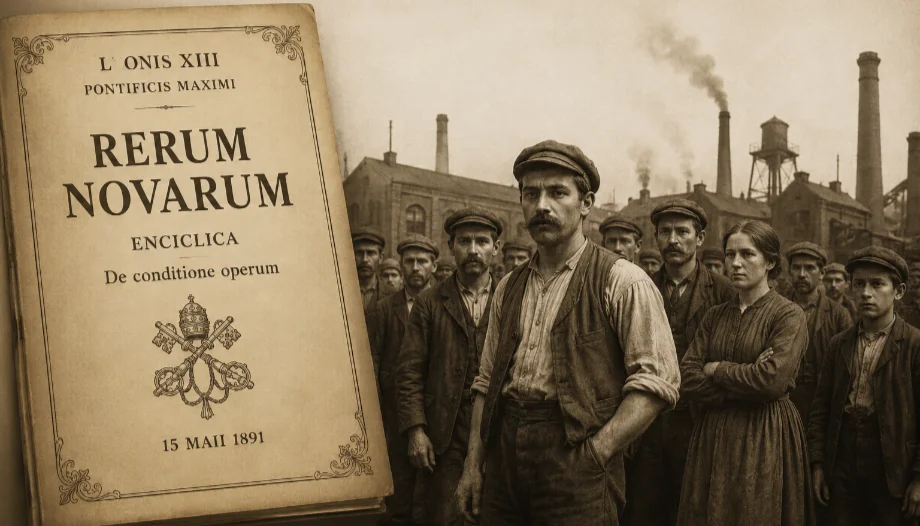
Imagine working in a factory where, at the end of each week, the owner places a flower arrangement on the most productive machine, instead of the worker. This happened in France during the Industrial Revolution, and it is a shocking anecdote that explains why Pope Leo XIII considered it necessary to defend the working class in his encyclical «Rerum Novarum», published on May 15, 1891.
Throughout most of the 19th century, the world continued to undergo major social changes, following the various revolutions that overthrew ancient regimes and even stripped the papacy of its property outside the Vatican. Pope Leo XIII contextualizes the encyclical «Rerum Novarum»(«Of New Things») in its opening paragraph: «The elements of the conflict that now rages are unmistakable: the vast expansion of industrial activities and the marvelous scientific discoveries; the transformed relations between employer and worker; the enormous fortunes of a few individuals and the absolute poverty of the masses».
The impact of the industry
Pope Leo XIII perceived a threat to the working class. The industrial revolution transformed the way people worked and supported their families. The «marvelous discoveries of science» resulted in machines that produced goods more efficiently than workers, and these machines enriched their owners.
The working class, accustomed to earning a living from trades and crafts, was forced to exchange their labor for wages. While the artisans had guilds to protect their interests, the workers had no one to defend them.
The Pope laments that «workers have been handed over, isolated and defenseless, to the cruelty of employers and the greed of unbridled competition... so that a small group of very rich men have been able to impose on the masses of poor workers a yoke little better than that of slavery itself.».
Private property and dignity
Aware of the situation, Pope Leo XIII illuminates the plight of the working class in the light of Scripture and tradition and, based on his reflections, offers a remedy in «Rerum Novarum.» In addition to naming the remedy, the Pope indicates where it is to be found and how it is to be applied, with due regard for «the relative rights and mutual duties of rich and poor, of capital and labor.».
Pope Leo XIV has highlighted this document, considered by many to be the first social encyclical, as part of the inspiration for the choice of his papal name.
In essence, «Rerum Novarum» exhorts everyone to honor the God-given dignity of every person, rich and poor alike, by eradicating greed and promoting private property for all. However, those living in poverty deserve special attention in their efforts to earn a living, since they are more vulnerable to oppression.
The Pope affirms that the remedy to alleviate the plight of the masses must be the inviolability of private property, a principle rooted in Scripture, which condemns the covetousness of the property of others. Moreover, the natural law of God obliges man to preserve his life and that of his family, without neglecting the common good. Private property enables him to fulfill these obligations. Indeed, through the gift of reason, he cultivates his portion of land (or allocates his wages) for his immediate and future needs. Therefore, man has the inherent right - before any consideration of the State - to acquire the resources necessary to live, which allows him to acquire private property.
Cooperation versus conflict
The Pope then points out that the right to private property must be achieved through cooperation among the members of society. The Church, the rulers, businessmen, the wealthy and even the workers themselves must participate in the effort to promote the interests of the working class.
The goal is not a utopia or a society where everything is common, as some of the Pope's detractors argued at the time. On the contrary, there are real differences among men (not to mention the reality of sin and evil). Some earn more money than others. People have different talents. However, these differences need not generate hostility between social classes.
Nor does it mean that one person should live in opulence and another in poverty. As Pope Leo XIII points out, «capital cannot exist without work, nor work without capital». Both can and should collaborate for the common good, as determined by justice. It could even be said that God allows differences precisely so that people learn to live in community.
The common good is achieved when each person and each group attends not only to their rights, but also to their duties; in other words, when they live a virtuous life. The Church contributes to this effort by training people in the practice of virtue, which is «equally within the reach of all, rich and poor».
From the perspective of eternity, social position offers no advantage. God loves each person equally. However, how one lives and uses one's gifts will be subject to divine judgment. The encyclical presents a list of duties for both workers and employers that respects the dignity of others and upholds the obligations of justice. Ultimately, each person is called to fraternal love, to follow the way of Jesus.
The role of institutions
The encyclical «Rerum Novarum» offers various practical applications that respect the right to private property and promote the common good. The working class provides the goods that contribute to the increase of the wealth of the State. Virtuous employers seek not only economic profit, but also the welfare of their employees and society. The Church creates organizations (such as Catholic Charities) to care for and defend the less fortunate. And the State has the primary duty to «achieve public welfare and private prosperity,» considering the interests of all - equally - as superior and inferior.
According to the encyclical «Rerum Novarum,» one exemplary way in which the State supports the working class is by encouraging and protecting organizations and unions that bring together employers and workers. These unions have the advantage of allowing both parties to enter into mutual agreements that protect their rights and promote the fulfillment of their obligations. The State must intervene when it is necessary to remedy a wrong or eliminate some injury, making sure that its intervention does not exceed the scope of the solution.
Challenges of today's world
Pope Leo XIII concludes that when the members of society work together for the common good, founded on virtue and justice, so that even the worker can support himself and his family comfortably through the acquisition of private property (land, salary), excellent results are obtained: the gap between great wealth and extreme poverty will be closed, all men will be more productive in their labors, and citizens will remain in their own country instead of trying to find a dignified life elsewhere.
After explaining the remedy, where to find it and how to apply it, the Pope calls everyone to action: «Each one must put his hand to the work that corresponds to him, and do it immediately, so that the evil, which is already so great, does not become, by delay, absolutely irremediable».
Few would argue that there is no possible solution regarding the distribution of property (income, wealth) and power in our world. Efforts to alleviate poverty and eradicate greed and tyranny have never ceased. However, few would disagree that there are still real injustices to be corrected and challenges to be faced.
For example, we live in a society that tolerates each of the top 15 mutual fund managers earning more than $840 million a year, while elementary school teachers need two salaries for decent housing. Most U.S. citizens simply take for granted that the economic system unfairly favors politicians, large corporations and the wealthy. Meanwhile, perhaps in reaction to such injustices, we have an emerging generation espousing Marxist ideas such as the rejection of private property and Christian morality. Clearly, we have a lot of work to do on justice and love.
The See-Judge-Act Method
The encyclical «Rerum Novarum» is still relevant even though it was published 131 years ago and offers us a way to respond to the injustices of our time. In writing it, Pope Leo XIII employed a theological method he learned from studying St. Thomas Aquinas. This method consists of three steps: perceiving the reality of the times, judging what is seen in the light of divine revelation (Sacred Scripture and Sacred Tradition) and acting on the conclusion reached through prayerful discernment.
Belgian Cardinal Joseph Cardijn (1882-1967), a disciple and admirer of Pope Leo XIII, developed the papal method for workers« groups, especially young workers, to engage with society on the important issues of their time. Even Pope St. John Paul II, one hundred years after »Rerum Novarum,« recommended in »Centesimus Annus« the See-Judge-Act method »as an enduring paradigm for the Church,« a tool for intervening in »specific human situations, both individual and communal, national and international.".
In this way, the Church fulfills its duty as a «citizen» to contribute to the common good and to keep the world centered on God's plan of salvation. It is a duty we all share.






 Español
  English
  Italiano
  Français
  Deutsch
  Polski
  简体中文
简体中文