



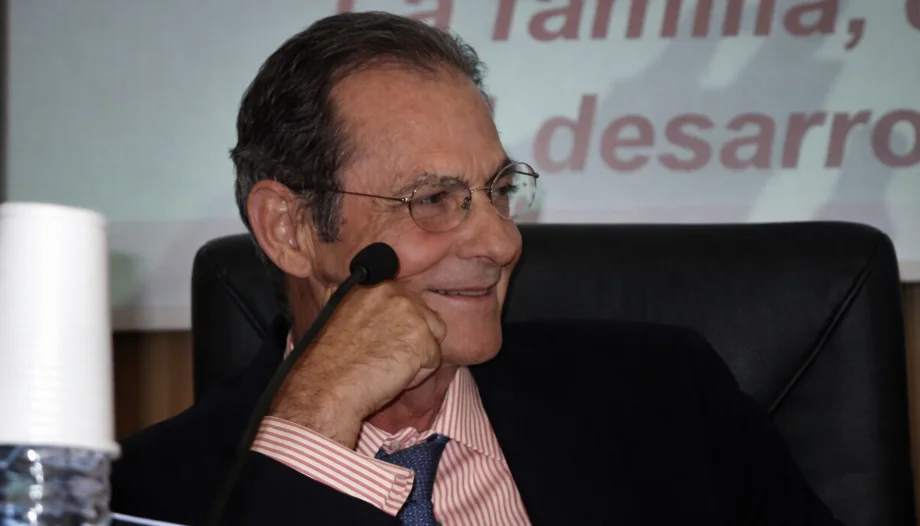
Fifty years of clinical practice and teaching are enough to observe the human soul in all its lights and shadows. Aquilino Polaino, a referent of psychiatry in Spain and co-author of The art of getting married and having no regrets, reflects on what he has learned over the years about the person, the bonds and the structure of the family in a society that seems to have forgotten the instruction manual of commitment.
What are the changes that have surprised you the most in the five decades you have been in your profession?
ーFirst of all, the radical change, and I would almost say the opposite, of what the family used to be. It seems to me that the family, as we knew it, has fallen apart. Secondly, the immaturity of the parents' generation. It seems to me a very substantive change, almost paradigmatic.
And, in third place -although already at a greater distance- I would put the situation of young people from adolescence onwards: the number of problems they have and the almost absolute lack of personal resources to face them. This causes them to collapse even more and they become the object of enormous uncertainty, in a context where there is a lack of exciting and enthusiastic youth policies, really designed for them.
To someone it might seem that your diagnosis focuses primarily on the lost.
ーNot all times past were better. I, at least, in the social relationships I maintain - with former students, with patients I once had - I continue to find isolated points, but which are of enormous value. If I compare those young people with those of my generation, in some things they clearly surpass us.
I don't like to call them “nuclei of resistance”, but they are. They open up a very real hope that change will come sooner or later. It may take fifteen or twenty years, but I am convinced that they will succeed. Why? Because they are very prepared, very serious people, who share old values, who have suffered a lot. They have discovered a world in which young people are in the way and are relegated to the back of the queue in the face of economic predators: underpaid, with housing problems, with male-female relationships that do not work. And yet, they are strong, have illusions and know what they want in life. That, sooner or later, has to turn the tables.
How do you interpret the phenomenon of the “Catholic turn” in Spain?
ーThere are many factors that have prepared this “turn” that we now see. One of them is very human: the ability to get fed up. There comes a time when you get fed up, and then you enter a crisis. The discomfort is so great that it can no longer be tolerated.
If we add a minimum idea of justice to this weariness, the person begins to change by himself. That is where the radical change takes place. The return to faith and religious values contributes very strongly to this change, as long as a necessary condition is met, although it is not sufficient: to distinguish between religion and emotion.
If they are confused, the result will be unsatisfactory, somewhat explosive and regrettable for many young people. Because religion cannot be reduced to a feeling. Faith needs affectivity, transforms it and has much to do with it, but it cannot be identified with mere affectivity.
Do you say this because of concrete situations, recent movements, Church documents?
I am not saying this because of a specific text but because of an underlying dynamic. Many young people who are now open to religion have seen and suffered as their parents went from being believers to an agnostic and non-religious stance. In extreme cases, they have seen their parents become apostates.
When the religious aspect of their lives takes root in them, they find that what should have been transmitted to them as an example and education was not. And there arises a love-hate problem towards parents. Sometimes it is justified, and it must be solved by resorting to forgiveness. Other times it is not justified, but it is also necessary to solve it, because otherwise the wound becomes chronic.
Today we see it, for example, in many young girls: everything positive they find in themselves -intelligence, sportsmanship, good heart- they attribute to themselves. The negative - laziness, consumerism, lack of industriousness - they blame on their parents. Parents become the scapegoat for everything bad. The good, on the other hand, would be the exclusive fruit of their own merit. This is a tremendous mistake.
What are the psychological consequences of this way of reading one's own biography?
ーParents accept children as they come, not knowing who their child will be. The parent does not choose the child, nor does the child choose the parents. There is a reciprocal acceptance supported by psychobiology and the nature of the human condition.
On that basis, parents should devote themselves to the human and religious education of their children, spending time with them and setting an example in a hundred thousand details. And the children, for their part, must observe their own defects and not project them onto the false scapegoat that is the parents. Otherwise, many psychological problems become chronic.
If a person does not accept his father as he is and only sees him surrounded by defects that he projects onto himself, he believes that he only harms his father, but the one who harms himself the most is himself, because he comes from his father. If he hates his father or lives in a permanent attraction-rejection towards him, he reproduces the same dynamic with himself. And no one can live well with himself if, at the same time, he rejects himself.
Listening to you talk about youthful wounds, about how the family past is reworked, it is inevitable to remember Jordan Peterson. What do you think of his contributions and his influence?
ーAnyone who has professional experience with young people in psychology or psychiatry will have perceived phenomena very similar to those described by Peterson. In societies where about half of the young people have not had a good attachment to their parents, a generation is growing up that has never felt truly secure.
Many say that their father always corrected them in public, humiliated them, never gave them a big hug, emphasized only the negative. That image not recognized as valuable generates resentment. And a resentful person is a bitter person who seeks revenge through aggressiveness.
This aggressiveness is used against himself and others. He can insult himself and nothing happens, but whatever another says to him, he experiences it as an aggression that forces him to fight. From there it goes on to something very fashionable, also fed by certain trends ideologicalvictimology. Many young people have discovered that, if they present themselves as victims, politics offers them subsidies. An escape route has been constructed through subsidized victimization.
What are the social consequences of this logic of victimization and subsidization?
ーIf I declare myself a victim - rightly or wrongly - I conclude that society owes me justice, and should compensate for my pain with a subsidy. That is part of a great environmental materialism. But the victimizer will never get out of this false attitude by reaching out and asking for subsidies.
When the citizen's relationship with politics is reduced to being a subsidized class, dependent on the state, personal freedom is seriously eroded. There are more and more victims, more subsidies and more resentment and bitterness. What people want, deep down, is to be free, and this permanent economic dependence does not make people freer but more vulnerable to manipulation.
For the first time in decades, certain anthropological changes linked to transsexuality have found clear brakes in the public debate -in prisons, bathrooms or mixed sports-, with a clash between trans activism and feminism. Do you think we are facing a “this is as far as we have come” or is it just a parenthesis?
ーI think all these are slow brakes, they cannot yet be considered a consolidated trend. We are in a phase of self-awareness: of realizing the reality, of how many people have been manipulated and led down a wrong path, full of mistakes and great suffering.
The signs of change exist and come, to a large extent, from very capable people who have been able to see them. This means that we have emerged from the ideological and dogmatic hermeticism in which almost all of society used to live. There are points of light, more critical spirit, and what today are incipient signs may become a trend in a few years.
In the medical field this is very clear: hormonal treatment of adolescents with gender dysphoria has been restricted or banned in quite a few countries, after it was found that it was not really helping the patients.
What specific events seem to you to be the most significant in this change of medical course?
ーMany medical teams have observed that those who underwent hormone and surgical sex changes obviously continued to have the same biological cellular sex, and that their underlying problems were not resolved. Longitudinal follow-ups have shown elevated rates of severe psychiatric distress, including schizophrenia and suicide.
This has acted as a very strong deterrent among the professionals themselves. A paradigmatic case is the Tavistock Clinic in London, for years a world reference in the treatment of young people with gender dysphoria, which has had to close its service after complaints from parents of patients.
That a clinic with more than a century and a half of history, pioneering and influential even for American child and adolescent psychiatry, has taken this step is a wake-up call for the whole of English society and beyond. The fact that underage hormone therapy is now banned or severely restricted in England and in many states in the United States indicates that the issue is beginning to change in substance. I trust that, in time, colleagues who got it wrong will apologize for a malpractice that was often exercised with good intentions, but with little awareness of its consequences.
Before I finish, I would like to add a topic: the demographic winter. Why do you think it is so important?
ーBecause it's tremendous, and it's closely related to my last book, The art of getting married and having no regrets, written with a very young boy. I have always maintained that young people can do much more than they think they can, and I have seen it empirically. The problem is that, because they don't know themselves, they live in a very strange situation.
They overestimate themselves in what they are worth little and underestimate themselves in what they are worth a lot. A girl can consider herself very beautiful (overestimation) and yet hide or not value that she is very intelligent (underestimation) because she is afraid of being labeled a “nerd”. The boy puts all the emphasis on muscles, when he will never be a Real Madrid player. And at the same time he considers himself mediocre, stupid, incapable of achieving great goals. They underestimate his capacity for audacity, courage, leadership, for guiding his life well, for having a high biographical project and fighting for it every day.
Do parents share this distorted view of their teenagers?
ーMany times yes. They too get carried away by clichés and fears. They think that having a teenage child is almost an impossible mission, something close to heroic survival. And it's not true.
Adolescence is a difficult period of transition, because it is the first time freedom and the multiplication of impulses, but it is also a stage where the young person raises human and anthropological questions that border on the metaphysical. It is an accelerator of the radical change towards maturity.
This must be taken advantage of. Neither parents can underestimate or belittle their teenage children, nor can children disqualify their parents. However, a very erroneous state of opinion has spread that presents the adolescent child almost exclusively as a problem.
How does this connect to the declining birth rate and fear of parenthood?
ーToday many potential parents believe that having a child is to stop living well in order to live badly. They only put in the balance the effort, the dedication, the economic cost. They do not put on the other plate all that a child brings to the family.
Thus, the balance never stabilizes and the fear of filiation grows, which is basically a fear of paternity. Without children one cannot be a father. And parenthood has a biological and human dimension, but also a spiritual dimension: it is taking responsibility for someone other than yourself. It is precisely this responsibility that makes people “stretch”, that makes them improve, that makes them mature much more.
Instead of seeing children as a threat to the “good life”, we should see them as the best thing that can happen to a couple: a gift that is given to them so that they can educate, love, protect, support and form them, bringing out the best person possible. And, incidentally, so that they never feel alone again. Changing this narrative is essential if we want to reverse the demographic winter.
What would become of the parents without their children, you might ask? Quite simply, they would work less, consume more, delay and hinder their personal development, indulging in an adolescent and individualistic lifestyle. They would start a path towards individualism, at the end of which is the cold of loneliness and the perplexity of boredom.






 Español
  English
  Italiano
  Français
  Deutsch
  Polski
  简体中文
简体中文