



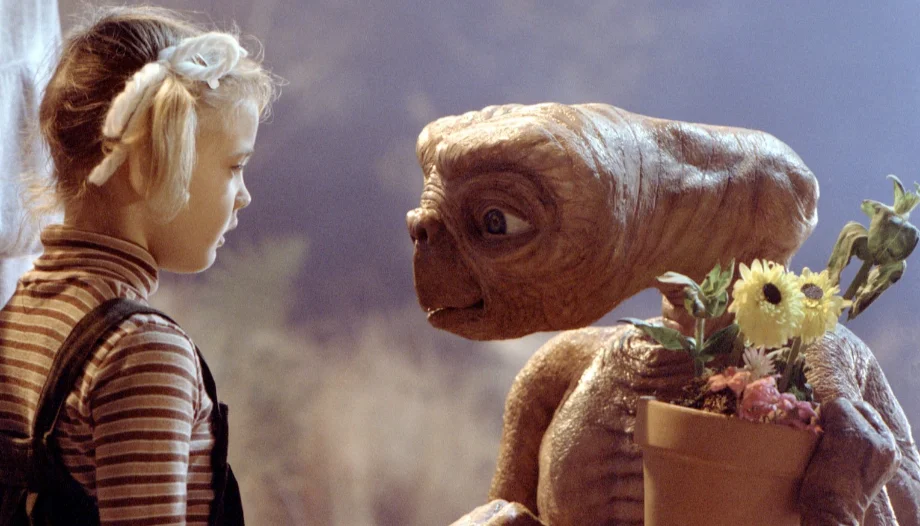
During the second half of the 20th century, the possibility of non-human intelligences was often imagined in an extraterrestrial key. It was, in itself, a striking cultural phenomenon: a combination of technological fascination, geopolitical anxiety, media expansion and perhaps the age-old human desire not to be alone.
In the midst of the atomic age, when technology seemed capable of both destroying the world and inaugurating a new age, the skies began to be filled with ambiguous presences. Those lights could be secret weapons, remote visitors, perceptual errors or simple rumors -although they were first and foremost symbols.
The hegemonic expression itself in the fifties and sixties - “flying saucers”, translation of flying saucers- could come from a well-known journalistic distortion. In 1947 the American pilot Kenneth Arnold described the movement of objects in the sky as plates bouncing on water, and the press transformed that kinetic comparison into the shape of a ship; years later, the witness himself would end up linked to the nascent ufological culture.
It is significant that one of the great contemporary technological myths was born out of a faulty mediation. As Carl Jung suggested in Flying Saucers: A Modern Myth of Things Seen in the Skies (1958), the enduring interest of the phenomenon depended not only on the material reality of the sightings, but on their capacity to condense collective hopes, anxieties and symbols-very Jungian, of course.
Spanish ufology
However, to reduce the UFO phenomenon to a North American cultural pathology linked to the Cold War would be insufficient. In Spain, too, a reception of its own crystallized (Spain is different). As Ignacio Cabria showed in his historical-anthropological studies on Spanish ufology, the so-called flying saucers arrived largely as a product of post-war American mass culture, which allows us to interpret the arrival of the myth as a form of symbolic colonization together with imported music, images and lifestyles. But its Spanish roots were not a mere copy. The myth was grafted onto a specific context -late Francoism, modernization of technology, religious persistence and growing fascination with astronautics- until it acquired its own flavor.
The same author also proposed a particularly fruitful distinction between the UFO in the strict sense - the unidentified aerial object - and the “UFO” in the cultural sense: the figure already loaded with expectations and meanings, almost automatically converted into an extraterrestrial spacecraft, cosmic visitor or superior intelligence.
This difference allows us to understand that the phenomenon did not consist only in sightings, but in the formation of a recognizable subculture: amateur researchers, specialized bulletins, disseminators, believers, contactees and an intense media circulation. Beyond the reality or unreality of the phenomenon, what is certain is that it spread, offering a new image of man's place in the cosmos and, for some, even a promise of spiritual regeneration.
From flying saucer to algorithm: two myths, one structure
The analogy with a phenomenon of our time is immediate. It is also useful today to distinguish between artificial intelligence in the technical sense - large linguistic models, predictive systems, computer vision, automation of limited tasks - and “AI” in the cultural sense: a diffuse entity to which imminent awareness, autonomous will, the appearance of operational omniscience or the capacity to globally replace human beings are attributed.
In the same way that many unidentified objects were absorbed by the previous image of the flying saucer, heterogeneous innovations are today absorbed by the mythical figure of a nearby superintelligence, sometimes feared as a threat to civilization and sometimes invoked as a redeeming technical solution.
Also today, much of the public imagination about artificial intelligence stems less from direct knowledge of its mathematical foundations than from spectacular demonstrations, business promises and extreme future scenarios. Recent surveys show that a significant proportion of the population considers it plausible that future artificial systems will become conscious or develop forms of autonomy comparable to human ones.
A 2023 international poll indicated that about one third of respondents saw the appearance of a conscious AI as plausible in the coming decades. The data recalls another cultural climate: in 1973 a Gallup poll recorded that 51% of Americans believed in the reality of the UFO phenomenon, and between 1973 and 2019 between 47% and 57% held that UFOs were “something real” and not mere imagination. These are not equivalent phenomena, but a telling affinity: the periodic willingness of technologized societies to imagine non-human intelligences acting on their horizon.
The threat of no longer being unique
It would be easy to dismiss both episodes - yesterday's ufological enthusiasm and today's algorithmic anxiety - as mere surges of credulity. It is more interesting to note what they have in common: in both cases there is the suspicion that the humanity, or any of its most intimate features, could cease to be unique.
This is not a minor concern. A good part of modernity rested, even when it ceased to express it in religious language, on the conviction that man occupies an exceptional position: rational animal in the Aristotelian sense, Kantian moral subject, author of technique, bearer of reflective consciousness. When the possibility of another intelligence arises -whether from other worlds or from our own artifacts- this self-understanding is revised.
The immediate question seems to be directed outward: do they exist, do they really think, could they surpass us? But the deeper question is directed inward: what trait remains specifically human if intelligence ceases to be our exclusive patrimony?
These reactions can be interpreted from a psychological point of view in terms of human distinctiveness threatthe discomfort that arises when faculties considered distinctively human - complex language, creativity, deliberation, autonomy or self-awareness - appear to be attributable to non-human agents. The question does not, therefore, boil down to the utility of a technology, but to the symbolic status of certain capacities by which a culture defines itself.
Copernicus, Darwin, Freud... and now
In a convergent line, the research on anthropomorphic robots and on the so-called uncanny valley, initially formulated by Masahiro Mori, suggests that quasi-human entities often provoke a mixture of familiarity and rejection: the closer they approximate our traits without fully matching them, the greater the unease they may arouse. We are not just defending functions; we are defending identity boundaries.
From a broader historical perspective, the problem refers to a sequence of successive decentering of the human image. Nicolaus Copernicus displaced the Earth from the center of the cosmos; Charles Darwin questioned the absolute boundary between man and animal; Sigmund Freud insisted that consciousness is not transparent to itself. Extraterrestrials would have questioned our cosmic centrality; artificial intelligence now interpellates our cognitive centrality. Each epoch fears losing the privilege it considers to be its own.
The temptation of redemptive intelligence
In the 1950s there was no shortage of those who expected from space visitors a moral superiority capable of correcting terrestrial violence. In much of the post-war contactees, from George Adamski - who claimed to have met UFO occupants, describing them as benevolent aliens with Nordic features, the so-called “Space Brothers”, and even claimed to have traveled with them to the Moon and other planets - to many European epigones, the visitors did not arrive as conquerors, but as ethical admonishers warning against nuclear war, materialism or spiritual decadence.
Our time reproduces the reverse symmetry: certain discourses present artificial intelligence as a neutral instance called to overcome human biases or cognitive limitations.
In both cases, there is a temptation to attribute to a non-human intelligence what we miss in our own. Yesterday it was projected onto advanced civilizations from Mars or Venus; today it is projected onto automatic learning systems. But there is also the opposite temptation: to project onto them our deepest fears and the characteristic biases of each era.
Much of the extraterrestrial imaginary of the mid-20th century reproduced the sexual anxieties, racial hierarchies and gender fantasies of its time: there was no shortage of B (and not so B) movies populated by hypersexualized venusines or invaders that stirred the geopolitical fears of the Cold War.
Similarly, current narratives about artificial intelligence often reflect more contemporary obsessions: total surveillance, job loss, algorithmic manipulation, erosion of intimacy or affective substitution. Imagined otherness is rarely neutral; it often returns to us, exaggerated, the traits of our own age.
Salvific expectations without God
The sociology of religion allows us to add a relevant nuance here. In secularized societies, certain salvific expectations do not necessarily disappear; they change their object. What was once formulated in explicitly religious language sometimes reappears as trust in morally superior cosmic visitors or as faith in a technology capable of resolving persistent human conflicts. The promise remains, even if its symbols change.
It is significant that even ancient religious traditions, such as Christianity, have for centuries considered the existence of non-human intelligences - angels, for example - although in a metaphysical register radically different from that of the extraterrestrial or the algorithm.
The Catholic response: neither panic nor enthusiasm
Catholic thought reacted to these questions in a more nuanced way than is usually assumed. The extraterrestrial hypothesis did not produce a doctrinal crisis, but rather an exercise in intellectual broadening, although there was no lack of naive speculations, apologetic excesses and enthusiasms of little rigor. Along with nowadays forgettable witticisms, more serious reflections appeared.
Karl Rahner maintained that the universality of grace did not depend on the biological solitude of man in the universe. Pierre Teilhard de Chardin, from a cosmic Christology marked by evolution, conceived Christ as the convergent center of the whole of creation, not of a single isolated species. Decades later, the Jesuit astronomer José Gabriel Funes would publicly recall that the possibility of extraterrestrial life does not contradict the Christian faith and that a populated universe would not limit God's creative freedom.
In all these cases, it is worth stressing the obvious: it was less a question of responding to a proven fact than of exploring, with greater or lesser success, the theoretical consequences of a still entirely open hypothesis.
From this debate emerged, in a schematic way, four major models. The exclusivist model holds that only humanity participates directly in the economy of redemption linked to the unique historical Incarnation of Christ. The inclusive model proposes that this same salvific work could also be extended to other rational beings.
Other authors imagined multiple incarnations of the Logos in different worlds, while a fourth position simply stressed the divine freedom to lead other intelligences along paths unknown to us. None of these hypotheses has been dogmatically defined by the Church, which is not surprising: they were discussing speculative scenarios, not established facts.
Other authors, such as Ted Peters - a Lutheran theologian and one of the main promoters of the so-called astrotheology, dedicated to thinking about the religious implications of extraterrestrial life - or Andrew Davison - Anglican theologian and author of Astrobiology and Christian Doctrine, perhaps the most systematic recent study on the question, have shown in recent times that the issue does not force a choice between naive fideism and apologetic panic. The dominant intuition, in any case, is clear: an eventual discovery of intelligent life would require theological development, not doctrinal collapse. These are intellectually suggestive reflections, although inevitably not verifiable in an empirical sense.
The problem of whether someone is there
Something similar is happening today in the face of artificial intelligence. The recent Catholic response has not so much focused on denying future technical capabilities as on clarifying the difference between functional performance and personal dignity. Documents promoted by the Pontifical Academy for Life, such as the Rome Call for AI Ethics (2020), insisted on criteria of transparency, accountability and inclusiveness. More recently, the Vatican note Antiqua et nova (2025) has stressed that artificial intelligence, however sophisticated it may become, is not equivalent to human intelligence understood as a faculty inseparable from corporeality, freedom, moral judgment and relational openness. Hence, no ethically relevant decision can be left to automatic systems without remainder.
The question is not simply what machines will be able to do, but what cannot be reduced to machines without impoverishing the very idea of the human.
Here the philosophy of mind offers an instructive parallel. From John Searle's “Chinese room” thought experiment to David Chalmers“ ”hard problem" of consciousness, much of the contemporary debate distinguishes between information processing and subjective experience. A system can perform complex tasks, produce compelling language, or learn statistical regularities without resolving the decisive question: whether anyone is there.
Authors such as Noreen Herzfeld - one of the pioneers in the dialogue between Christian theology and artificial intelligence, especially around the biblical notion of the image of God - have transferred this question to the theological realm by asking whether a machine could be considered a person in the strong sense.
Others, such as Shannon Vallor - a leading authority on technology ethics and author of an influential contemporary reformulation of virtue ethics as applied to the digital world - have stressed that the issue is not just about artificial consciousness, but about how technology reshapes basic human virtues such as prudence, responsibility, mindfulness and practical judgment. The serious debate about AI is therefore not over whether machines will think like us, but whether we will continue to think humanely with them.
What neither Martians nor machines can take away from us
This distinction does not imply contempt for technology. The contemporary Church has shown, despite persistent historical simplifications, a sustained willingness to dialogue with scientific innovation, as witnessed by a long intellectual tradition that has sought to think about technical progress without renouncing the philosophical and moral questions that inevitably accompany it.
What it seeks to preserve is something more elementary: that the person is not reduced to an aggregate of efficient processes, that dignity does not depend on performance and that freedom exceeds all logic of optimal calculation. Hence the insistence that artificial intelligence must remain at the service of man and not the other way around. This is not just a matter of normative prudence, but of a certain conception of human reality; ultimately, of philosophical anthropology.
Something similar could be said retrospectively of the UFO episode. The Catholic interest in the possibility of other intelligences did not respond mainly to astronomical curiosity, but to the need to think about the universality of meaning. If the cosmos were inhabited, would it also be a moral cosmos? Would other beings share some orientation toward truth and goodness? Would there exist among radically different creatures communities deeper than mere biology? Formulated in this way, those questions are less extravagant than they seem today.
Seen from a certain distance, both flying saucers and advanced algorithms belong to the changing history of our figurations of otherness. The UFO phenomenon eventually became integrated into popular culture - cinema, literature, iconography, humor, nostalgia - while losing much of its original social intensity. It is not impossible that something similar will happen with AI: after the initial phase of panic and euphoria, it may end up becoming an everyday infrastructure, less mythical and more banal, but no less influential for that.
To put it briefly: human uniqueness is not at stake in the exclusive possession of certain capacities, always susceptible to being imitated or surpassed, but in a way of being that includes moral responsibility, openness to truth, the capacity to love and awareness of one's own finitude. If this is true, neither the old Martians nor the new machines displace us: they force us to better understand what we are and to resist two opposing simplifications: to react with automatic fear to any emerging form of non-human intelligence or to celebrate it as a redemptive instance.
The last century has known both temptations with respect to extraterrestrials: invasive threat in some narratives, superior civilization called to rescue us in others. Our time repeats the scheme with artificial intelligence: for some it would herald mass unemployment, total manipulation or loss of control; for others it ushers in an era of cognitive abundance, perfect medicine and neutral administration of human conflicts. Neither position tends to think calmly enough.
Perhaps that is, in the end, the paradox of these imagined or emerging intelligences. They arrive as rivals, threats or saviors, and end up forcing us to undertake a much less spectacular task: to know ourselves better. From the Christian point of view, human uniqueness does not depend on monopolizing certain capacities - always expandable or imitable - but on having been called to a personal relationship with the truth, with others and with God.






 Español
  English
  Italiano
  Français
  Deutsch
  Polski
  简体中文
简体中文