



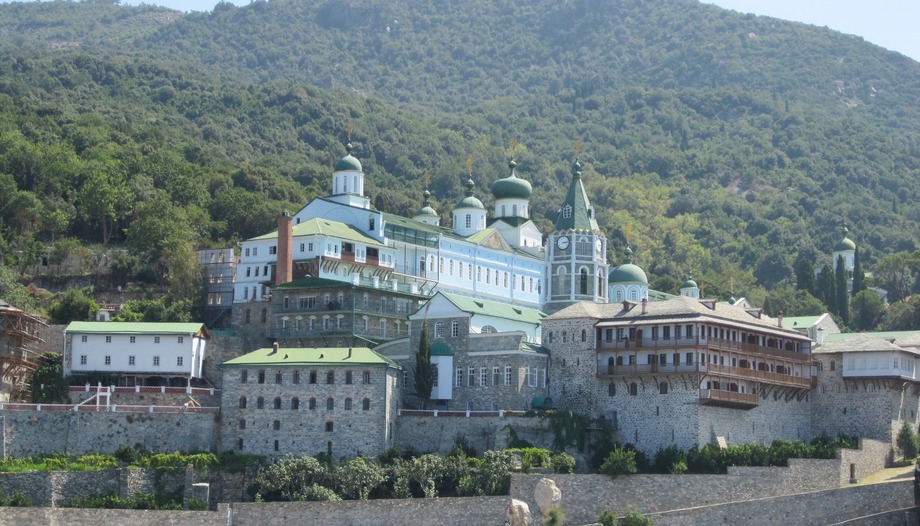
The ship departs from the small port of Ouranoupoli.
I am standing on the deck and contemplating the coast of Chalkidiki.
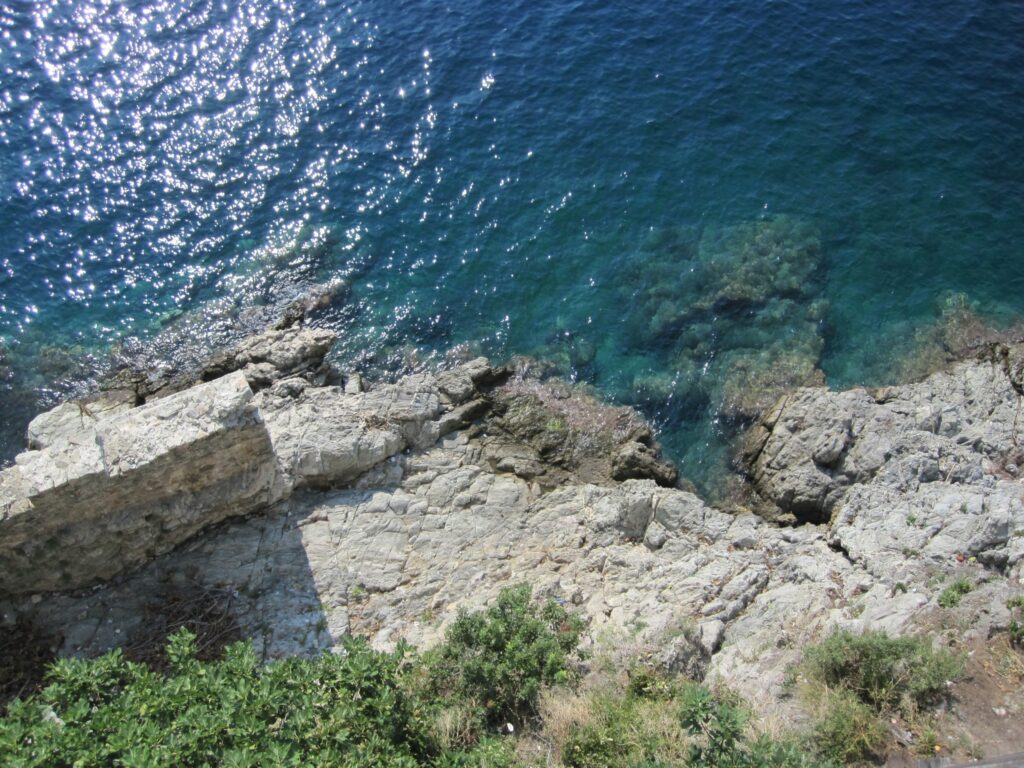
The water is blue and crystal clear. In front of us even appear some dolphins playing near the shore, next to the pier of the first monastery of Mount Athos; the peninsula rises like a promontory (one of the three into which the peninsula of Chalkidiki, in northeastern Greece, is divided).
On board I am one of the few non-Greeks and the only Italian.
The crossing is silent and spectacular. Once past a rocky cape, one has the impression of entering a fairytale world, formed by constructions - sometimes imposing, sometimes discreet - that seem to emerge from the rock between coves and inlets.
We stop at each small jetty to drop off or pick up visitors, supplies and even monks, passing by monasteries such as Dochiariou and Xenophontos, almost at sea level, and then monasteries situated in spectacular locations, such as Simonopetra and Grigoriou, literally clinging to the mountainside above the Aegean Sea.
What strikes me most, just before arriving in Daphnis, where I will also disembark, is the large Russian monastery of St. Panteleimon, a white complex with green domes, already visible from afar. A little further on, on the paper map (in 2011 we were still using them), I also see the only Serbian monastery marked.
After a whole week in the bustling chaos of Istanbul, an overnight train ride to Thessaloniki, a few hours on the bus and a night in Ouranoupoli, where I picked up the “diamonitirion”, the special entry and stay permit requested by fax from Rome, the three nights in the peace of Mount Athos seem like a gift to me.
I disembark in Daphni and take a short walk around the area, waiting to catch the minibus that will take the visitors to their respective destinations, the various monasteries.
What is the «monastic republic» of Mount Athos?
From a geographical point of view, Mount Athos is the easternmost point of the three «fingers» that enter the Aegean Sea from the peninsula of Chalkidiki: a peninsula at the end of which is the great mountain called precisely «Athos», «sacred mountain».
From the political point of view, it is an autonomous territory within the Greek State, with its own statute, internal administration and very strict rules of access: the number of visitors is limited, women are not allowed to disembark and each visit requires a nominative permit issued by the monastic administration. Entry is forbidden (“avaton”) even to female animals (except cats, useful to keep rodents away, and some birds, including chickens) since 1060, to protect the monastic enclosure: the only woman admitted is, symbolically, the Virgin Mary.
This special status is the fruit of a history that goes back more than a millennium. As early as the 10th century, the Byzantine Empire recognized Athos as having a special status: monks of different origins were entrusted with an autonomous territory in which to live and dedicate themselves to prayer, study and manual labor.
In the following centuries, under Ottoman rule and later in the modern Greek state, this status was challenged on several occasions and then confirmed, until it was also incorporated into the legal system of the European Union.
At the heart of this republic are the twenty large monasteries (“monastíria”), structured cenobitic communities with a main church (“katholikòn”), refectory, libraries, common areas and their own administration. Next to them there are “monì” and “kellia”: houses and hermitages dependent on a main monastery but scattered on the mountain slopes, where few or even a single monk lives.
From the liturgical point of view, Mount Athos continues to use the Julian calendar («old calendar»), different from the one used today in the Orthodox Church of Greece, with a difference of thirteen days in the feasts of fixed date. The monasteries of Mount Athos did not adhere to the 1923 calendar reform, which they considered an unnecessary innovation and too closely tied to state and «Western» requirements, preferring to maintain continuity with tradition while remaining in communion with the Patriarchate of Constantinople and the Church of Greece.
Megisti Lavra, the monastery of origins
My first destination is the monastery of Megisti Lavra, at the tip of the peninsula. In Daphni I board a van that meanders through narrow streets and rocky paths, being the only foreigner.
Upon arrival at the large monastery, after checking in and having my permit checked, I am told a few words, given some water and some “lokum” (Turkish delicacies); then I am assigned a folding bed in a large common dormitory, with beds lined up and little personal space. But there are only a few of us: me and two Greeks. Neither speaks English, but I try to make them understand that I didn't bring a towel for the shower. We understand each other when we discover that in Greek they use an Italian word, «pezzetta,» for towel.
Next, I begin to explore Megisti Lavra, the oldest and most prestigious Athonite monastery, founded at the end of the 10th century by St. Athanasius the Athonite.
In fact, it is a fortified citadel, with towers, inner courtyards, a large central church (“katholikòn”) and several buildings added over the centuries. In its libraries and archives are preserved manuscripts and illuminated codices. I cannot access these rooms, but the igumen of Megisti Lavra speaks French (he studied in Paris) and personally explains to me many details of the place. He then accompanies me to the “katholikòn” to show me some wonderful frescoes and icons. Shortly after, however, at the beginning of the common prayer, he makes me leave: as a Catholic, I am not allowed to participate in the Orthodox liturgy and must stay in the vestibule. There I meet a Frenchman who, only during the return trip, will reveal to me that he is a Catholic priest, a Catholic priest who, out of discretion and respect, has chosen not to wear a cassock or collar during his stay.
After prayer, it was time for lunch. In the refectory we sit at the table reserved for the guests and have a frugal meal: vegetables, bread, water and little else.
The time is marked by the sound of a wooden instrument, the “semantron”, which is struck rhythmically: when it stops resonating, the dishes are removed, even if you have not finished eating. I, in fact, had not finished. In any case, the day continues to be marked by a sequence of liturgical offices that will also occupy a good part of the evening and morning.
One rises long before dawn to attend the long liturgy, standing, while the first rays of sunlight pour through the doors, windows and slits, illuminating the icons. The scent of incense permeates the atmosphere and one feels suspended between heaven and earth, just like these monasteries.
Grigoriou, a balcony overlooking the Aegean
The next day I arrived at the monastery of Grigoriou, located overlooking the sea.
From the pier, you walk up a stone path along the cliff; behind you, the sea; in front, the walls of the monastery overlooking a narrow courtyard, surrounded by buildings huddled against each other.
Here too, after the welcome with water and Turkish delicacies at the beginning, I am assigned, like everyone else, a folding bed in a dormitory. However, unlike Megisti Lavra, here there are a lot of young pilgrims (they explain to me that this is a kind of retreat).
At the thought of another night in the common dormitory, a young monk clearly notices my bewilderment: he smiles at me and invites me to follow him. We walk a small path inside the walls and he accompanies me to the guesthouse, where he assigns me a small single room, with a balcony directly overlooking the sea. I must have seemed really desperate to him.
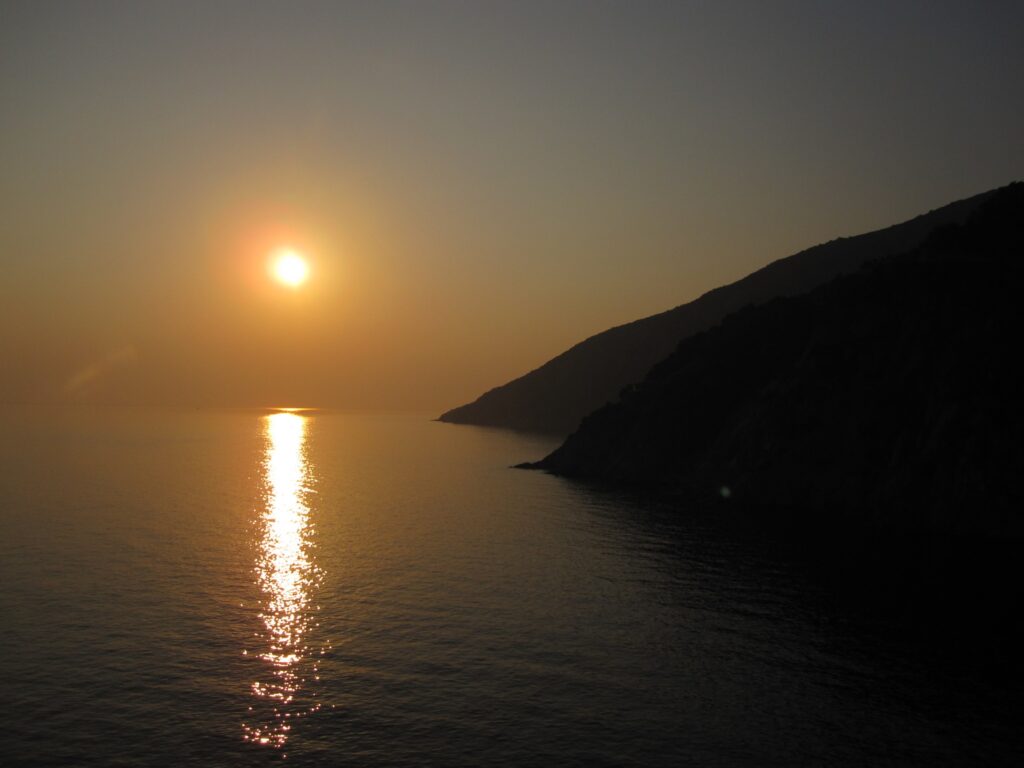
In any case, I take the opportunity to spend the whole afternoon almost without a word, sitting on that makeshift terrace, contemplating the coast and the blue of the Aegean. As the hours pass, the blue becomes softer, then orange, as the sun sets behind this rocky outcrop of the Chalkidiki peninsula.
For an outsider, the impact of life on Mount Athos is not easy. Accustomed to a lot of words, gestures, initiatives and projects, here one is almost overwhelmed by the exclusive use of necessary words, necessary gestures and necessary projects. Even my words of thanks to the monk who was so kind to me seemed one too many.
«Together for Athos».»
I was able to get to know and visit Mount Athos thanks to the «Insieme per l'Athos«For years it has been promoting the knowledge of the Sacred Mountain by organizing study meetings, pilgrimages, translations and moments of exchange.
Thanks to its founder and president, I managed to find my way through the formalities, permit applications and waiting times, obtaining authorization to stay at both Megisti Lavra and Grigoriou. The same founder then invited me to moderate the 2026 International Congress of Athos Studies, to be held in Rome, in the Basilica of the Holy Twelve Apostles.
Visiting Mount Athos has allowed me to get closer to the complexity of monastic community life: a life that, although apparently isolated from the world, remains fully human, with its differences between monks and monasteries, its tensions, its changes, its entrances and exits, its restorations and its internal discussions.
And yet, if this web of buildings and lives has been standing for more than a thousand years, there must be something that holds it together: spirituality, mysticism.
In conclusion, the words of Karl Rahner come to mind: «The Christian of the third millennium will either be a mystic or he will not be. And Athos, with its monastic republic, is a pearl of mysticism and peace in an increasingly troubled world.






 Español
  English
  Italiano
  Français
  Deutsch
  Polski
  简体中文
简体中文