


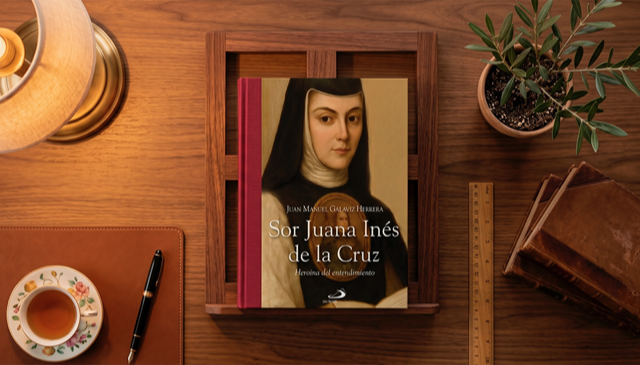
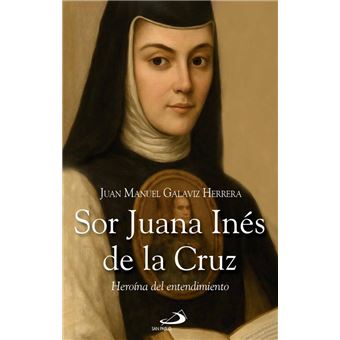
I was reading the magnificent biography of Sister Juan Inés de la Cruz, written by Juan Manuel Galaviz Herrera (1942–2019), undoubtedly one of the most important figures of the Viceroyalty of New Spain, when I suddenly came across a novel set in the present day at the University of Madrid with a very eye-catching title: The smartest girl I know.
In fact, the biography of Sor Juan Inés de la Cruz—a 2026 reprint—is titled “Heroine of Understanding,” that is, almost the same phrase as in Sara Barquinero’s novel, but in a 17th-century version. The coincidence of the titles caught my attention, and I decided to read both books side by side.
First of all, we should note that Sor Juana Inés de la Cruz’s mother had ten siblings and was the daughter of the famous Pedro Ramírez, a native of Sanlúcar de Barrameda (Cádiz), who had made his fortune in the Marquisate of El Valle and whose marriage to a Mexican Creole woman would bring him great happiness and many children (p. 11).
It is interesting to note, incidentally, that the New Laws of 1542 had already been implemented in those lands by that time and, therefore, much to the delight of Bartolomé de Las Casas, the indigenous people had fully regained their lands and possessions and were exercising their rights and fulfilling their obligations, just like the other subjects of the Crown of Castile, in peace and freedom (p. 12).
Our protagonist, Sor Juana Inés de la Cruz—born Juana Ramírez de Asbaje—was born in San Miguel de Nepantla, on the slopes of the Popocatepetl volcano, in 1648. She was born out of wedlock and was raised by her mother and her grandfather, Don Pedro Ramírez, and is believed to have taken her vows as a Hieronymite nun at the order’s convent in Mexico as early as 1668.
Parallelisms
The novel by The smartest girl I know It was written by Sara Marquinero and tells the story of a rather shy girl from the provinces—an only child and extremely intelligent—who enrolls in a philosophy program and begins to stand out among her classmates from day one. A life centered on her studies, friendships, her first boyfriend, and her romantic pursuit of a professor—in other words, the slow and unhurried process of maturing in our time, though without any transcendent view of life or spiritual reference.
Meanwhile, the life of Sor Juana Inés de la Cruz seems to have been a direct path toward growth in love. First, through her studies and early education in the capital, and then at the viceroy’s court, where she would further develop her literary skills—for which she had already shown clear talent since childhood.
His introduction to poetry through careful reading and the guidance of the capital’s learned men ran parallel to an intense spiritual life, which would ultimately lead to his religious profession, growth in holiness, and the development of an early passion for writing that, from the publication of the first volume of his works, had an enormous impact both in New Spain and in the Mother Country.
It is interesting that on that path toward her definitive conversion to the love of loves and her divine vocation in the cloister, it would come to her precisely through a romantic disappointment, just as she describes it in one of her most significant poems, which is undoubtedly autobiographical in nature: “Love seized me without warning, cunning and tyrannical: clad in the garb of a courtier, he entered my heart” (p. 51).
Indeed, the biographer astutely points out that “Juana Inés loved so intensely that she could not find a suitable partner” (p. 52). In addition to this account of the facts, we have Menéndez Pelayo’s assessment, in which he states: “Sor Juana’s secular verses are among the most gentle and delicate ever to flow from a woman’s pen” (p. 53).
The life of the smartest girl I know will be marked by the delusions of false and superficial loves that ultimately lead to “agape” love—the love of self-giving and total devotion that Benedict XVI so aptly describes in the encyclical “Deus Caritas est.”.
Indeed, the life of Sister Juan Inés demonstrates exactly the opposite, for what happens to her is precisely what María Zambrano had predicted in her poetic philosophy: that the paths of knowledge, understanding, and love run parallel both in the intellect and in the will (p. 69).
Undoubtedly, for Sor Juana Inés, literary and poetic creation did not distract her from her duties as a nun, and her contemplative vocation intertwined with her writing—and there lie the fruits: both in her impressive collections of poetry and in literary texts of the highest caliber that can be included in the tradition of the Golden Age of Spanish literature, since at that time the viceroyalty and the mother country drew from the same cultural sources.
It is very interesting how the biographer highlights Sor Juana Inés’s lifelong passion for reading and her interest in the study of theology; it stands to reason, after all, that to love God and souls, one must know God and human nature, which is why study and prayer made her a woman of great inner richness that she was later able to express through literature (p. 84).
It is very interesting—and even amusing—to see how many pages the biographer devotes to countering the gossip and rumors about the nun’s dedication to writing, reading, and understanding the broad outlines of theology and literature of the Golden Age, as well as their reception in the New World. He returns to the same point: “These setbacks, though true, were not Sor Juana’s cross to bear” (p. 133).
Finally, we must mention the injustices suffered by this righteous woman throughout her long religious life, particularly at the hands of certain spiritual directors who, not content with humiliating her in private so that she might grow in humility, did so in public as well (p. 145).
Sor Juana Inés de la Cruz. Heroine of the Mind






 Español
  English
  Italiano
  Français
  Deutsch
  Polski
  简体中文
简体中文