


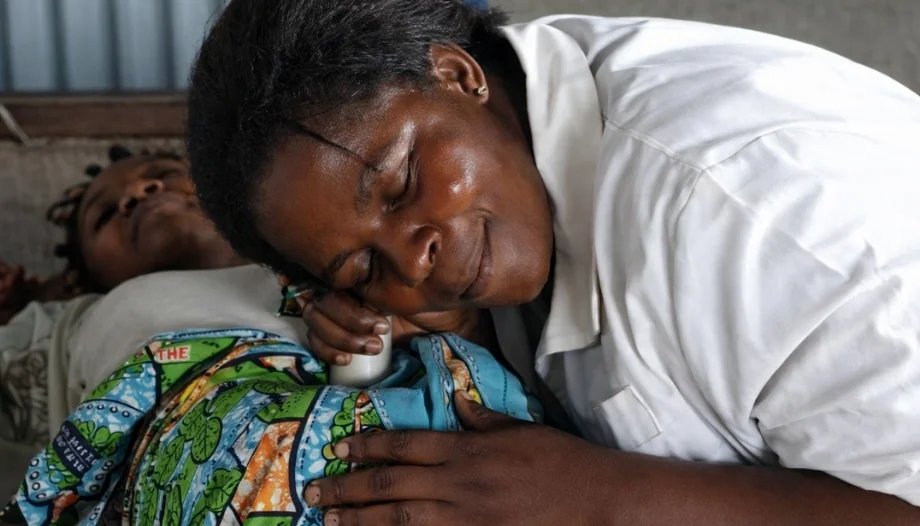
For many families in the rural areas of Isangi, in Tshopo Province (Democratic Republic of the Congo), the birth of a child remains a time marked by fear. The lack of healthcare infrastructure, long distances to health centers, and poverty force many women to give birth in their own homes or under extremely precarious conditions, without professional assistance and at risk of complications that endanger both their lives and those of their babies.
In this region, maternal and infant mortality rates remain high. Many of these deaths could be prevented with adequate care during pregnancy and childbirth. However, the progressive deterioration of the Malaika Health Center, managed by the Diocesan Office of Medical Works (BDOM) in Isangi, has significantly reduced its capacity to care for pregnant women. What had been a lifeline for the most vulnerable families for years eventually lost much of its capacity due to the deterioration of the facilities and a lack of equipment.
To address this situation, Harambee Spain and Harambee Switzerland, in collaboration with the Diocese of Isangi, have launched the «Born with Dignity» project, an initiative that will renovate and equip the delivery room at the Malaika Health Center. The project includes a complete renovation of the facilities, the purchase of obstetric equipment, training for healthcare staff, and an awareness campaign to encourage women to go to the center rather than give birth at home.
The goal is to improve childbirth care for some 2,000 women, reduce maternal and neonatal mortality, and restore the facility’s role as a safe place for the birth of a new life.
Sister Agathe Franka, director of the Diocesan Office for Medical Works (BDOM) in Isangi, explains the reality faced by women in this region and how they hope this project will transform the future of thousands of families.
What is life like for women in rural areas of Isangi when it's time to give birth?
–On the one hand, in rural areas, only a small number of women give birth at health posts, health centers, or hospitals. These are generally women whose husbands or relatives have some financial resources that allow them to cover the associated costs, and, in most cases, they are women who live in areas where it is still possible to find a health facility capable of providing childbirth-related services.
Furthermore, the vast majority of women in rural areas give birth outside of delivery rooms and outside of health centers. The reasons include, among others: difficulties in reaching the hospital quickly due to distance and road conditions, and economic hardship (women prefer to seek the help of a midwife who does not charge much for her services). Sometimes, a woman arrives with only a single garment to wear and has not prepared anything—neither clothes nor maternity supplies—for the newborn. Most women face significant risks: the delivery bed is uncomfortable, and childbirth takes place on the floor, on a mat, on a table, or on a mattress.
It should be noted that the Congolese government has made maternal care free of charge and has banned home births.
As can be seen, in rural areas, the consequences of inadequate maternal care include: hemorrhage, cervical lacerations, infections, postpartum complications, infant mortality…
What specific consequences are unassisted births having on maternal and neonatal mortality in the region?
–The consequences of unassisted childbirth are very serious for both mothers and newborns. High-risk pregnancies are often not detected in time, and the necessary precautions are not taken to prevent complications such as uterine rupture. Furthermore, in the event of hemorrhage, the appropriate medication to treat it is often unavailable. There is also a lack of knowledge and equipment to perform resuscitation procedures when a newborn has breathing difficulties, as well as insufficient understanding of the progression of labor and the use of basic tools such as the partogram. Added to this are inappropriate practices, such as rupturing the amniotic sac before the cervix has fully dilated—which can cause tears—delayed transfer to a hospital when complications arise, and a lack of hygiene and adequate medical supplies, all of which contribute to increased maternal and infant mortality.
What did the Malaika Health Center previously mean to the families of Isangi, and what do they hope its renovation will bring?
–Previously, the Malaïka center played a very important role for families in Isangi by providing care to vulnerable families, including pregnant women, malnourished children, people with leprosy, and women and men who had difficulty accessing other primary health care services.
With the renovation of the delivery room, many women will be delighted to give birth in good conditions. This joy is shared by their entire family. We believe that the infant mortality rate will decrease and that postpartum complications will disappear. Furthermore, this could lead to a significant reduction in home births and an increase in the number of women who come to the center to give birth. They will be delighted to give birth in good conditions.
How can we encourage women to trust the facility and choose to give birth with professional care rather than at home?
–This will be possible thanks to certain aspects and specific practices at the facility. In fact, the trust of women can be earned by providing a warm welcome to patients, adequately educating them during prenatal consultations (CPN), and showing them—or allowing them to see for themselves—how well-equipped the delivery room is and that hygiene and well-being are the center’s top priorities. Another important aspect is also offering an affordable fee (if necessary).
How can we ensure that the project remains sustainable over time?
–We ensure the project’s sustainability through the involvement of the local community. To this end, the Diocesan Office of Medical Works will strive to mobilize the community to take ownership of the project. Thus, the opening of a pharmacy, raising chickens and pigs, farming, and the income generated by this center will contribute to the project’s sustainability.
If you had to explain in one sentence why this project is necessary, what would you say to someone who is considering supporting it?
–«Thanks to this project, childbirth conditions will improve, which will reduce infant and maternal mortality rates as well as the number of home births; this is a great relief for the Isangi community and a source of hope.».






 Español
  English
  Italiano
  Français
  Deutsch
  Polski
  简体中文
简体中文