


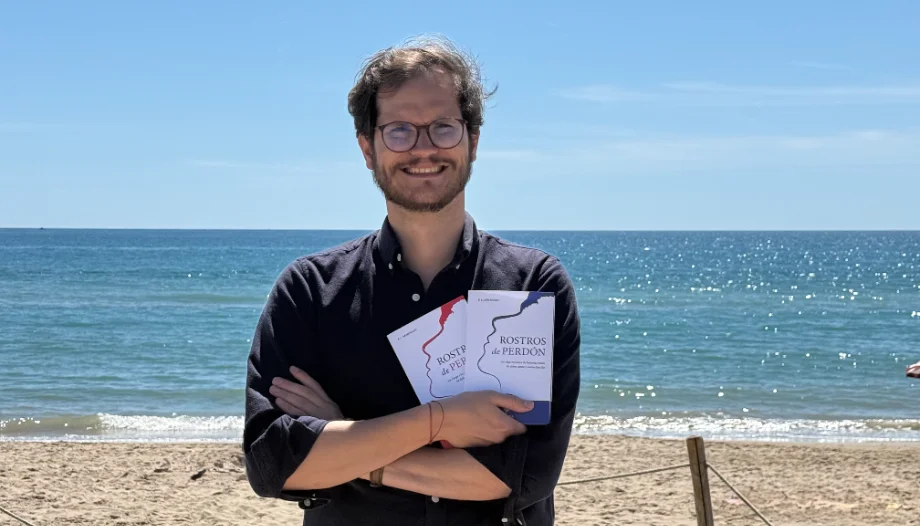
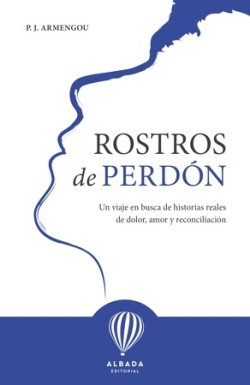
In a world marked by conflicts, polarization and open wounds, journalist PJ Armengou, editor in chief of the Diari de Tarragona and former freelance correspondent in Jerusalem for various media, proposes a different perspective: that of forgiveness. His book Faces of forgiveness brings together five real, hard and unusual stories, where victims and perpetrators meet in deeply human processes of reconciliation.
This book is not a theoretical treatise, but collects the stories of five people who forgave their victimizers or the aggressors of their loved ones. The book gathers testimonies of major contemporary conflicts, from South African apartheid to the war in Syria, including the Arab-Israeli conflict.
In your book you collect extraordinary stories of forgiveness. What have you learned that we can apply in everyday life?
ーThat forgiveness has degrees and is a process. It is not something immediate or natural; in fact, it is almost unnatural. It is something revolutionary.
A first step can be “selfish” forgiveness: to stop living anchored in resentment for one's own well-being. A second level involves empathy, understanding that the other is also limited. And the highest level would be to love the offender, something that of course cannot be done without having gone through the previous ones.
Many people do not fully reconcile, especially in the family environment. What do you think?
ーIt is painful, especially in the family, where love is expected. But even an incomplete forgiveness - a truce, to stop attacking each other - is already an important step.
In social or political contexts it can prevent violence. In the family, however, we are called to something deeper. The more intense the relationship, the more complete forgiveness is necessary.
In the book you talk about how we need “the revolution of forgiveness”.
Yes, there is an idea, influenced by Friedrich Nietzsche, that forgiveness is for people who follow “the morals of the weak. I believe just the opposite: forgiving requires more courage than hating. It is an act of freedom and inner strength.
We live surrounded by conflict, tension and pain. This book does not give recipes, but it shows concrete faces of people who have forgiven or asked for forgiveness in extreme situations. And that is key: we need references that show us that what seems impossible is possible.
At the end of the book you mention close cases, especially of women who have suffered abuse. Why?
ーBecause the distant stories I talk about in the book - Rwanda, Syria, Palestine - can make us think that the pain is far away. But it is enough to scratch a little to discover that it is very close: in our families, in our friends.
I wanted to make visible that forgiveness is not only for great tragedies, but also for everyday wounds, sometimes invisible. In my case, while I was writing, I kept thinking about specific people. Although I have not lived through an experience of abuse, I know many women very close to me who have gone through circumstances of abuse, both sexual and of conscience.
They have been my true inspiration: both in how they deal with day-to-day life and in the way they have allowed forgiveness to enter their lives.
Within the abuses of conscience, we must distinguish between true abuses of conscience and the lack of delicacy, but even both need a process of forgiveness. Even in small things, it is necessary to say: «Hey, I made a mistake here, this hurt you and I apologize.». Maybe I was not aware that I was hurting you, but recognizing it is the only way to heal it quickly and, above all, so that it does not happen again.
What experience do you draw from when you give sessions on forgiveness?
ーThat's something I'm starting to do now. And I like to propose an exercise to listeners: that they stop and think about what they should forgive parents for.
Many of us have small childhood wounds. Not necessarily big traumas, but experiences that marked us. Forgiving is not pointing fingers, but understanding that our parents were limited, that they did the best they could. Accepting this is a healing process.
Is there an ideal model of forgiveness?
ーThere is an ideal, yes: a forgiveness that loves, that understands, that expects nothing in return. But it cannot be imposed. Forgiveness is a process that can only be personal.
When one comes not only to forgive but to love the one who caused one's pain, one finds that it is profoundly liberating, but it takes time, process and often help.
You have lived through conflicts such as the Israeli-Palestinian conflict. What role would forgiveness play there?
ーIt would be transformative. But what we see is the opposite: dynamics of punishment, hardening, even a few days ago the death penalty was approved.
In this new context, one of the book's protagonists, a former Palestinian terrorist, would never have had the opportunity to redeem himself, nor to devote himself to his current work, which consists of working for the resolution of the conflict through forgiveness. Forgiveness opens paths that violence closes.
What would you like the reader to take away?
ーThat forgiveness is possible. That there is an alternative to hatred and violence. And that, although it may be difficult and time-consuming, it is worth walking that path.
Faces of forgiveness






 Español
  English
  Italiano
  Français
  Deutsch
  Polski
  简体中文
简体中文