



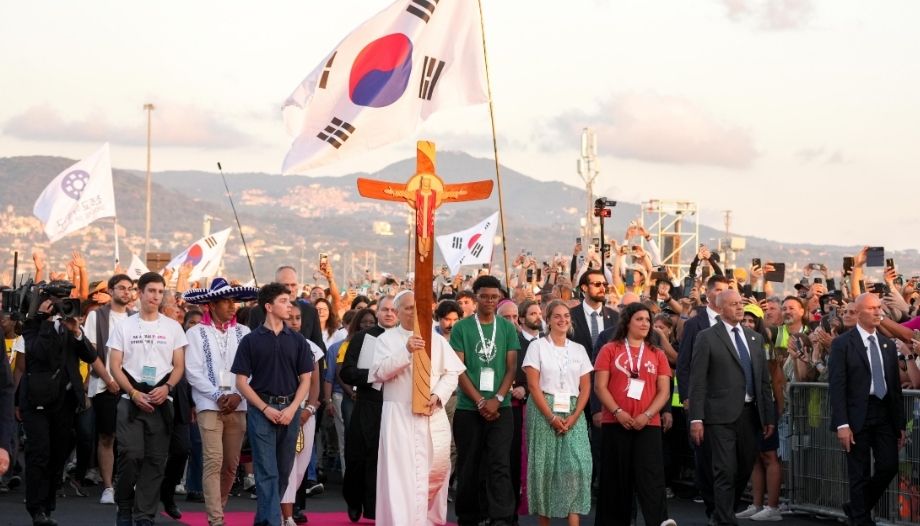
With the precedent of some great Pentecost Vigil celebrated in Rome with movements and ecclesial realities of the laity, promoted by St. John Paul II (1998) and Benedict XVI (2006), Pope Leo met this Thursday with two hundred leaders of movements and associations of the faithful. The meeting was promoted by the Dicastery for the Laity, the Family and Life.
Among the realities that have now come together - even then - are the Focolare Movement, the Neocatechumenal Way, Communion and Liberation, the Community of Sant'Egidio, the Charismatic Renewal, the Schoenstatt Movement, etcetera.
Among the messages delivered by Pope Leo XIV, which can be found in their entirety on his Speech, The following, necessarily synthesized and practically verbatim, are to be found. We begin at the end.
A priceless gift to the Church
1) Dearest friends, I thank you for all that you are and all that you do. Associations of the faithful and ecclesial movements are an invaluable gift to the Church. There is a great richness among you, many well-educated people and many good people. evangelists; many young people and various vocations to the priestly and married life.
2) The variety of charisms, gifts and methods of apostolate developed over the years allows them to be present in the fields of culture, art, social and work, bringing the light of the Gospel everywhere. Take care and, with God's grace, make all these gifts grow! The Church supports and accompanies you.
3) Governing: it is about set a safe course, so that the community is a place of growth for the people who are part of it. Thus, also in the Church there are those who are in charge of government. Here, government is generally entrusted to the laity. (...) It is placed at the service of the other faithful and of the associative life, and it is the fruit of free elections.
Governance, a gift of the Holy Spirit
4) Government is a particular gift of the Holy Spirit, that the members of a community recognize as present in some of their brethren in the faith, it follows that at least three consequences.
5) The first is that it must be for the good of all (...). The second is that can never be imposed from above, It must be a gift that is recognizable in the community and freely accepted. The third consequence is that, as with any charism, the governance of an association is also subject to the discernment of the Pastors., who watch over the authenticity and reasonable exercise of the charisms.
6) Dearest, those who lead your associations and movements take on a delicate taskon the one hand, they are called upon to safeguarding and enhancing the memory of a living heritage; on the other hand, they have a prophetic“ role”, which involves be attentive to current pastoral urgencies in order to understand how to respond to new challenges and to the cultural, social and spiritual sensitivities of our time.
7) Part of the prophetic task of those who govern consists, therefore, in to promote the openness of the association or movement, and of each of its members, to historical situations.
Communion
8) Another element of vital importance is communion. I would like to stress the importance of the dimension of communion with the whole Church. Sometimes we find groups that close in on themselves and think that their specific reality is the only one or is the Church, but the Church is all of us, it is much more!
9) Therefore, our movements must truly seek how to live in communion with the whole Church, at the diocesan level. And that is why the bishop is a very important reference figure. We should try to live in communion with the whole Church, both at the diocesan and universal levels.
10) From this perspective, we can to better understand the meaning of fidelity to the foundational charism, which constitutes an essential reference for the governance of an ecclesial reality. To govern in a manner faithful to the founding charism means, therefore, to find in it the inspiration to open up to the path that the Church is following today. (...), allowing themselves to be challenged by new realities and challenges, in dialogue with all the other components of the ecclesial body.






 Español
  English
  Italiano
  Français
  Deutsch
  Polski
  简体中文
简体中文