


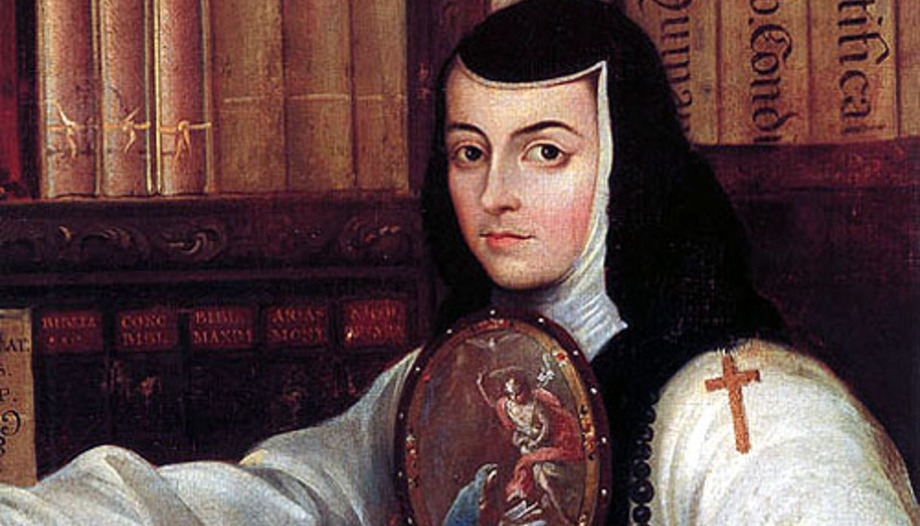
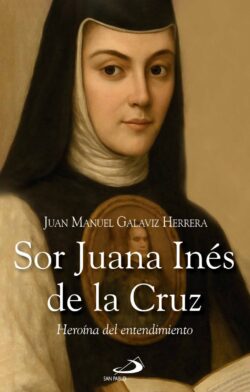
Certainly, the subtitle chosen by Juan Manuel Galaviz Herrera (1942-2019) to characterize the magnificent biographical sketch of Sister Juana Inés de la Cruz (1648-1695), a “heroine of understanding”, is still a striking figure today. It should be recognized that it aptly defines the style of this nun and the peculiar narrative approach of the work.
This way of naming Sor Juana Inés de la Cruz -religious, poetess and writer- intends to magnify her extraordinary literary qualities and to underline her outstanding position in the letters of the 17th century in America. It is also known that her works were published in the metropolis and appreciated at the Court.
First of all, it should be noted that the mother of Sister Juana Inés de la Cruz had ten siblings and was the daughter of the landowner Pedro Ramírez, a native of Sanlúcar de Barrameda (Cádiz), who would have made his fortune in the Marquisate of El Valle. Her marriage to a Mexican Creole provided her with a large number of descendants (11).
It is interesting, by the way, that already in those years the New Laws of 1542 had been applied in those lands and that, therefore, to Bartolomé de las Casas' satisfaction, the Indians would have recovered their lands and possessions, living their rights and obligations as the other subjects of the Crown of Castile, in peace and freedom (12).
Our protagonist, Sor Juana Inés de la Cruz -Juana Ramírez de Asbaje in the century-, was born in San Miguel de Nepantla, at the foot of the Popocatépetl volcano, in 1648. A natural child, she was raised with her mother and her grandfather, don Pedro Ramírez. Thanks to the early awakening of her intellectual abilities, her family decided to send her to Mexico City, where she lived with her uncles and aunts and could access a thorough education.
The portrait also focuses on the cultural and artistic life that surrounded the court of the viceroyalty of New Spain, which aspired to be a reflection of the Court of Madrid. In this environment, Juana stood out for her literary qualities, her beauty and her sympathy.
At the age of eighteen, Doña Juana's vocational awakening took place and she entered the Carmelite cloister. Months later, in 1668, she professed as a Hieronymite nun in the order's convent in Mexico.
The life of Sister Juana Inés de la Cruz is thus presented as a direct path towards growth in love: first in her spiritual life and then in her human and academic formation.
His approach to poetry, nourished by careful readings and the guidance of the educated men of the capital, ran parallel to an intense spiritual life. This evolution led both to a growing sanctity of life and to the development of an early literary vocation that, from the publication of his first volume, caused a notable impact in New Spain and in the metropolis.
It is significant that her vocation to the cloister could be linked to a love disillusionment, as she herself suggests in one of her poems of a markedly autobiographical tone: “Cogióme sin prevención Amor, astuto y tirano: / con capa de cortesano / se me entró en el corazón” (51).
In fact, the biographer acutely points out that “Juana Inés loved intensely to the point of not finding adequate correspondence” (52). To this is added the judgment of Menéndez Pelayo, who affirms: “the profane verses of Sister Juana are among the softest and most delicate that have come from the pen of a woman” (53).
Perhaps the term “heroine of understanding” could be qualified by that of “heroine of feelings,” since her trajectory seems to pass rapidly through the stages of the mystical life described by St. Bonaventure: interested love of God, disinterested love and love of union. An actualization of this itinerary can be found in the concept of “agape,” understood as love of total self-giving, developed by Benedict XVI in the encyclical Deus caritas est.
In fact, the life of Sor Juana Inés seems to confirm what María Zambrano expressed in her poetic philosophy: that knowledge and love run in parallel, both in the understanding and in the will (69).
For Sister Juana, literary creation was never a distraction from her religious vocation, but was fully integrated into her contemplative life. From this union were born works of great height -poems and prose texts- that can be inscribed with full right in the tradition of the Golden Age, given that the viceroyalty and the metropolis shared the same cultural sources.
Galaviz Herrera emphasizes the constant passion for reading that characterized Sister Juana, as well as her interest in theology. It is not strange: to love God and souls, it was necessary to know both God and human nature. Thus, study and prayer made her a woman of extraordinary inner richness, which she knew how to express in her literary work (84).
The biographer also devotes numerous pages to refute the rumors and criticisms about the dedication of the nun to writing and study. He insists that, although there were difficulties, “these setbacks, although true, were not the cross of Sister Juana” (133).
Finally, it is necessary to allude to the “injustices of the just” that she suffered throughout her religious life, especially on the part of some spiritual directors who, not content with correcting her in private, also humiliated her in public (145).
Sister Juana Inés de la Cruz: Heroine of Understanding






 Español
  English
  Italiano
  Français
  Deutsch
  Polski