


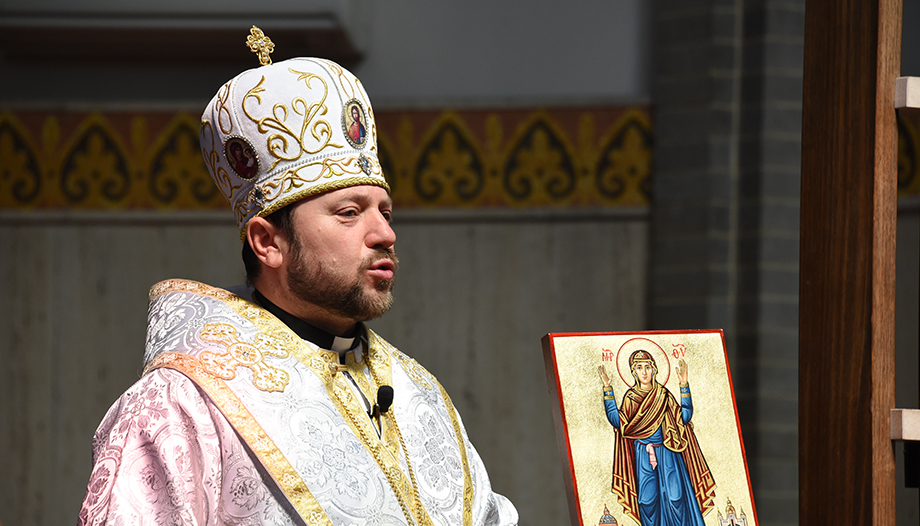
In the College of Cardinals, seniority is usually the norm, but Ukrainian Redemptorist Mykola Bychok broke all the rules when he was created a cardinal by Pope Francis. Now 46 years old, he remains the youngest cardinal in the world and continues to shepherd Byzantine Rite Catholics in the heart of Australia from Melbourne.
To understand its mission, it is necessary to look at the Ukrainian Greek Catholic Church, the largest of the 23 Eastern Churches in communion with the Holy See. This institution, juridically defined as a Church, is a sui iuris, has an autonomous hierarchy headed by Major Archbishop Sviatoslav Shevchuk.
In a world marked by haste and noise, what can the Latin Church learn from the spirituality of silence, repetition and theological depth characteristic of Eastern rites?
-As you know, last year the entire Catholic Church celebrated the Jubilee Year of Hope. As part of these celebrations, in May 2025, the Jubilee of the Eastern Catholic Churches took place in Rome. In his address to the participants of this Jubilee, Pope Leo XIV echoed the words of his predecessor, Pope Francis, who emphasized that the Eastern Catholic Churches preserve unique traditions of spirituality and wisdom and can teach us much about Christian life, synodality, and the liturgy. At the same time, His Holiness also recalled Pope Leo XIII, who was the first to dedicate a separate document to the dignity of the Eastern Churches within the Catholic Church.
The Pope highlighted the invaluable contribution of Eastern spirituality to the universal Church. He said in particular: “We have great need to recover the sense of mystery that remains alive in your liturgies, liturgies that engage the human person in his or her entirety, that sing of the beauty of salvation and evoke a sense of wonder at how God’s majesty embraces our human frailty! It is likewise important to rediscover, especially in the Christian West, a sense of the primacy of God, the importance of mystagogy and the values so typical of Eastern spirituality!”. He called for the preservation of these traditions.
I believe that the Latin Church and the Eastern Churches mutually enrich one another precisely through these complementary emphases. Both East and West share the same mission — to lead people to Christ. And in a restless world, every authentic path that helps the human heart rediscover God is a gift to the whole Church.
From your pastoral experience, how do Eastern Catholic faithful live in communion with Rome while maintaining their liturgical and cultural identity?
-For the faithful of our Church, being in communion with Rome is completely natural. In fact, only a few decades ago, many of our faithful faced persecution and were sent to forced labour in Siberia precisely because of their commitment to this communion. In many of the court cases at that time, one of the accusations was that they “listened to Vatican radio.” Our Church endured great suffering for the sake of this unity, and continues to value and uphold it to this day.
Recently, the Head of the Ukrainian Greek Catholic Church, His Beatitude Sviatoslav Shevchuk, together with the bishops of the Permanent Synod, visited Brazil. The Permanent Synod meets four times a year, and these meetings are held each time in different parts of the world, wherever our faithful reside. For example, in December, the Patriarch and the Synod were in Australia.
In Brazil, our Church has a metropolitan structure, which includes two eparchies. Ukrainians first arrived there over 140 years ago, and to this day their descendants—more than 150,000 faithful—although some no longer speak Ukrainian and speak only Portuguese, still feel a strong sense of belonging to the Ukrainian people and to the Ukrainian Church. They make significant efforts to cultivate Ukrainian traditions, learn the Ukrainian language, and preserve Ukrainian culture. It is precisely because of their dedication and faithfulness that our Church continues to thrive in Brazil.
Many Eastern Churches have suffered persecution, war or diaspora. How has this experience of suffering marked their theology, liturgy and Christian witness?
–Yes, you are right. Many Eastern Churches throughout their history have endured wars and persecution. Our Church in Ukraine has experienced the same, living under the conditions of war for over twelve years since 2014, and, since 2022, in the midst of a full-scale war. Our churches in the eastern part of Ukraine have been destroyed, and two of my fellow Redemptorist priests were held in Russian captivity for over a year. Every day, our people face extraordinary trials. This past winter was especially harsh, as the enemy deliberately targeted the energy infrastructure, attempting, quite literally, to leave our people in the cold.
Yet, Ukraine stands, Ukraine fights, and Ukraine prays. Our clergy remain with our faithful in these difficult circumstances. Chaplains support our soldiers on the front lines, while priests in the rear provide spiritual care during rehabilitation and humanitarian assistance to those in need. We are constantly seeking ways to heal the wounds of war—not only the physical, but also the spiritual and psychological.
I believe that despite all the difficulties and oppression, our Churches stand as a shining example of living faith in Almighty God, showing that it is possible to preserve faith and traditions even in extremely challenging circumstances. As Scripture says: “With men it is impossible, but not with God; for all things are possible with God”.
What other historical examples could be cited?
-For instance, in the Ukrainian Greek Catholic Church, after the pseudo-sobor of Lviv in 1946, 80 years ago, when our bishops, priests, and faithful were arrested and deported to Siberia, and when the Church in Ukraine was strictly banned and effectively forced to operate underground, our clergy and faithful who found themselves in various parts of the world after World War II did everything possible to preserve and develop the Church in their new places of residence.
In Australia, for example, the first Ukrainians began immigrating in 1948 and immediately worked to sustain their spiritual life. Officially, August 13, 1949, is considered the date when the Holy Liturgy was first celebrated in Australia by Fr. Pavlo Smal in a chapel near St. Patrick's Cathedral in Melbourne. In 1950, Fr. Ivan Prasko volunteered to come to Australia. As a priest, he served Ukrainian faithful in Melbourne, Victoria, and Tasmania for eight years, during which he founded numerous church communities, contributed to the construction of churches, organised Ukrainian Saturday schools, and established several church and community associations. On October 19, 1958, Fr. Ivan Prasko was ordained bishop by Metropolitan Maksym Hermaniuk, Archbishop Ivan Buchko, and Bishop Isidore Boretsky. He then immediately became the head of the Apostolic Exarchate for Ukrainians in Australia, New Zealand, and Oceania, established on May 10, 1958, by Pope Pius XII.
The same dedication was seen in other countries where our faithful settled. Consequently, after the Church emerged from the underground in Ukraine, the structures and experience of the diaspora greatly contributed to the restoration of the Church in Ukraine. Therefore, I believe that, with God’s help, the Eastern Catholic Churches will endure these upheavals, and through them, the faith of our people is strengthened.
How would you encourage Latin Rite Catholics to learn about Eastern rites?
-I can share what it looks like in Australia, for example. Australia as a country is made up of many immigrants who form the backbone of the Catholic Church in the country. There are five Eastern Churches in Australia: the Ukrainian, Syro-Malabar, Melchite, Maronite, and Chaldean Churches, which bring their deep culture and strong faith in Christ. We are all members of the Australian Catholic Bishops' Conference, which gathers all the Catholic bishops of Australia twice a year.
Our Church and especially our liturgy are very exciting for young Australians. To give one example, in Sydney a choir of English-speaking Australian Catholics has been formed in our church to sing Vespers on Saturday and Divine Liturgy on Sunday, which is a living example of our mutual enrichment. With fervent faith and divine worship, as a Ukrainian Catholic Church here in Australia, we can truly challenge secularization and be a clear sign of the Lord's presence.
There are now also many Ukrainians in Spain, Eastern Catholic faithful, who have come here in large numbers, especially seeking refuge after the full-scale war of Russia against Ukraine began. Our Church always strives to be present wherever its faithful are, in order to provide them with proper spiritual support. This gives you a wonderful opportunity to experience our spirituality. You are welcome to attend the Divine Liturgy or any other church service. I believe that for all of us, having the chance to learn about each other’s traditions and to pray together is a great gift.
In ecumenical dialogue, especially with the Orthodox Churches, what role do Eastern Catholic rites play as a bridge for encounter and mutual understanding?
-The Eastern Catholic Churches often find themselves in a unique and sometimes delicate position. We share the same liturgical, theological and spiritual heritage with the Orthodox Churches, and at the same time we are in full communion with the Bishop of Rome. Because of this, we understand both the sensitivities and the hopes that exist within ecumenical dialogue.
Our role is not to create tension, but to witness that communion with Rome does not require abandoning one’s Eastern identity, spirituality or tradition. Our existence itself testifies that unity and fidelity to one’s own heritage are not contradictory realities.
Ecumenical dialogue is not only about theological commissions and official documents. It is also about encounter, prayer and personal relationships. Where we share the same liturgical language, similar spirituality and often a common history of suffering, there is already a foundation for deeper understanding.
I believe that Eastern Catholic Churches can serve as a bridge by promoting respect, patience and humility. We carry historical wounds, but we also carry hope. By remaining faithful to our tradition while living in communion with Rome, we can help demonstrate that the unity for which Christ prayed is not uniformity, but communion in truth and love.
There are currently six cardinal electors of Eastern rites. What is your perception as the youngest cardinal in the world, and what surprised you about the conclave?
-Currently, there are 245 cardinals in the world, of whom 122 are electors and 123 are non-electors. Among them, there are seven Eastern Catholic cardinals, of whom five are electors and two are non-electors. This means that, in terms of the overall number, Eastern Catholic cardinals represent only a small group within the College of Cardinals.
Indeed, being the youngest among the cardinals was an experience I could hardly have imagined 2 years ago. This experience is important not only for me personally but, I believe, for the entire Church.
At the conclave, I truly felt a strong sense of brotherhood. Being part of this process carries great responsibility—not only in choosing the next Pope but also in helping to shape the future of the Catholic Church, which today numbers 1.4 billion faithful. This decision affects not only bishops and priests but the entire People of God.
During the conclave, there were many emotions, and I experienced what people call “goosebumps” on two occasions. The first moment was in the Chapel of St. Paul, from where we processed to the Sistine Chapel. When the choir began to sing and the procession started, I felt those goosebumps. And I thought to myself, what is about to happen in just a few minutes? We are about to enter the Sistine Chapel, stand beneath the scene of the Last Judgement painted by the famous Michelangelo, the doors will be closed, and we will elect the successor of the Apostle Peter. That was the first deeply emotional moment for me. The second time was after the election had already taken place. We were waiting before going out onto the balcony, and then came the moment of the announcement of the new Holy Father and the name he had chosen—Leo XIV. It was something truly incredible. When you stand on the balcony and look out, you see hundreds of thousands of people who gathered to hear this joyful news, with cameras and journalists in the square, on rooftops, and in every available space. The view from the balcony of St. Peter’s Basilica was simply breathtaking.
What does the tradition of Eastern Catholic rites contribute to the spiritual life of the universal Church that may not always be understood in the West?
-I think the best answer to this question is the Pope’s words at the meeting with representatives of the Reunion of Aid Agencies for the Oriental Churches (ROACO), which took place on June 26, 2025, at the Vatican. The Pope emphasised that today Eastern Catholics are no longer “distant relatives”, but due to forced migration, they live in close proximity to Western Catholics. He called on the representatives of the Council to discover the beauty of God's people in the Eastern tradition, who show resilience amid the many sufferings caused by war, as well as to look at those who“join the great ranks of martyrs and saints of the Christian East,” thus becoming witnesses to “the light of the East in the night of conflict.”
The Pope noted that there is still a great deal of ignorance and lack of knowledge about the Eastern Catholic Churches and that the wish of St. John Paul II—who said that the Church must learn to breathe again with two lungs, Eastern and Western—has not yet been fulfilled. He also talked about specific steps to remedy this situation, such as starting to organise basic courses on the Eastern Churches in seminaries, theological faculties, and Catholic university centres, and organising joint meetings and pastoral events. For me, these words are a sign that the Church, like no other, strives to deepen this unity and that, on the initiative of Pope Leo XIV, this will indeed be achieved.





 Español
  English
  Italiano
  Français
  Deutsch
  Polski