


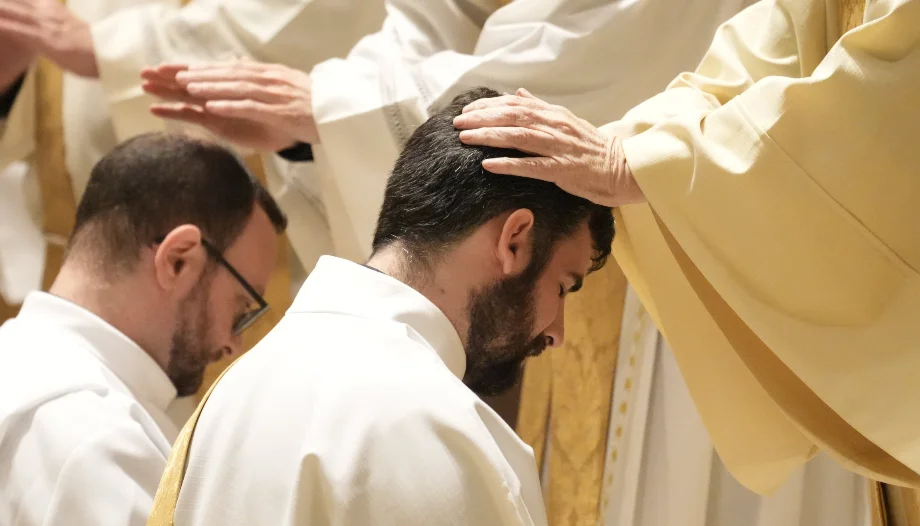
This spring, the United States will see the ordination of more than 400 men to the priesthood, both diocesan and religious. What is the latest generation of priests in the United States like and what factors have influenced their vocation?
To find out, OSV News examined data from the 2026 Ordination Promotion Study, conducted by Georgetown University's Center for Applied Research in the Apostolate. The annual report, which CARA has overseen since 2006, is commissioned by the Committee on Clergy, Consecrated Life and Vocations of the U.S. Conference of Catholic Bishops.
Of the 428 citizens who were asked to participate in the survey conducted between February 12 and March 20, 334 (78%) responded to CARA.
As in previous years, the latest findings - announced by the United States Conference of Catholic Bishops (USCCB) in an April 21 press release - come ahead of the World Day of Prayer for Vocations, which is celebrated on the Fourth Sunday of Easter (April 26), also known as Good Shepherd Sunday in the Latin Church. The Gospel passage (Jn 10:1-10) used for the Mass highlights the role of Jesus as the Good Shepherd.
These are the 10 main conclusions of the CARA report:
Sixteen is the average age at which one begins to consider a priestly vocation.
Approximately half of the respondents said they were between the ages of 3 and 16 when they first considered the priesthood, while the other half were between the ages of 16 and 51, with an average age of 16.
But that age was slightly higher for those about to be ordained priests in religious orders, who were generally 18 years old when they first considered a vocation. Half of that group was between the ages of 3 and 19, and the other half between 19 and 39.
More than one-third (39%) of the candidates for the priesthood first considered ordination to the priesthood when they were still in elementary school, between the ages of 6 and 13.
2. The younger priests will, for the most part, be in their early 30s at the time of their ordination.
The current class of candidates for the priesthood will be, on average, 33 years old at the time of their ordination, half of them between 26 and 31 years old, and the other half between 31 and 75 years old.
Nearly half (49%) of this year's ordinands are 30 years old or younger, and 38% are between 31 and 40 years old. The latter age group accounts for 59% of religious institute ordinands, in contrast to 33% of their diocesan counterparts, a difference CARA called «statistically significant.».
The majority of respondents (62%) identified themselves as White, 17% as Hispanic or Latino, 11% as Asian or Pacific Islander, 5% as Black or African American, and 2% indicated another ethnicity.
More than 25% of this year's graduates were born outside the United States.
More than a quarter of this year's ordination promotion was born outside the United States. Of the survey participants, 26% claimed to be born outside the United States, with the most common countries being Vietnam (5%), Mexico (3%) and Colombia (2%). CARA noted that the class of 2026 came from 30 different countries.
4. Eucharistic adoration, rosary and prayer/bible study groups top the list of pre-seminary prayer practices.
The majority of respondents - 81% in total - claimed to spend time in prayer before the Blessed Sacrament. Diocesan seminarians were somewhat more likely to mention Eucharistic adoration (83%) than their religious order counterparts (75%), but this practice was in the majority in both groups.
Close behind adoration was the rosary, with 79% overall, and 81% of diocesan respondents and 70% of those in religious orders mentioning this devotion.
Just over half (52%) of respondents mentioned prayer groups and Bible studies, with members of religious orders (59%) more likely than diocesan ordained (50%) to mention such practices.
In general, lectio divina (48%), high school retreats (44%) and university retreats (29%) were also formative.
5. Most of this year's students had been altar servers before entering the seminary.
The majority of respondents (79%) claimed to have been altar servers before entering the seminary, with 81% of diocesan participants and 72% of members of religious orders mentioning that ministry.
Members of the ordination class also served as lectors (49%), extraordinary ministers of Holy Communion (35%), campus or youth ministers (34%) and catechists (32%).
6. At least one person encouraged them to consider ordination to the priesthood, and it was usually a parish priest.
Nearly all (92%) of those ordained this year claimed to have received encouragement from at least one person to consider becoming a priest. Overall, 70% of respondents indicated that person was a pastor, followed by a friend (49%), mother (46%), parishioner (44%) and father (37%).
Less than half (41%) were dissuaded from entering seminary by another family member (22%), friends or classmates (17%), or a mother or father (12% each).
7. Most of the new priests come from Catholic homes with both parents present and several siblings, and were baptized Catholic in infancy.
Overall, 93% of respondents claimed to have been baptized Catholic in infancy, accounting for 94% of diocesan ordinands and 89% of those ordained in religious orders. The latter group had a higher rate (11%) of persons who converted to Catholicism later in life.
The majority (86%) of the class of 2026 stated that both parents were Catholic: 88% in the diocesan group and 81% in the group of candidates for religious ordination. CARA predicted that, if current trends continue, this number is expected to reach 88% in 2031.
Nearly all members of the class of 2026 (97%) claimed to have been raised by at least one biological parent, and 88% claimed to have been raised by a married couple living together. Another 5% lived with a separated or divorced parent, and 2% with a widowed parent during the most formative stage of their childhood.
Another 2% were raised by an unmarried couple living together; those raised by an unmarried or married couple living separately, an unmarried single parent, or another person totaled approximately 1% each.
Younger priests tended to have three siblings, and most (37%) were somewhere in between in terms of birth order, while only 5% claimed to be an only child.
8. Not all students in the class attended a Catholic school, but more than 60% participated in a parish religious education program.
Overall, 45% of the ordination candidates attended a Catholic elementary school, while a smaller percentage attended a Catholic high school (38%) or college (34%). Another 11% reported being homeschooled.
The majority of respondents (63%) claimed to have participated in a parish religious education program. Diocesan seminarians (66%) were more likely to have done so than their religious order counterparts (51%).
9. More than half earned a college degree and worked full time before entering seminary.
Three out of five respondents, or 61%, claimed to have earned an undergraduate or graduate college degree prior to entering seminary. Philosophy, theology, engineering, business administration, science and mathematics were the most common areas of study.
CARA found that 64% of seminarians had at least some full-time work experience prior to entering seminary. The most frequently mentioned fields were pastoral ministry (18%), education (17%), business (15%), and sales and customer service (12%). One-third (33%) of the religious order group members who had worked full-time cited education as their field of employment.
10. While student debt was significant for some, it was not a problem for most when they entered the seminary.
The majority of respondents (79%) claimed to have no educational debt upon entering the seminary. Those who did, accumulated an average debt of just over $33,000, with half having between $2,000 and $25,000, and the other half between $25,000 and $150,000.
At the time of ordination, those with educational debt had average balances slightly above $22,000, with one half reporting between $800 and $11,500 and the other half between $11,500 and $150,000. Family members (65%) provided the primary assistance in paying off educational debt, followed by religious communities (29%), the Labouré Society (19%), the Knights of Columbus (16%), parishes (10%), and friends or co-workers (10%).





 Español
  English
  Italiano
  Français
  Deutsch
  Polski