


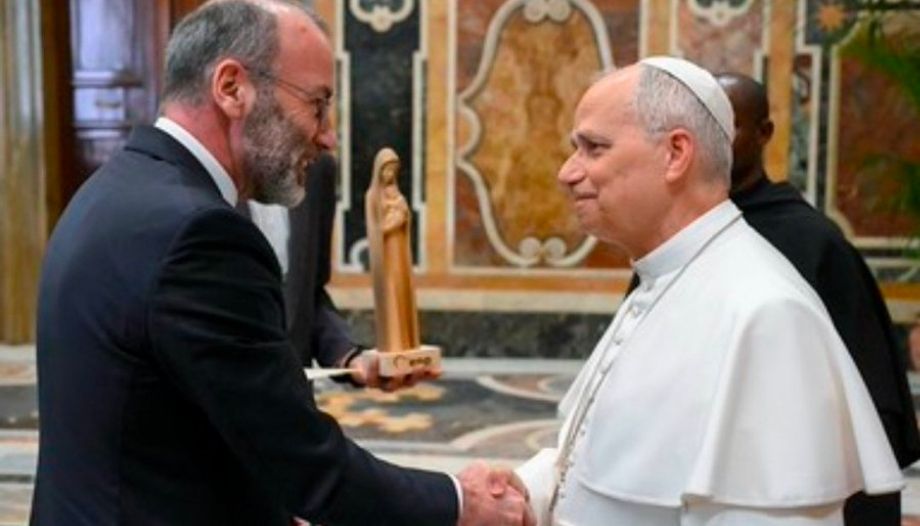
In a speech in which the Pope recalled the founding fathers of the European Union, such as Adenauer, De Gasperi, and Schuman, The Holy Father encouraged EPP leaders and parliamentarians to “discover the Christian heritage without falling into confessionalism.
That is, “maintaining the distinction between the prophetic mission proper to the Church and concrete political action,” the Pontiff added. “Being a Christian in politics,» he explained, «does not mean imposing a religion, but allowing the Gospel to illuminate difficult decisions, even when they do not generate immediate applause. In this context, he defended ”the link between natural law and positive law, and between Christian roots and public action".
The Pope greeted in a special way the president of the EPP, the German Manfred Weber, and the Irish Mairead McGuinness, special envoy of the European Union for the promotion of religious freedom outside the EU.
In the wake of the last Popes
The meeting takes place “in the wake of those that took place with my predecessors, St. John Paul II and Pope Benedict XVI, as well as the message that Pope Francis sent to them in June 2023, when he was unable to receive them personally due to his hospitalization. I am therefore pleased to continue this dialogue with the European People's Party, which draws its political inspiration from figures such as Adenauer, De Gasperi and Schuman, widely considered the founding fathers of modern Europe,” the Pope said.
“Like Benedict XVI twenty years ago, I too appreciate your Group's recognition of Europe's Christian heritage.”.
The European project, which arose from the ashes of World War II, “was undoubtedly born of the practical need to prevent such a conflict from happening again,” Leo XIV added. “However, it is equally imbued with an ideal vision, namely, the desire to foster a cooperation that overcomes centuries of division and enables the peoples of the continent to rediscover the human, cultural and religious heritage they share,” the Holy Father continued.
Christian principles, a common and unifying element
The founding fathers were inspired by their personal faith and saw Christian principles as a common, unifying element that could help end the spirit of revenge and conflict that had led to World War II. The Pope Francis’ coined a beautiful and simple expression that sums up this idea: “unity is superior to conflict”.
Human person at the center, and not leaving the people aside.
De Gasperi pointed out that pursuing an ideal means placing the human person at the center, the Pope recalled, “with his spirit of evangelical brotherhood, with his reverence for the law inherited from antiquity, with his appreciation for beauty refined over the centuries and with his commitment to truth and justice, sharpened by millennia of experience.”.
This is the framework within which politics can still be practiced today and to which political activity needs to be redirected. “Your party is called the European People's Party. The people is at the heart of their commitment, and they cannot leave it aside. They are not mere passive recipients of political proposals and decisions; they are, above all, called to be active participants who share responsibility for every political action,” Leon XIV said clearly yesterday.
The best antidote to populism
According to Pope Leo, “being present among the people and involving them in the political process is the best antidote to populism, which seeks only easy approval, and to elitism, which tends to act without consensus. Both are widespread trends in today's political landscape. An authentically “popular” politics requires time, shared projects and love for the truth”.
It is necessary to recreate a genuine sense of ‘people’, involving “personal contact between citizens and their representatives, in order to respond effectively to the concrete problems of the people in the light of an ideal vision,” the Pope added.
We could say metaphorically that in the era of the ‘digital triumph’, “political action truly oriented to the common good requires a return to the ‘analog’”.
In addition, to overcome a certain disaffection with politics, it is necessary to “recover people by bringing them closer personally and rebuilding a network of relationships in the areas where they live, so that everyone can feel that they belong to a community and share its future”.
6 challenges: what it means to be committed Christians
Finally, the Pope specified some points of what it means “to be Christians engaged in politics: a realistic perspective that begins with the concrete concerns of people”. The phrases are verbatim, although synthesized. You can consult them here.
1 - Encourage decent working conditions that encourage people's ingenuity and creativity in the face of an increasingly dehumanizing and unsatisfactory market.
2 - Allow people to overcoming the fear of starting a family, of having children, a fear that seems to be especially prevalent in Europe..
3 - Addressing the root causes of migration, caring for those who suffer, taking into account the real capacities to welcome and integrate migrants into society.
4 - Addressing the major challenges of our time in a non-ideological manner, such as creation care and artificial intelligence. The latter offers great opportunities, but is also fraught with dangers.
5 - Investing in freedom -not a trivialized freedom reduced to mere personal preferences- but one based on truth, which safeguards religious freedom as well as freedom of thought and conscience in all places and circumstances.
6 - Avoiding the promotion of a “short-circuit” of human rights, because it ends up yielding to force and oppression.
The Pope concluded “with the hope that they may constitute a starting point for your commitment”.





 Español
  English
  Italiano