



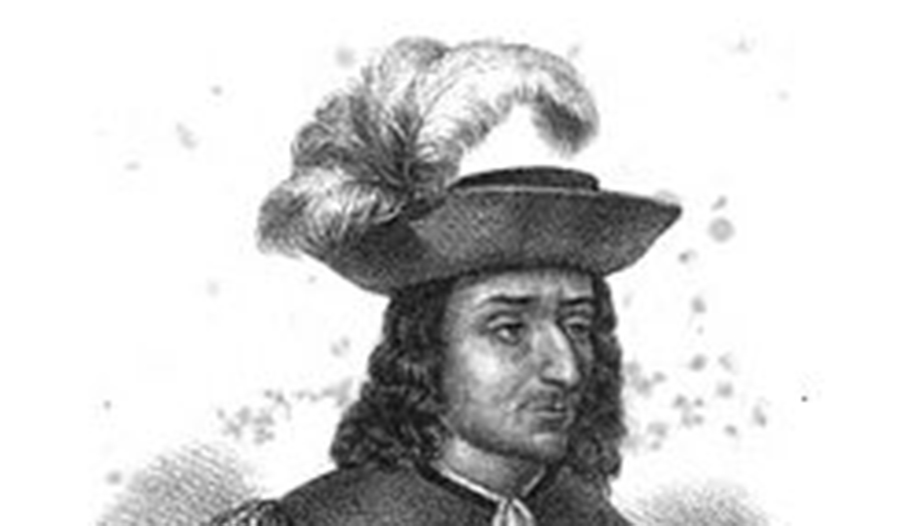
Vicente Mut (October 25, 1614 - April 27, 1687), born and died in Palma de Mallorca, was the son of a captain of the cavalry corps in the service of King Philip III. He studied with the Jesuits and entered the Society of Jesus, but did not continue in it. Afterwards he continued studying and attained a doctorate in law. In the military field, he achieved the rank of sergeant major in Palma, where he was an administrator and military engineer. He also worked as a lawyer, juror and general chronicler of the Kingdom of Mallorca.
Mut published several works on politics, history, hagiography, military tactics and cartography. Among them we can highlight History of the Kingdom of Mallorca y The prince of war and peace, in which he defends, in accordance with the Catholic Counter-Reformation, that the prince should subordinate politics to moral values and the State to religion. Another proof of his Catholicism is found in his Treatise on Military Architecture, an engineering work where he declares about a fortification: “it will be stronger, which in Peace would have the Laws as a wall and in War the defense of Reason, Justice and the Catholic Faith”.
But it is in astronomy where he shone the most, publishing three astronomical works: De Sole Alfonsino restituto (1649), where he defended the validity of the Alphonsian Tables and studied solar eccentricity by measuring the apparent diameter of the Sun; Observationes motuum caelestium (1666), with more than twenty years of observations of eclipses, planetary movements and parallaxes, applying instruments such as telescopes and micrometers; and Cometarum anni MDCLXV (1666), in which he studied the comets of 1664 and 1665. To explain the trajectory of the comet of 1664, Mut applied analogies with Galilean ballistics, suggesting a parabolic trajectory similar to that of a projectile.
He also corresponded with numerous astronomers, among them the Jesuits Athanasius Kircher and Giovanni Battista Riccioli, who included some of his observations in their work. Almagestum Novum.
Although he respected Kepler's ellipses, Mut did not fully understand their physics and preferred circular geometric models for the planets. Nevertheless, his rigorous methods of observation contributed to the improvement of measurements, especially the determination of the solar diameter and the analysis of parallax.
Public University of Navarra.
Society of Catholic Scientists of Spain






 Español
  English
  Italiano
  Français
  Deutsch
  Polski