


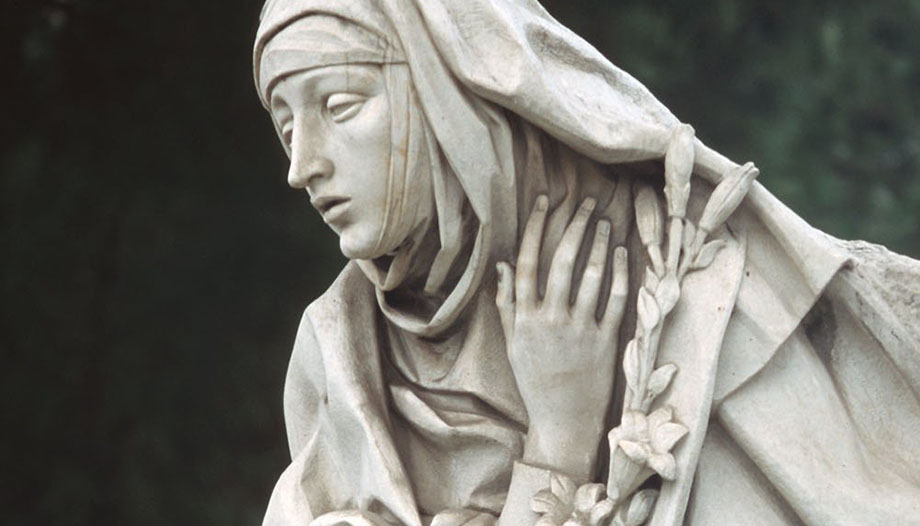
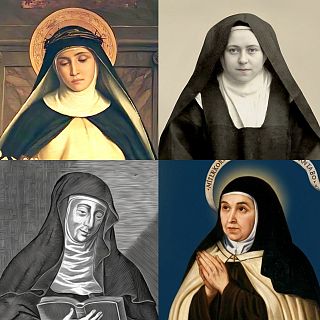
‘Women Doctors of the Church: mystics, visionaries and theologians’, is the title of the RNE Documents program on the only 4 Women Doctors of the Church named so far: Saints Catherine of Siena, Therese of Jesus and Therese of the Child Jesus (Lisieux), Discalced Carmelites, and the Benedictine abbess Hildegard of Bingen.
With screenplay by Ana Vega Toscano and sound design by Samuel Alarcón, this documentary that you can listen to here approaches the four women doctors following the chronology of their appointments. Also playing in the program (47’ 45”) are historical recordings from the RTVE Archive that portray each proclamation.
Experts
The program features, among other experts, Silvia Mas, Professor of the Department of Church History at the Pontifical University of Santa Croce and editor of the book ‘Women Doctors of the Church and Patronesses of Europe’. Josemi Lorenzo Arribas, D. in medieval history and specialist in female monasticism. José Carlos Martín de la Hoz, D. in the history of theology, member of the Academy of Ecclesiastical History and professor of the master's program of the Dicastery for the Causes of Saints. Y Victoria Cirlot, Professor of Romance philology at the Universitat Pompeu Fabra, editor of Hildegard von Bingen in Spanish and author of ‘La mirada interior. Feminine Mysticism in the Middle Ages’.
Four PhDs, and some under study
The title of Doctor of the Church was established at the end of the 13th century, but no woman was recognized until 1970, when St. Paul VI appoints the saint from Avila as a doctorate Saint Teresa of Jesus and saint Catherine of Siena, The church is a 14th century Dominican tertiary monastery.
Almost three decades later, in 1997, Saint John Paul II included the French saint Therese of Lisieux, a young Discalced Carmelite nun who died in 1897. Finally, in 2012, Benedict XVI promoted the doctorate of the German Hildegard of Bingen, a multifaceted Benedictine abbess who lived in the 12th century.
Other religious personalities are currently under study for possible distinction; among them, the Discalced Carmelite nun and philosopher St. Teresa Benedicta of the Cross, Jewish convert born Edith Stein, and died in Auschwitz.
Some brushstrokes. Saint Teresa of Avila
“A Doctor of the Church is a figure in which holiness of life is united, then a thought that is in accordance with the Gospel, with the transmission of the life of the Church, a doctrine that is coherent. But above all, for a Doctor of the Church what we need is an eminent erudition, not so much in extension, but in depth,” explains Professor Silvia Mas.
The audio includes the voice in correct Spanish of St. Paul VI in 1970, when he declared St. Teresa of Jesus (1515-1582) a Doctor of the Church, in a ceremony hitherto unpublished in the Church, in which he makes two observations “that seem important to us,” says the Pope (5’ 53”).
“Sublime mission of women in the bosom of the People of God.”
First of all, “St. Teresa of Avila is the first woman to whom the Church conferred the title of Doctor”. And then, there is the memory of the “severe” phrase of St. Paul: ‘women, be quiet in the churches’”. However, St. Paul VI affirms that this does not imply a violation of the apostolic precept nor a “belittling of the sublime mission of women in the bosom of the People of God”.
Teresa of Avila “has been unanimously recognized by all feminist trends as a thinker and a woman with a brutal push, which serves to broaden horizons and undermines the patriarchal foundations,” says Dr. Josemi Lorenzo Arribas. “In the culture of the Iberian Peninsula there has possibly not been another woman with such historical relevance.”.
Saint Catherine of Siena, April 29th
On October 4, 1970, a few days after St. Teresa, another woman was proclaimed Doctor of the Church, St. Catherine of Siena, also by St. Paul VI. The document of RNE offers the sonorous testimony in Spanish (14’ 20”).
Catherine of Siena (1347-1380), who died at the age of 33, was recognized as a mystic, preacher and writer, especially for her work ‘Dialogue with Divine Providence’, in addition to her decisive role in resolving the so-called exile of Avignon (France) by seven Popes between 1309 and 1377, according to the audio.
The Pope was in Avignon, he had no independence.
“St. Catherine of Siena is the key woman in the reform of the Church. The first great reform of the Church had to start by returning the Pope to Rome. The Pope was in Avignon, dominated by the French power, he had no independence”, explains historian José Carlos Martín de la Hoz (17’ 25”).
“It was important for the Pope to return, and to put the Roman Curia back on track, to be independent, to be universal, to be able to recover the great sense of the Church.”.
“She was the first person to call the Pope the Vice-Christ, and she sought to have dialogue with the Pope, to have dialogue with God.”.
Letter to Pope Gregory XI to return to Rome
The document contains the letter of Saint Catherine of Siena to Pope Gregory XI to return to Rome. Saint Catherine kept an abundant correspondence with personalities of the time.
“She had to prepare the ground in Rome. She didn't just go to the Pope and say: Come. She had to go and recover the Papal States, so that the Pope could come and have Gil de Albornoz, the strong man of that time, who allies himself with Catherine of Siena, to begin to put order in the Papal States,” adds scholar Martin de la Hoz.
St. Teresa Benedicta of the Cross, in study
The document also includes the sound testimony (22’ 07”) of the declaration of St. John Paul II granting the title of Doctor of the Church to St. Teresa of the Child Jesus. And also that of Benedict XVI (27’ 11”) on St. Hildegard of Bingen, a woman on which experts, such as Professor Victoria Cirlot.
About St. Teresa Benedicta of the Cross (Edith Stein), says Silvia Mas: “All her written production is being reviewed, she was a philosopher, a student of Husserl, father of phenomenology, and wrote ‘Being finite and eternal being’. She was one of the women who fought for women's right to vote in the 1920s”.




 Español
  English
  Italiano