



ARTISTIC COMMENTARY
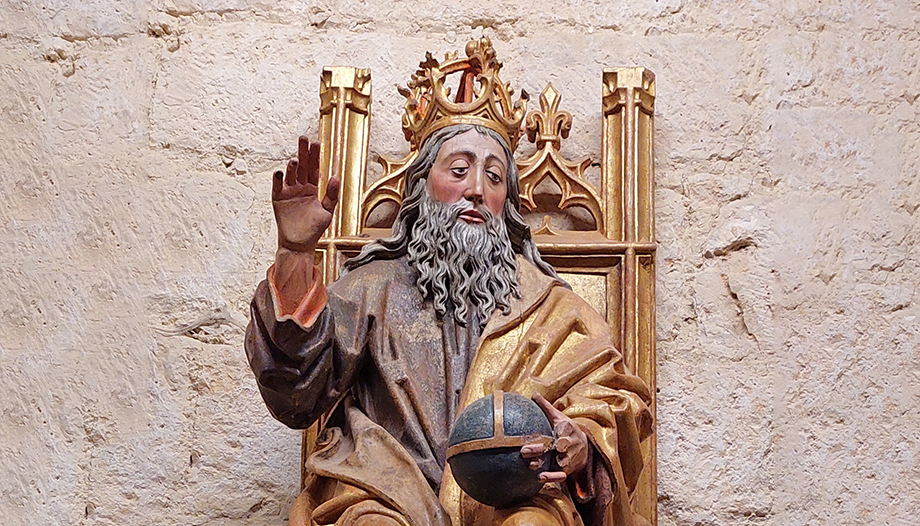
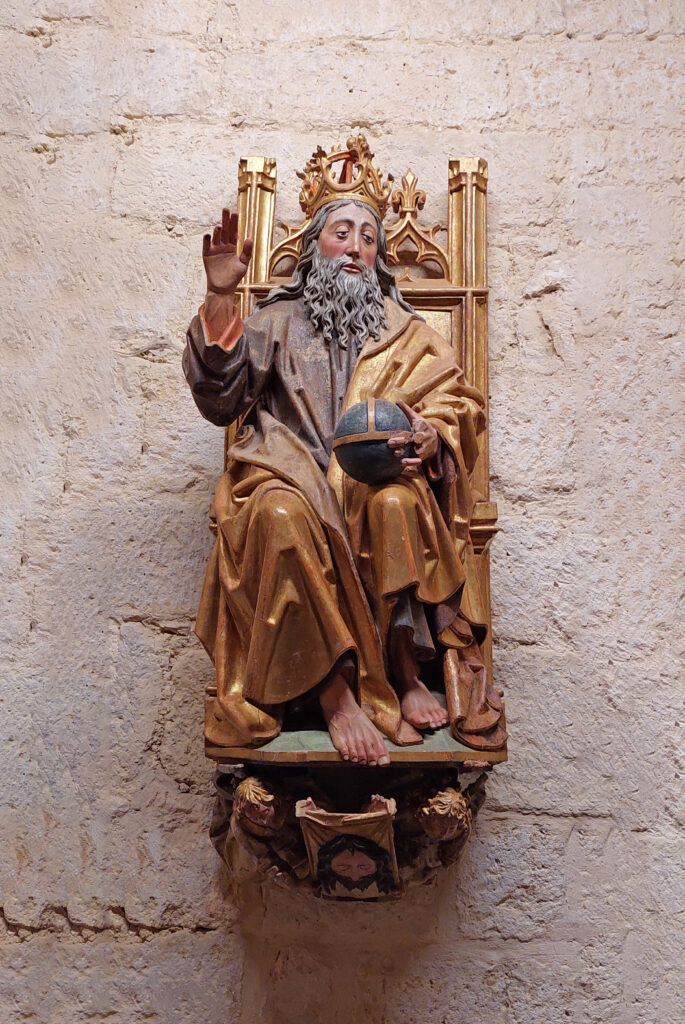
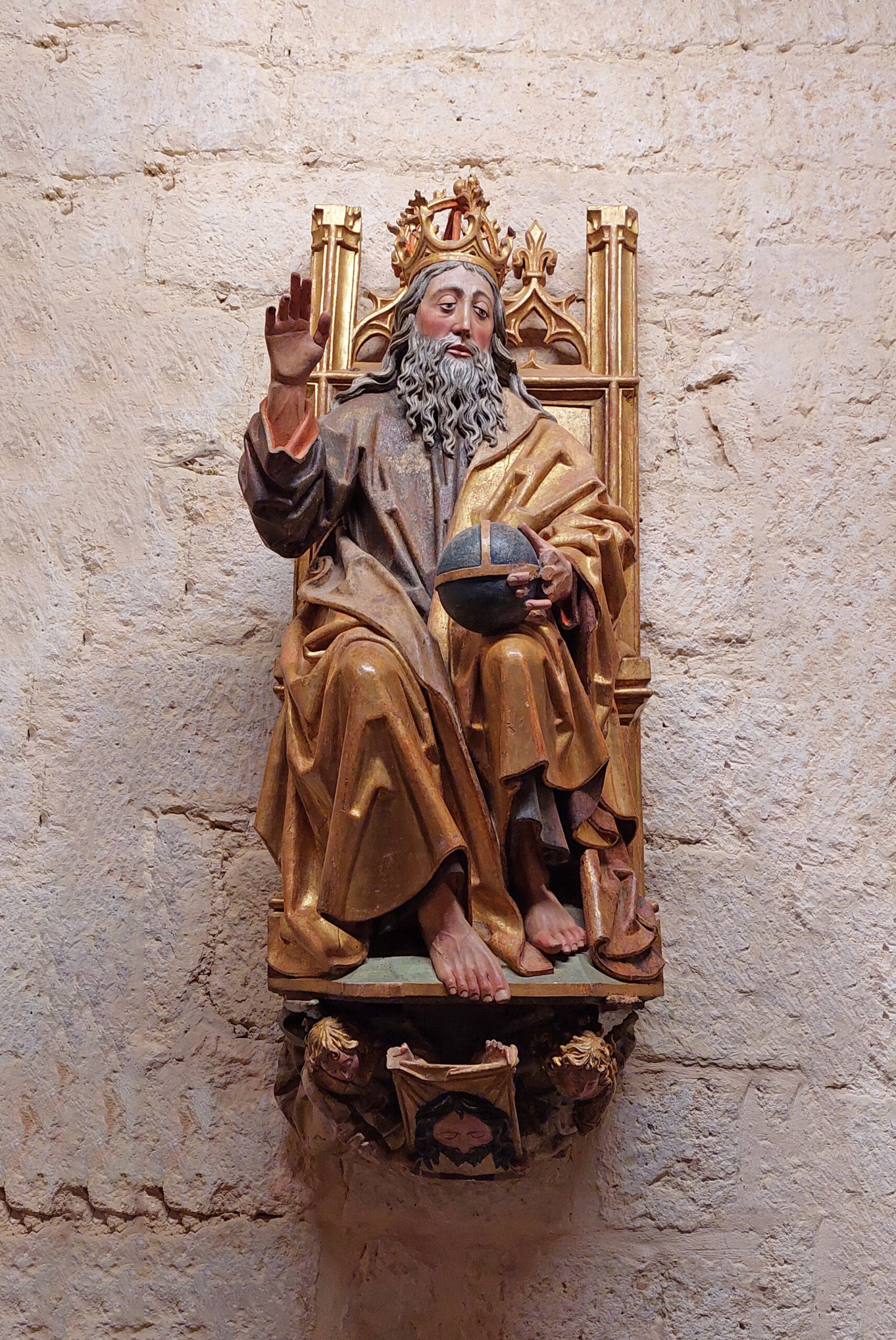
To close this series on Creation, we stop at this sculpture of God the Creator. The sculpture represents God the Father enthroned, represented as an older and majestic man, with his right hand raised in a gesture of blessing and his left hand holding the orb of the world crowned by a cross. On his head he wears a splendid crown, and a large halo or nimbus behind him emphasizes his divinity; earthly symbols of divine power.
Theological message
This iconography-God the Father with imperial and papal insignia (the crown/tiara and the orb)-was common in the 15th and 16th centuries, symbolizing God's supreme authority both spiritual and temporal. The figure is still somewhat rigid, with that frontal pose characteristic of late Gothic imagery. The carving is angular and precise, with well-defined linear folds in the robes and a curly beard, evidence of the artist's Nordic training. God's foot protrudes from the throne, as if pointing downward to where his Son is depicted.
Under the throne of the Father, Alexius includes a striking symbolic detail: two angels holding the True Cross or the Cloth of Veronica, showing the Holy Face of Christ. These angels act as a living pedestal for God enthroned. The inclusion of the Veronica's Cloth - the miraculously imprinted face of Christ - beneath the Father visually links the First Person of the Trinity with the Second, the Son.
It would be interesting to know the original location of the sculpture. In many retablos, in the upper part, the Holy Spirit is represented as a dove; if so in this case, the Trinity would be complete. It is likely that this composition was intended for the upper register of an altarpiece: The Eternal Father in glory, literally supported by angels, presiding from above the altar. The gesture of blessing and the globe in his hands reinforce God's role as universal Creator and merciful sovereign of the world. The iconography combines late Gothic devotional imagery with didactic symbolism, presenting God the Father as heavenly monarch and origin of salvation history. The impression is one of serene authority: the Eternal Father looks outward with a firm expression, embodying both God's mercy and power.
From the technical point of view, the Eternal Father is a magnificent example of Spanish polychrome Gothic sculpture. It shows a fusion of local and international influences: a Nordic (Gothic) stylistic framework coupled with the Spanish tradition of polychrome sculpture, in a work of extraordinary skill and artistic beauty. Normally, an imaginer or sculptor-painter carved, painted and decorated the polychrome sculpture himself, although it was common to have specialists assisting in the carving.
Iconographic evolution of God the Father
In earlier centuries, Christian art avoided depicting God the Father directly - only symbols were used (such as a hand coming out of the clouds) or centered on Christ. However, towards the end of the 15th century, the representation of the First Person of the Trinity in human form became widespread. This period in Spain was marked by a flowering of altarpieces and religious imagery under the Catholic Monarchs, combining Gothic traditions with early Renaissance influences. In the religious art of the Iberian Peninsula in the late 15th and early 16th centuries, depictions of God the Father became increasingly common. As early as the 1490s, Spanish retablos frequently included God the Father as a venerable old man in the heavens, reflecting an evolving iconography and new devotional practices. It is in this context that the Eternal Father by Alejo de Vahía, a sculpture that exemplifies both the artist's personal style and the Gothic tradition in Spain.
The exact original location of the Eternal Father of Alejo de Vahía is not fully documented, but it almost certainly came from an altarpiece in a local church in or near Becerril de Campos.
CATECHETICAL COMMENTARY
The first three chapters of the book of the Genesis have always made it possible to present a complete catechesis on the creative act of God, its result and its meaning. In fact, in the light of the biblical revelation guarded in its interpretation by the Church, it is possible to find a foundation for life and the existence of reality. And, therefore, it is also possible to offer an answer to the most universal and pressing questions that every human being asks: Where do we come from? Where are we going? What is the origin of everything? What will be the end of everything?
Revelation, while opening up a horizon of meaning for reality, also presents the author who made it possible: God the Creator, whom we Christians also call Father. From the very first lines of the Genesis it is made clear that the only subject of creation is God, even using a special verb for this purpose: the Hebrew verb bara, The only subject of which is God.
Therefore, as we have presented in previous articles the revelation about Creation, it is time to talk about its unique author, on whom we focus this month.
The author of all reality
Although in the Creed the creative act is attributed to the Almighty Father, we must not lose sight of the fact that such an act is the common work of the three divine persons, as are all the works performed by the three divine persons. ad extra of the divine being. Since the three persons share one and the same nature, their action is also one and the same. Therefore, the Father, the first person, does not create alone, but with the Son and the Holy Spirit. In fact, in Sacred Scripture and in the liturgy we find allusions to the presence of both in the creative act: we speak of the creative Word (John 1, 1-3) and of the Creator Spirit (Hymn Veni Creator Spiritus). Another way of representing the link between the divine persons in their action can be seen in the carving of Alejo de Vahía: united to the Father, as his support, is the Face of his Son, and above them, hypothetically, would be a carving of the Holy Spirit.
Hence, looking for the author of reality we finally find the Holy Trinity, a certainty expressed from the beginning by Christians in the formula: “the Father creates with his two hands, the Son and the Holy Spirit”.” (St. Irenaeus).
Now, if the Creed assigns the creative act to the Father, it is not denying the presence of the other two persons, but rather manifesting an important feature of Christian theology: the works of the Trinity are of the three persons, but there are certain works that can be attributed to a certain person, because they are more proper to that person.
Thus, just as the redemptive incarnation is attributed to the Son, and the sanctifying gift to the Holy Spirit, the creative act is appropriated to the Father. In all these works, however, the three persons act in their one divine nature.
The creative character of God made it possible, already in the Old Testament, to assign to him the title Father, as the origin of all reality, but also as protector and guide of Israel, especially of the poor. In the fullness of revelation brought by the New Testament, this title is illuminated with new lights: God is Father because from before Creation there is a relationship of paternity with his Son, eternally begotten by him, and who is addressed to him in the relationship of filiation (Matthew 11, 27).
Therefore, the Creator is the Eternal Father and also the Father of Our Lord Jesus Christ, as St. Paul calls Him and as represented in the design of Alejo de Vahía.
The meaning of Creation
If the Father, who eternally possesses everything, has created reality, he has done so not to obtain something he lacked, as if Creation were necessary, but to manifest and communicate his glory freely. Hence the creatures, and the human being as a special member of them, attain their true meaning when they glorify the Father Creator. The crown and the nimbus worn by this carving remind us of the divine glory of the Creator, who is to be sought, recognized and glorified by his creature, who will thus be able to find the Creator and the Father. artist divine that has given it being.
On the other hand, Christian revelation reminds us that the creative act was not a finished action, as if after creating the world the Blessed Trinity had already obtained a final result or had ceased to act in it. On the contrary, Creation is presented as a harmonious whole that is not fully finished, but on the way to perfection and consummation. In the carving we see how the Eternal Father still carries in his hand the orb with the cross, thus instructing us on the existence of divine Providence: the dispositions foreseen by the Creator to lead his work to perfection.
The Father remains solicitous and caring for all that he has created, from the smallest details to the grandest designs. The serene, firm and tender authority that we see in the expression of the carving is indeed a reminder that God rules in his power with merciful Providence.
The Creator has absolute sovereignty over the course of the becoming of Creation (Proverbs 19, 21), but, being also Father, he directs the course of events for the greater good of his children (Romans 8, 28). Thus, those who accept this revelation can develop their existence within the framework of this Creation with the filial abandonment that Jesus Christ teaches (Matthew 6, 31-33).
The beautiful carving that we can enjoy in the Museum of Santa María de Becerril de Campos, therefore, continues to remind us that Creation is on its way to the definitive Sabbath, until the final seventh day when everything reaches the rest in the Holy Trinity, thus reaching its definitive and consummated perfection.
Meanwhile, the paternal gaze of the Almighty Creator guides and orients us in the midst of this world which, without Him, returns hopelessly to primordial chaos.
Work
Art historian and Doctor of Theology





 Español
  English
  Italiano
  Français
  Deutsch
  Polski
  简体中文
简体中文