



 Luther, Kant and St. John Henry Newman
 In various European countries, a phenomenon that would have seemed improbable only a few decades ago is beginning to be perceived: a renewed interest in the Christian faith in profoundly secularized contexts. France, The Netherlands and, in particular, the Nordic countries are experiencing a religious awakening, especially among young adults.
Sweden is a significant case in point. In recent years, the number of baptisms and of people joining the Church has grown remarkably, to the point of doubling in some areas. Parallel to this phenomenon, another sign - more silent but equally eloquent - is beginning to attract attention: the reappearance of the Virgin Mary in churches of Lutheran tradition, places where her presence had been eliminated after the Protestant Reformation.
Could one speak of a “return of Mary” as a symbol of a broader return to faith?
An unexpected presence in Uppsala
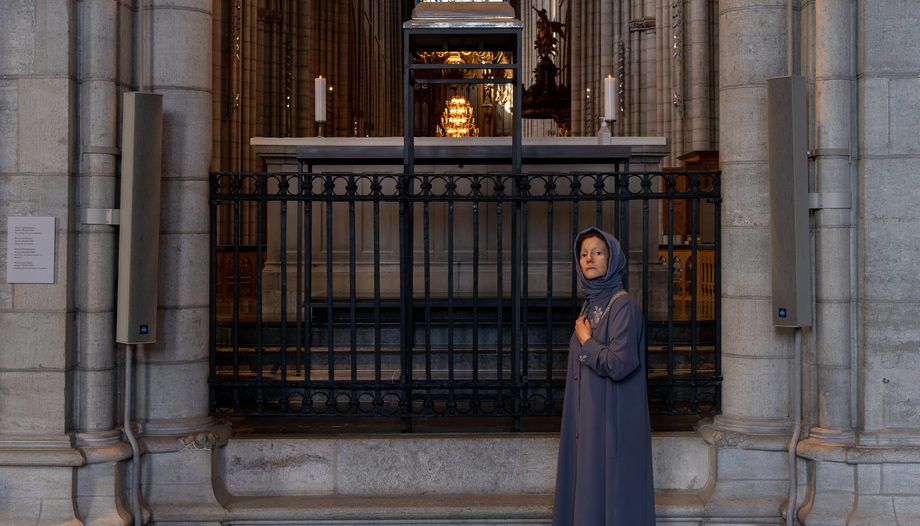
One of the most significant examples is found in Uppsala Cathedral, the main church of the Church of Uppsala. Sweden. There, in the ambulatory located behind the main altar, stands a contemporary sculpture titled “Maria (The Return)”.
The work, installed in 2005, is by artist Anders Widoff and depicts the Virgin Mary in a way that breaks with traditional images. Made of polyester with a surface reminiscent of silicone, the figure has an almost natural size and a surprising realism.
Mary appears dressed in everyday clothes -coat, skirt, simple shoes- without a crown, without a halo, without any element that immediately identifies her as a sacred figure. The artist wanted to represent her as a woman of our time, “someone you might find in the supermarket.” A close, recognizable, even vulnerable figure.
However, its location and orientation are loaded with symbolism. The sculpture faces the so-called Vasa choir, which before the Reformation was dedicated to Mary. The title “The Return” is not accidental: it alludes both to the physical return of a Marian image to the temple and to a possible spiritual return.
Between surprise and contemplation
The sculpture has elicited mixed reactions. Many visitors report that, upon seeing it for the first time, they believe they are in front of a real person. The realism of the skin, the posture and the gaze generate an intense sensation of presence.
Some perceive in this Mary an unprecedented closeness: not a distant and idealized figure, but a woman of today, accessible and human. Others point out that her presence invites silence and recollection, partly because she appears almost unexpectedly on the cathedral's route.
There are, however, those who experience some discomfort. The style breaks with the expectation of a religious art clearly recognizable as “sacred”. And in a Lutheran context, where Marian devotion was historically minimized, the presence of this image raises questions.
Precisely for this reason, many see in the sculpture a bridge between Christian traditions - Catholic, Orthodox and Lutheran - a reminder of a common heritage that predates the divisions.
A symbol with multiple readings
Beyond its artistic dimension, the work invites theological reflection. The absence of traditional symbols raises an underlying question: must holiness be visibly manifested, or can it be discovered in everyday life?
The “return” to which the title alludes can be interpreted on several levels. On the one hand, as a recovery of the maternal and welcoming dimension of ecclesial life. On the other, as a rediscovery of the incarnate: of a God who makes himself present in the human, in the simple, in the everyday.
In this sense, the figure refers to the Mary of the Gospel, She who “kept all things in her heart”: a discreet, silent, but profoundly transforming presence.
Light and nature: Maria in Linköping
Another significant example of this renewed Marian presence is found in Linköping Cathedral, where a contemporary stained glass window offers a profoundly original interpretation.
Located in the chapel of Mary (Mariakapellet), this work was inaugurated in 1998 and is the creation of the artist Lisa Bauer, with engraving by Lars Börnesson. It is not a painted stained glass in the classical sense, but a large glass engraving, considered one of the largest of its kind.
In the center is the face of Mary, crowned by wild roses. But the most striking thing is her mantle, formed by a complex composition of plants and flowers -up to ninety species- linked to the Swedish popular tradition: flowers with Marian names, plants associated with legends about the Virgin, symbols of purity, life and protection.
The result is a sort of “Marian cosmos”, where the whole of nature seems to reflect her figure.
A theology expressed in images
The stained glass window offers a rich theological reading, although expressed in contemporary language. The mantle of flowers evokes Mary as the “Virgin Mary".“new Eva”The reconciled creation, the fruitful earth that welcomes Christ.
At the same time, the work integrates Maria into the cultural and natural landscape of Northern Europe, bringing her closer to the local sensibility.
Like all stained glass, its perception changes with the light. Sometimes it is barely distinguishable; at other times, it emerges strongly. This variability suggests a spiritual dimension: Mary does not impose herself, but allows herself to be discovered in contemplation.
A sign of the times?
The reappearance of Mary in these contexts does not necessarily imply a return to traditional forms of devotion. Rather, it seems to point to something deeper: a search for meaning, for closeness, for incarnation.
In societies marked by secularization, the figure of Mary - human, close, silent - can become a point of encounter. Not so much as an object of debate, but as a presence that invites us to pause, to look, to wonder.
Perhaps in this discreet rediscovery lies a key to understanding the current spiritual rebirth in Europe: a return that does not always begin with great affirmations, but with humble signs... like that of a woman who returns, silently, to take her place.






 Español
  English
  Italiano
  Français
  Deutsch
  Polski
  简体中文
简体中文