


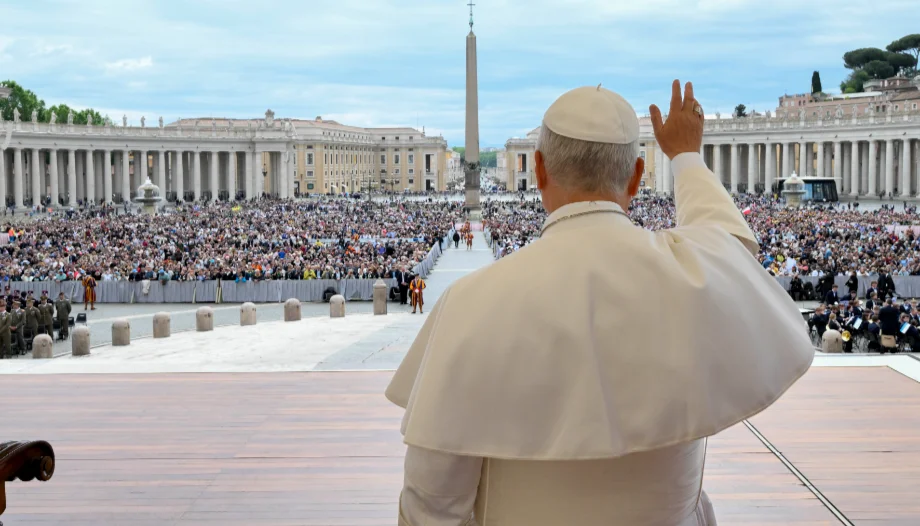
When the French Cardinal Dominique Mamberti, in his capacity as protodeacon, announced the new Pope with the traditional formula “Habemus Papam” that May 8, 2025, followed by the “qui sibi nomen imposuit” (who has imposed the name of...)., Perhaps we did not realize that the new Pontiff, U.S. Cardinal Robert Francis Prevost, by adopting the name Leo XIV, was already sending a coded message to the world. It was not just an onomastic choice; it was a declaration of intent: Leo XIV was emerging, from the very first second, as the “Pope of the new social question for this 21st century.”.
His first words, serene and powerful, “Pax vobis”, resounded in St. Peter's Square and throughout the world with a prophetic charge: “Peace be with you all! (...) This is the peace of the Risen Christ, a disarmed peace and a disarming, humble and persevering peace. Today, one year after that event, we pause to reflect on the style and thought of this pontificate, which has begun to mark a clear path in the history of the Church.
The mystery of continuity
To understand Leo XIV it is imperative to first understand the vision of the Church as a mystery of continuity. His pontificate is built on the principle of “No Rupture”. At a time when many seek drastic changes, the Pope has reaffirmed that the Church does not advance through ruptures, but through organic development. As Joseph Ratzinger-Benedict XVI recalled, the Christian faith assumes the previous experience of faith - like the Israelite creed - turning it into an internal dimension, in this sense the German Pope affirms that “the historical character of religion and of the history of faith develops through points of contact, never in full discontinuity”.
As men and women in communion with Peter, whoever he may be, we must be companions on the journey, seeking together to read the signs of the times. Unity in diversity is the hallmark of this first year: each Pontiff brings his or her own nuance, but the thread that holds the ecclesial fabric together remains the Holy Spirit. From this perspective, we are not and cannot be preachers of rupture, but of communion.
The echo of Leo XIII and the new social question
Why Leo XIV? The choice of this name refers us directly to Leo XIII, author of the encyclical letter Rerum Novarum (5-V-1891). From the communicative point of view, the message is unequivocal: we are before a Pope who makes his heart beat to the rhythm of the Social Doctrine of the Church (SDC).
His style of government is based on a tripod: synodality, evangelization and prayer (discernment). This was evident in his first extraordinary consistory on January 7-8, 2026, where nearly 170 cardinals gathered not for a bureaucratic formality, but for a fraternal encounter. The approval of the axes of synodality and evangelization - in the wake of the Apostolic Exhortation Evangelli Gaudium (Francisco, November 24, 2013)– demonstrates that it seeks unity of command through collegiality.
The thread of the heart: From «Dilexit nos» a «Dilexi te»
There is an unquestionable mystical and social bridge between the end of Francis' pontificate and the beginning of Leo XIV. If Francis gave us the gift of the encyclical letter Dilexit us (October 24, 2024) to remind us of the love of the Heart of Jesus, Leo XIV responded with the Apostolic Exhortation Dilexi te (October 4, 2025), which translates as “He loved you”, focusing his gaze on love for the poor.
In the Dilexit us Pope Francis reminded us that, in serving our neighbor, we meet Jesus “side by side” (nn. 214-215). Leo XIV takes this heritage and, in his exhortation Dilexi te, acknowledges the joy of making this message his own, proposing it at the beginning of his pontificate.
The diagnosis presented by Leo XIV in the Dilexi te is blunt: poverty is not an inevitability, but the product of a structure of sin. The Pope denounces the existence of elites who live in “luxury bubbles” while millions survive in unworthy conditions. He warns against the tendency to turn the poor into a statistic in order to avoid touching their reality. His proposal is clear: charity is not a palliative, but a “leaven of justice” that must change unjust systems.
The new poverties of the 21st century
Leo XIV's pontificate is not limited to traditional material poverty. In his October 23, 2025 address to the Popular Movements, he identified technological and social “novelties” that generate new forms of exclusion, including the following:
- Anxiety and consumption: The impact of social networks on young people, who face the mirage of unattainable success.
- Digital addictions: The design of betting and gambling platforms that exploit vulnerability.
- Ethics and the body: The opioid crisis and the commercialization of pain under a false “idolatry of the body”.
- Extractivism: The violence behind the technology (coltan and lithium), which fuels political destabilization.
In the face of this, the Pope demands that global ethics prevail over technical-economic profit. He insists that almsgiving is not a gift, but a moment of human encounter: “To sit the poor at the table, to give them back their name and dignity”.
Towards a “disarmed and disarming” peace”
In his message for the 59th World Day of Peace (January 1, 2026), Leo XIV proposed an innovative concept that encapsulates his social and spiritual vision and which he had already enunciated in his first message on May 8, 2025: disarmed and disarming peace. It refers not only to the absence of weapons, but to the disarmament of language and aggressive intentions. It is the force of active nonviolence, an attitude of openness that forces the interlocutor to lower his guard.
As we complete this first year of his pontificate, it is clear that Leo XIV has not come to invent a “new Church,” but to renew the Church's fidelity to the Gospel. He invites us to be leaders who not only look at the bottom line, but who know how to decipher the impact of technology on human dignity.
The question that this first anniversary leaves us with is not only what we think of the Pope, but how we integrate his message into our lives. It is up to us to “decipher” how to live out in our daily lives this invitation to be a Church that, to be truly the bride of the Lord, must be, above all, a sister to the poor, a firm promoter of peace.
Presbyter. @GCandanedoPaez





 Español
  English
  Italiano
  Français
  Deutsch
  Polski
  简体中文
简体中文