


 St. Philip Neri and the "three H's".
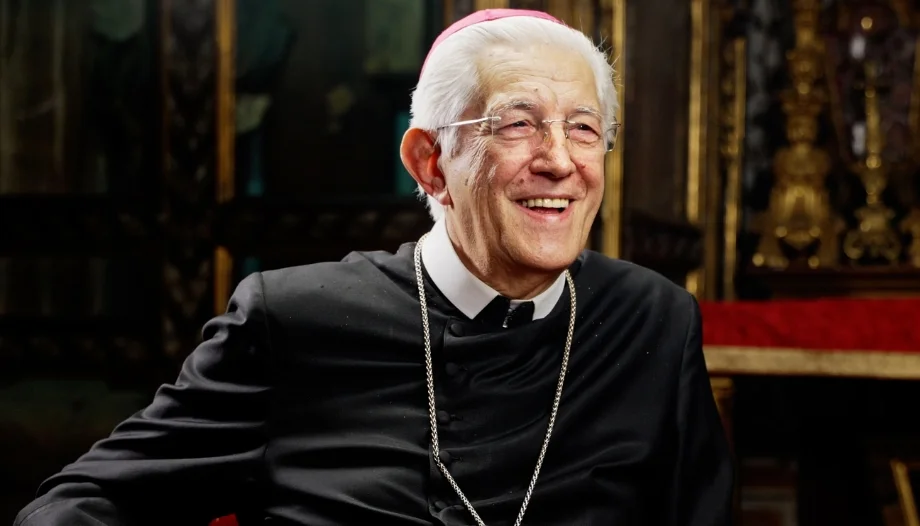
Today, May 26, on the occasion of the Feast of St. Philip Neri, the editorial staff of «Omnes» is pleased to offer its readers an exclusive interview with Bishop Edoardo Aldo Cerrato, of the Congregation of the Oratory of St. Philip Neri, Bishop Emeritus of Ivrea (Italy).
In this dialogue, the bishop reviews, together with journalist Lorenzo Iorfino, the actuality of the Philippine charism, the great educational challenge for young people and the deep secret of Christian and priestly joy.
Your Excellency, the work begun by St. Philip Neri has spanned the centuries. What is the heart of his spiritual message and the experience of the Oratory?
The work of St. Philip, instituted and directed directly by him, was the Oratory, that is, a school of spirituality in which Christ is the absolute center. Philip always said that whoever wants something other than Christ does not know what he wants. He who tries so hard but does not seek Christ does not know what he is doing, because He is not a vague reference or the memory of a great person of the past, but the true center of life. As St. Paul reminds us, life is Christ.
Having lived the teaching mission for years, what, in your opinion, is the greatest challenge an educator faces with today's youth?
School and society have changed a lot, but what never changes is the heart of man. Today's young people are not as ideologized as in the past, and this places them in an attitude of expectation and openness to the search for what lies beyond. Certainly, today there is a great fragility, but the real challenge of the teacher is to respond in a clear and friendly way to their deep aspirations: the aspiration for freedom, love and knowledge, speaking not only to their intelligence, but directly to their heart.
The different Congregations of the Oratory are united in a Confederation. How is this parallelism expressed and how do you reconcile unity with the plurality and local characteristics of your communities?
There is a very strong parallelism with the relationship that exists between the universal Church and the dioceses, which are not simply a part of the universal Church, but the Church itself living in a given place. In the same way, the Congregation of the Oratory is not a subsidiary of a mother house or of a generalate house, but has been erected directly by the Holy See as a domus sui iuris, The members of the Confederation, that is to say, as an autonomous house within a relationship of fraternity that is the Confederation. In this way, one becomes part of a large family, while remaining one's own person with its own characteristics, determined by local situations and needs. From the very beginning, our Constitutions define the community as a Familiaris coetus, a family group based on mutual help and affection that enables them to overcome difficulties. The Confederation represents the great embrace that the universal Church gives to these individual families so that they may live their vocation to the full.
As we contemplate the universal mission of the Church, can we say that this centrality of Christ remains the only true answer to guide us in the contemporary world?
It would undoubtedly suffice to start from the Acts of the Apostles: the first faithful were called Christians by the pagans of Antioch precisely because they followed Christ. Christianity embraces and welcomes all those who hear this word of salvation. The history of the Church is characterized by the diversity of eras and personalities of the pontiffs, but there is a substantial unity in its supreme task: to proclaim and bear witness that Jesus is the Christ, the Son of the living God. This is the reality of all times within the Church.
Many today flee from their vocation for fear of renouncing their own happiness. What is the secret for a priest, and more generally for a Christian, to be able to call himself truly happy?
Being happy does not mean that everything is always going well or being exultant at all times. Happiness is that peace, serenity and deep trust that is felt even in the hardest moments of life. St. Philip Neri, in fact, is the prophet of deep Christian joy, rather than passing joy. The secret is the awareness of having been chosen even before we have been chosen: we are called by the Lord of the cosmos and of history not to play the role of functionaries, but to live a life of service and love for people.
journalist and student at the Pontifical University of the Holy Cross.






 Español
  English
  Italiano
  Français
  Deutsch
  Polski