



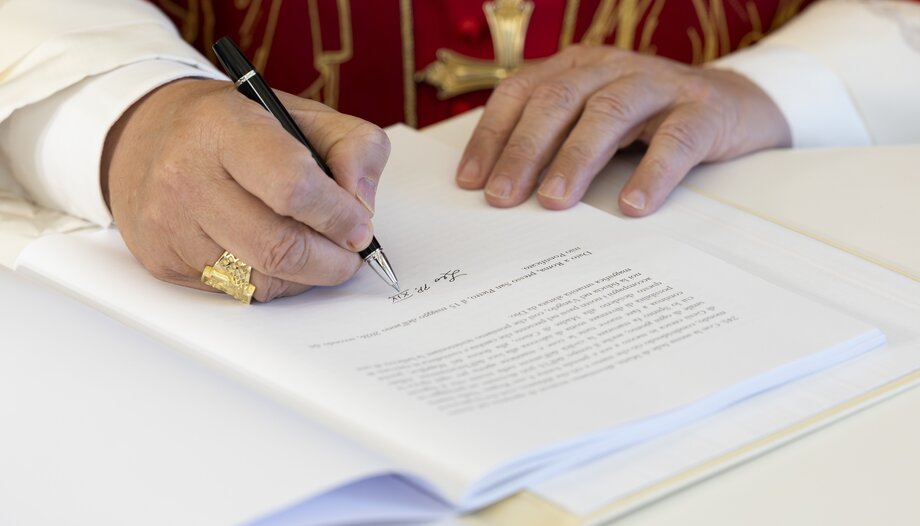
 What does Magnifica Humanitas say to Catholics today? “Magnifica humanitas”: human dignity in the face of artificial intelligence.
On May 25, the presentation in Rome of the first encyclical The Pope's visit to Spain is expected to raise the hearts and spirits of Christians and all people of good will to look forward and face the future with enthusiasm and hope.
As stated several times by Msgr. Luis Argüello, Archbishop of Valladolid and President of the Spanish Episcopal Conference, the Holy Father will raise our gaze beyond ideologies and outdated systems of thought during his upcoming trip to our country.
Everyone's wish is that it will do as John Paul II in his visit to Santiago de Compostela when he revived the Christian roots of our country and launched us to be fruitful in love and to put man in the construction of a democratic country, open and full of trust in man: “I from Santiago, I launch you, old Europe, a cry full of love: find yourself again. Be yourself. Discover your roots. Revive your roots” (Santiago, November 9, 1982).
Orientation for all
Coming down to the encyclical “Magnificat humanitas” of Leo XIV, let us begin by remembering that an encyclical is a document of universal value addressed to Christians throughout the world and to men and women of good will who desire guidance for their lives and light to understand the world in which they are living.
It is technically called the ordinary Magisterium of the Church because it concerns questions of faith and morals of ordinary administration. For this reason, they can be useful for non-Christians, since they do not appeal to faith nor do they elucidate serious questions that are under discussion.
Undoubtedly, enough time has passed since his election to reassure all those who feared lurches or extreme attitudes. The Pope will continue the centuries-old tradition of the Church to live what is called creative fidelity. Therefore, he will “govern” the Church inspired by the Holy Spirit who really governs the Church.
This Encyclical will help us to realize that the mystery of the Incarnation of the Son of God is the key dogma of the Church's life and that the magisterial horizon is illuminated by it.
Analysis of current events
It should also be noted that the Holy Father has taken advantage of his first Encyclical to analyze the cultural, anthropological and sociological situation of the world, where there is a lack of great illusions and, at the same time, important debates and problems to be solved or resolved.
First of all, he has shown us the way to meet the challenges of our time: to turn to the Scripture, We must turn to the Fathers of the Church and to the Magisterium, that is, to the Gospel, to find Jesus Christ, the Incarnate Word, and in Him the answers to our problems and uncertainties.
The solution always passes through the commandment of charity: “A new commandment I give to you, that you love one another as I have loved you” (Jn 13:34-35). It is enough to look at the papal coat of arms to find the flaming heart of St. Augustine and to put the love of God and the love of others back in the middle of the board.
The Holy Father's great confidence in man and in man's creative capacity to overcome the most complicated problems is immediately striking. It is always a question of love, of seeking the common good, that which leads to the development of the dignity of the human person, of every human person. That is why the Holy Father Leo XIV wishes to meet in Canary Islands on his next trip, with those thousands and thousands of emigrants who arrive at our shores risking their lives because in their lands the horizon was already closed. Likewise, the theological and juridical precision with which the issues are expressed, typical of a man of law and also a good theologian who knows that only truth shapes freedom, as we have already mentioned.
Human needs
It is interesting that the Social Doctrine of the Church, which was renewed and structured by Leo XIII in his famous Encyclical “Rerum Novarum” (1891), returns to the forefront in his first Encyclical, and renews it once again, recovering the concept of God incarnate, the central mystery of our faith, for therein lies the dignity of the human person; we are the image and likeness of God and sons and daughters in the Son.
It is precisely within this framework that he situates the question of Artificial Intelligence, an instrument of technology that, like any other, must be at the service of man, of the integral progress of the dignity of the human person. Therefore, we will learn to apply it, because freedom and its works must be shaped by truth.
In this sense, it seems as if the Roman Pontiff has recalled the importance of the dialogue between faith and science, as the Pope Benedict XVI emphasized the dialogue between faith and reason. After all, both have their origin in the mystery of creation. Moreover, the Pope is a scientist and Benedict was a man of letters.
Logically, the themes and style of the Holy Father's message in an Encyclical contain sufficient evidence to show continuity with the previous pontificate, thus manifesting a merciful heart attentive to the spiritual and material needs of all people, especially the disadvantaged, and especially for peace in the world. The Pope's sorrow for the increase in wars and, above all, for the intensity of the material and spiritual damage is logical.
Likewise, throughout the pages of the new Encyclical, the lines of his pontificate are highlighted, which are already indicated in his first speech delivered on the balcony of St. Peter's Square on May 8, 2025, when he spoke of continuing to work for peace in the world and in consciences; of cultivating the unity of the Church and the pastoral zeal for all men and especially for the most needy; and of teaching us to love with the vibrant heart of the Church and to love with the heart of God. St. Augustine and of the Blessed Virgin.






 Español
  English
  Italiano
  Français
  Deutsch
  Polski