


ARTISTIC COMMENTARY
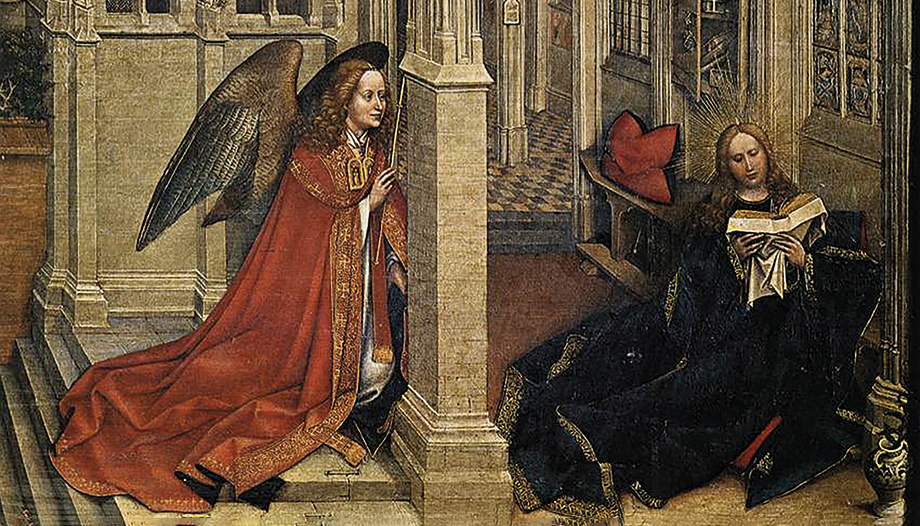
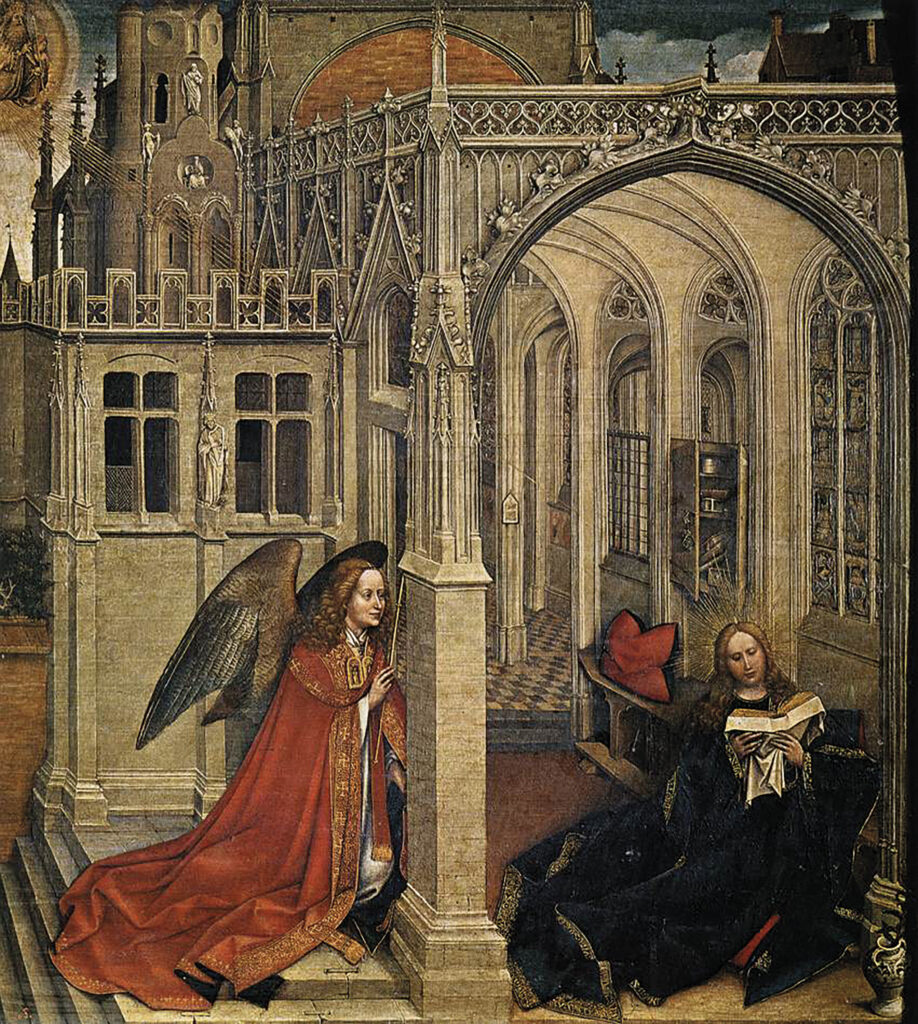
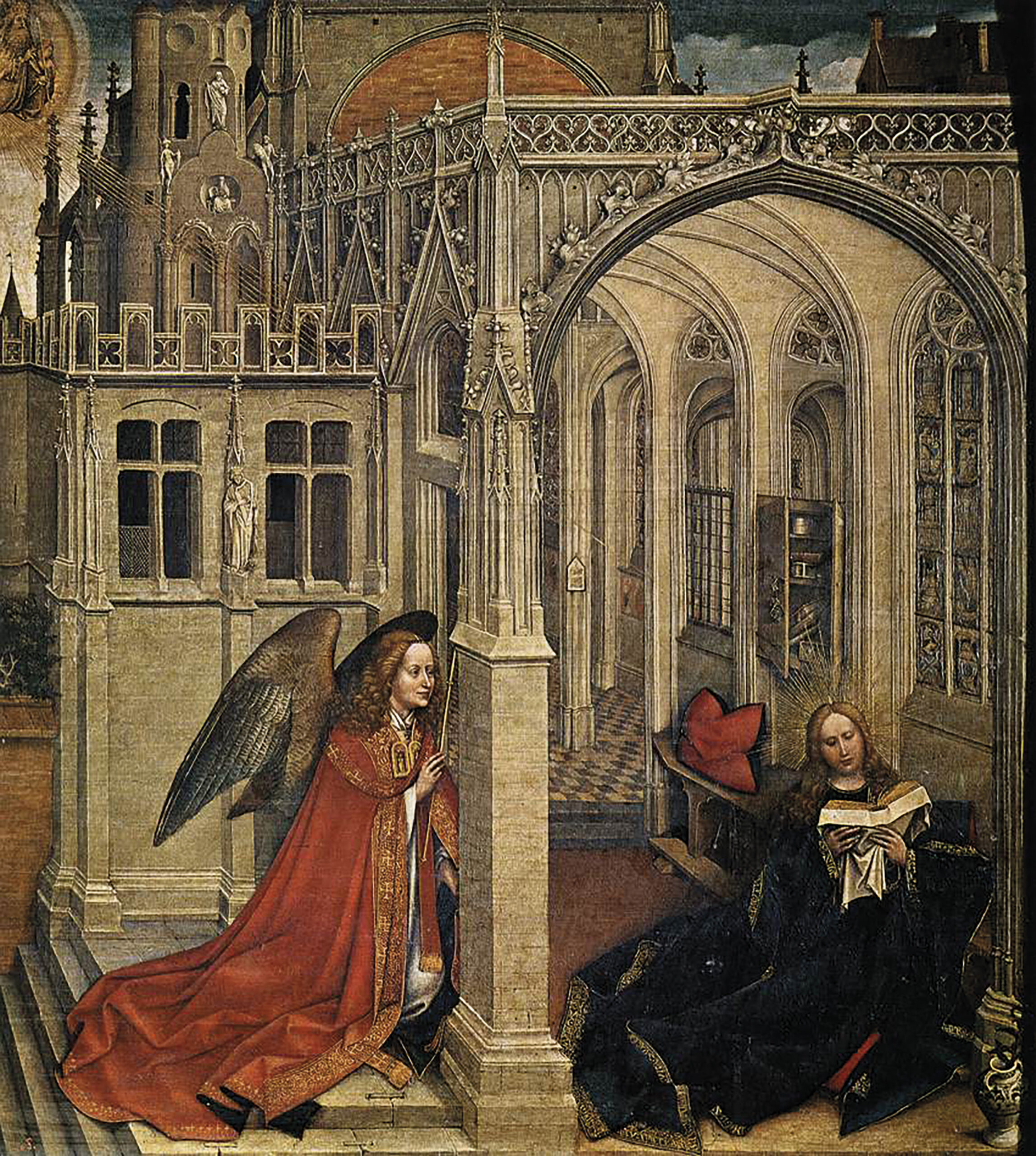
This panel is a classic example of 15th-century Flemish painting. The scene depicts the Virgin Mary praying in a room when the angel sent by God appears to her, following the account in the Gospel of Luke (1:26–38). Mary wears a magnificent blue cloak with sculptural folds and a richly decorated border. Reclining on cushions on a bench, she appears absorbed in her reading. At her feet stands a vase of white lilies, a symbol of the Virgin’s purity; a motif widely used in painting that continues to be employed even in more modern times (see, for example, Émile Bernard’s version on the same theme, 1890, Thyssen-Bornemisza Museum, Madrid). The angel enters through an opening in the wall, kneels before her, and raises his hand in greeting. He, too, wears a rich red cloak resembling priestly vestments and carries what appears to be a small diptych worn as a brooch; the feathers of his wings and the curls of his hair are rendered in minute detail. Both figures, in red and blue, dominate the composition. In the upper left corner, God appears surrounded by heavenly beings, sending his Son—this time in the form of lightning bolts descending from above—a graphic way of representing divine power.
The Four Moments of the Annunciation: The Viewer's Perspective
When viewing 15th-century scenes of the Annunciation, it is worth considering how audiences of that time would have understood them. To us, it may seem like just another depiction of the Archangel Gabriel’s visit to the Virgin Mary, but viewers back then knew how to distinguish which moment in the story they were seeing. Four stages were recognized: Mary in prayer or reading (before noticing the angel’s presence), listening (when she hears his greeting), reflecting or asking questions (as she ponders the message), and accepting (when she submits to the divine will). Each moment has its own distinct characteristics. This panel depicts the first phase, when Mary has not yet realized the angel is present.
Between the Domestic and the Sacred: A Meticulously Crafted Gothic Interior
The painter not only depicts the scene of the Annunciation, but also offers a view of the interior of a Gothic church. The carefully rendered room—the small bookcase, the key, the stained-glass windows—is an illusory space that functions both as Mary’s private room and as a small chapel or annex to a church. Stained-glass windows depicting religious scenes would have been uncommon in a domestic setting. The building is painted with great attention to detail: one can see the exterior of a Gothic church with decorated pinnacles, turrets, sculptures in niches, ashlars, balustrades, and even the small nails on the window shutters. This visual information is invaluable to art historians, as are the objects adorning the interior. On one wall, a small cartellino can be seen that may contain prayers, suggesting a certain level of erudition and devotion among the faithful.
The panel was created in the first quarter of the 15th century. Although the artist demonstrates great skill in depicting architecture and figures, his use of perspective is less confident. The proportions between the figures and the space are not entirely accurate, and the way the bookcase opens seems somewhat odd. However, these aspects do not detract from the subject matter.
This Flemish painting, part of the Spanish Royal Collection, was acquired by King Philip II in 1584 from Giacomo (Jacome) Trezzo for the Monastery of San Lorenzo de El Escorial. It was later recorded as being in the infirmary chapel at El Escorial before being transferred to the Prado Museum. Given its size and format, it likely formed part of a wing of an altarpiece, perhaps within a series dedicated to the Virgin Mary and the Nativity of Christ.
CATECHETICAL COMMENTARY
In the angel’s greeting depicted in this splendid panel painting at the Prado Museum, we discover that he is a messenger sent by God for an event of exceptional and once-in-a-lifetime significance in history. The Incarnation of the Son of God, who, as we saw in previous chapters of this series, takes on a humanity like our own (except for sin), will take place through the cooperation—both free and necessary—of a humble virgin from the people of Israel, who lives in a forgotten and hidden place in Galilee (Luke 1:26–27).
The Greeting of Fulfillment
Indeed, St. Gabriel’s greeting heralds the arrival of the fullness of time—a time that is full because, at last, God the Creator unites himself personally with his crowning creation, the human being, so that in Christ the fullness of the Godhead dwells bodily (Colossians 2:9). Time reaches its zenith and human history attains its highest fulfillment in this moment of fullness, in which the Son of God unites himself through the Incarnation to all humanity by being conceived through the power of the Holy Spirit in the womb of the humble Virgin of Nazareth.
Dwelling in the womb of the Virgin, God makes himself present in his Creation—not because he was not present in his work before, but because he is now present in a special and complete way. This new presence of God in His Creation is the fruit of the missions of the divine Persons, as depicted in the painting portraying the Father and the Holy Spirit. The Holy Spirit is sent to sanctify and make fruitful the Virgin Mary’s womb, while the Son is sent by the Father to be conceived in the fullness of the Spirit. The presence of the Holy Spirit in the painting reminds us that Jesus Christ is, from his conception, the Anointed One, the one who makes the fullness of the Holy Spirit present in Creation (Acts 10:38).
This new presence involves the cooperation of the young woman who will make it possible for God to dwell in a new way in the world He has created. Mary was chosen and predestined even before the Creation to be the Mother of God, as revealed by her magnificent mantle and the rich and splendid hem of her garment. But God’s choice respects her freedom, for grace cooperates with nature; it neither suppresses nor forces it. God waits for her “yes” before acting, because the conception of the Son of God takes place after a prayerful dialogue—one of listening, questions, and acceptance—in which both the Creator, through his messenger, and his most perfect creature, the humble Virgin of Nazareth, converse with supreme freedom.
Thus, in Mary, the fullness of a history is also realized: that of the people of Israel, saved by God through the necessary cooperation—and, paradoxically, through the freedom—of women who are seemingly defenseless, weak, and incapable. The young woman from Nazareth is the final and most splendid episode in a series that, beginning with Eve’s fall, unfolds through Sarah, Hannah, Deborah, Ruth, Judith, and Esther, carrying out God’s plan to remain present among his people and thus continue to fulfill his covenant of salvation.
Mary, the Ever-Virgin
It is, from a human perspective, paradoxical that the fullness of life should have come into the world solely through the cooperation of a virgin, without the intervention of a man. However, Christian tradition has found in this apparent absurdity a precious mystery of the faith, which must be accepted, understood in all its profound richness, and passed on as part of the Catholic faith. The Gospel of Saint Matthew, in particular, teaches us that we are not dealing with a mere incomprehensible event—one that some might even consider unnatural—but rather that the virgin birth of the Messiah places us before a unique divine act. So unique that Saint Joseph, who was righteous (that is, lived in full union with the God of the Covenant), is unable to grasp its meaning, until the wisdom of God reveals it to him through an angel: Mary is expecting a Son who is the fruit of an act of the Holy Spirit (Matthew 1:21) and, therefore, a work that can never be deciphered or explained by mere human understanding.
The conception of Jesus Christ without the intervention of a man, through the cooperation of Mary alone, has been, for the evangelist and for the Church, the fulfillment of one of the greatest prophecies of the Old Testament: the oracle of Emmanuel (Isaiah 7:14). “”A virgin will conceive and give birth to a son" as an incomprehensible and wondrous sign of God, as the evangelist once again emphasizes (Matthew 1:23). For this reason, the Church has not been deterred by the apparent impossibility of such an event, despite having faced ridicule and misunderstanding because of it since its very beginnings. Embracing the virgin birth as a unique and unrepeatable sign of God, the Church has safeguarded it in her deposit of faith and proclaimed it from her earliest history.
In it, the Church has seen an unfathomable mystery, but this has not prevented her from discovering the profound meaning it holds for our understanding of God and the life of faith. The Virgin Birth reveals the absolute initiative of God, the one Savior and Guide of human history. The history that began in paradise is also brought to fulfillment in the New Adam, when Adam was formed from the bosom of virgin, uncultivated earth and received his definitive identity through the breath of the divine Spirit. And it is also taught that human beings can be born again, born from above (John 3:3), provided they sincerely accept the gift of the Holy Spirit.
By conceiving Jesus Christ as her only Son, Mary is permanently consecrated to Him, so that she remains the Ever-Virgin. This brings us to the dogma of Mary’s perpetual virginity: before childbirth, during childbirth, and after childbirth. She is not merely a virgin who conceives the Messiah, but the Ever-Virgin par excellence—with a capital “E”—who forever extends her unique motherhood—the motherhood that gave life to Jesus Christ—to all the members of his Body, the Church. In a manner analogous to what happened in Nazareth, the Virgin cooperates with God in the supernatural birth of the new members of her only Son, thus living out a universal motherhood. For this reason, she is also a sign of the Church—Virgin and Mother of the new humanity—which was virginal conceived in the humility of Nazareth and will be brought to fulfillment at the glorious return of the Son of the Virgin.
Work
Art historian and Doctor of Theology





 Español
  English
  Italiano
  Français
  Deutsch
  Polski
  简体中文
简体中文