



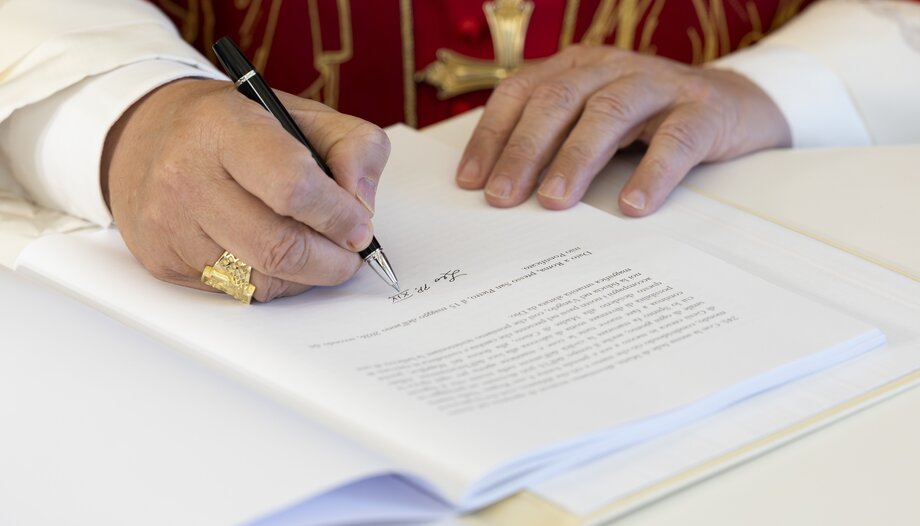
Magnifica humanitas, the first social encyclical of Leo XIV, is much more than a document on artificial intelligence. In it, almost without a sound, a movement of greater significance takes place: the social doctrine of the Church (DSI) is described as «a theology of communion in history» (n. 27). The formula is luminous and, in my opinion, contains the most significant development of the entire text.
From Moral Theology to Theology of Communion
St. John Paul II, in Sollicitudo rei socialis (1987), had placed the SDC «in the sphere of theology, and especially of moral theology» (n. 41). It was a prudent and necessary affirmation: it defended the doctrine against those who reduced it to ideology or a mere political agenda of the Vatican. Over the years, however, this formula has tended to be read in a restrictive way, as if the DSI were nothing more than the part of the manual of moral theology dedicated to the social questions that have arisen from Rerum novarum (1891). In reality, as the Pope explains, its patrimony is much more extensive: it has its roots in Sacred Scripture, the Fathers, medieval and modern theology and law. Think of the School of Salamanca.
Moral theology accompanies the DSI and will continue to do so. But no longer as its exclusive seat. It is not that it loses its place, but rather that its place is integrated into a greater horizon: that of the theology of communion. To the question «what is to be done?», it adds another, more foundational one: «how to keep us united, and what favors or fragments our unity?». One looks at acts; the other, at the bonds that sustain them. Both are needed, but the heart of the DSI beats today in the second.
This shift did not come out of nowhere. In the twentieth century, two major shifts prepared the ground: the relational shift in Trinitarian theology -Rahner, von Balthasar- and that of conciliar ecclesiology toward the communio. The social magisterium itself matured in this direction. The document of Aparecida (2007), written in large part by the then Cardinal Bergoglio, already strongly reflected the language of communion applied to social transformation. Benedict XVI, in Caritas in veritate (2009), placed charity-constitutive relationship-as «the master path of social doctrine» (n. 2). Francis, in Fratelli tutti (2020), elaborated the idea of fraternity as a social principle. Magnifica humanitas clearly names what was already operating in that tradition without a name: the theology of communion.
Dimensions of communion
In the encyclical, «communion» is a precise theological category, articulated on four levels. The first is Trinitarian. The Christian God is a communion of Persons. Leo XIV formulates it in number 48: «the mystery of the living God, revealed in Jesus Christ as a communion of persons; Father, Son and Holy Spirit: love in relationship, which gives itself reciprocally and communicates itself to the world». Communion, before being human, is divine; before being an ethical quality, it is a founding ontological reality.
The second is ecclesiological. The Church, faithful to Vatican II, understands itself to be communio. It is one of the great fruits of the Council, still maturing in the different theological disciplines. In this document, the DSI fully receives the category that is proper to it.
The third is anthropological. Man, made in the image of the triune God, is a being for communion. Gaudium et spes 24 already said: man «cannot find his own fullness except in the sincere gift of self». Leo XIV quotes him expressly.
The fourth is social. The relationships between persons, peoples and institutions are already, or are called to be, the historical manifestation of that ultimate communion. It is here that the object of the SDC is properly situated.
Consequences
Understanding the SDC as a theology of communion crystallizes what was already maturing and brings with it three decisive consequences.
First, a structural multidisciplinarity. Human communion cannot be understood from a single perspective: it requires dialogue with anthropology, law, economics, ecology and other human and experimental sciences. It is not a concession of theology to other disciplines; it is an internal demand of its own object. Its foundation, in my opinion, lies in the unity of reality. This is a profoundly Christian idea and, at the same time, one that can be shared with other spiritual and philosophical traditions: if God, the founding reality, is one and is Love, all of reality must be one and is Love.
Second, a renewed recognition of the autonomy of the temporal. Understood in this way, the SDC offers criteria for discerning links, not technical prescriptions in areas where other knowledge is competent. Here we find a serene response to the ancient secularist objection, a distant echo of the silete theologi by Alberico Gentili. The DSI does not intend to replace the competencies of law, economics or political science.
Third, a communitarian subject. The SDC is not produced only by moral theologians nor read only by the hierarchy. Leo XIV underlines this in Dilexi TeIt would be unimaginable to reread the Christian revelation in modern social, labor, economic and cultural circumstances without Christian laity dealing with the challenges of their time« (n. 82). The insight is not new, but it needed to be remembered. For years, an overly clerical presentation has distanced not a few lay people from exercising their own responsibility in this field.
Practical applications
The change of key is immediately perceived, as soon as the doctrine lands on concrete issues. Take artificial intelligence, the central theme of the encyclical. Along with the usual questions about the rightness of its use - legitimate and undeferrable - the theology of communion introduces another that weighs just as heavily, if not more so: does this technology strengthen human bonds or does it wear them down? The bonds between people, between man and his work, between generations, between peoples and cultures. When the question gains depth, so does the answer.
In the economic field, the relational perspective enriches the discernment of structures: those that allow a human life in which work, the family and care for creation occupy their true place. And, in the debate on migration, the category of communion gives new life to the essential moral judgment, placing it in its authentic horizon: that of the unity of the human family, always fragile and to be rebuilt.
Conclusion
Magnifica humanitas offers to the SDC a key that has been maturing for decades and that now receives its proper name: theology of communion. It is a fundamental step, because it adds to moral theology - without replacing it - a relational gaze capable of embracing human complexity in all its orders. And it is a faithful step: it prolongs the line opened by Benedict XVI and continued by Francis, rooted in Vatican II.
This clarity gives back to the SDC something precious: its own voice in the public debate. Not as a moral code applied from outside, but as wisdom about the bonds that constitute the human. Once again, Leo XIV shows himself to be the pope of unity.





 Español
  English
  Italiano