



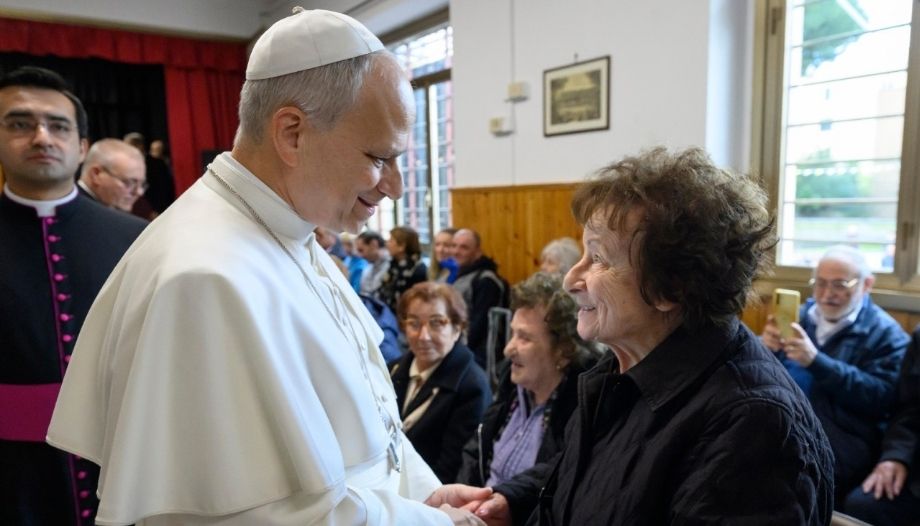
If last year the Pope invited a “care revolution”In his Message for the Sixth World Day of Grandparents and the Elderly in 2026, he has further clarified the revolution he proposes, especially for young people.".
“The Church is called to be a mother to all,” he wrote, expressing the hope that this World Day for Grandparents and the Elderly on July 26 will therefore be “an inspiration to everyone. In particular for the youngest among us, so that we may revive the beautiful custom of visiting our own grandparents, the elders of the family, and also those who receive no visitors.”.
In addition, the Holy Father has given them a mission. “Convey to them, along with this message and your presence, the Pope’s closeness and affection. Do so in such a way that the prophet’s words, “I will never forget you,” take the form of a tender and affectionate encounter.”.
"Do it this way," the Pope adds in the Message, so that the prophet’s words “I will never forget you” (referring to Isaiah) “take the form of a tender and affectionate encounter.”.
Human flesh craves tenderness. The heart craves closeness.
“In an age that tends to accelerate and fragment, the human body continues to cry out for care and recognition from hands capable of tenderness, from attentive minds, and from kind words. Digital culture multiplies connections and offers new possibilities for encounter; however, the human heart retains an inalienable need for closeness” (Encyclical *Magnifica humanitas*, 239).
The Church is aware of the suffering of her elderly members, the Pontiff continues. «She knows full well that they are often viewed with prejudice and considered a burden; she is aware that an economy focused on profit weakens family relationships. It knows that many elderly people are abandoned by their children who are forced to migrate or, in some cases, to fight in war. For each of these reasons, it rejoices in proclaiming the Lord’s promise: “I will never forget you.””.
The promise of a God who never abandons us
The message takes its title from the words of the prophet Isaiah: “I will never forget you” (Is 49:15), an expression that runs throughout the text as a divine promise addressed especially to those who experience the loneliness, abandonment, or frailty characteristic of old age.
Leo XIV begins by recalling that God never abandons his children. The Pope acknowledges, however, that many older people experience precisely the opposite feeling. As the prophet recalls, the complaint often arises in the heart: ‘The Lord has forsaken me; my Master has forgotten me’ (Is 49:14). That painful experience of feeling forgotten is common in a society that tends to marginalize those who are no longer considered productive.
The Pontiff laments that over the lives of many elderly people “a veil seems to have been cast that blurs the features of their faces and shrouds them in oblivion.” This situation is evident both in homes marked by loneliness and in healthcare facilities or nursing homes, where personal identity runs the risk of being reduced to a number or a disease.
The Church understands the suffering of the elderly
In the following section, the Pope demonstrates a deep understanding of the difficulties faced by many elderly people. «The Church is aware of the suffering of her elderly children,» he states. She knows that they are often the target of prejudice, viewed as a burden, or pushed to the margins of society.
The Pope urges that the Christian response to these situations cannot be indifference, but rather a renewed culture of encounter and care that allows us to recognize the unique dignity of every person.
We never cease to be children of God
Leo XIV then delves into a fundamental truth: we never cease to be children of God. Recalling the words of Blessed John Paul I, he notes that we are the recipients of ‘timeless love’ and that God always keeps his eyes open upon us. Furthermore, he adds a particularly meaningful image: God is “father; even more, he is mother.”.
This certainty takes on particular significance in old age, when people may feel more vulnerable or in need of support. Leo XIV observes that for many people, the discovery of God’s tenderness comes precisely in the final years of life.
In an age when it is possible to reach old age without having had a profound experience of faith, old age can become a special time to begin or resume a spiritual journey.
St. Augustine: God “is a mother because she nourishes, nurses, and cares for”
In this context, he quotes Saint Augustine, who stated that God “is a mother because she warms, nourishes, nurtures, and protects.» Recognizing this divine closeness helps us accept our own fragility and understand that we all need one another. The Pope insists that it is never too late to begin a deeper relationship with God and that prayerful trust can become a great gift for those going through this stage of life.
The Pontiff urges us not to be afraid of fragility. “Do not be afraid of fragility!” he exhorts. Far from being merely a limitation, weakness can reveal a new spiritual richness. When accepted, “it opens the heart to mutual aid” and to the action of God, who grants profound reconciliation and authentic peace.
Old Age: Renewed Fruitfulness. Thank you for your prayers
From this Christian perspective, old age can be experienced as a time of renewed fruitfulness. The Pope speaks of people who are “fragile,” yet at the same time ”called.” Even in old age, it is possible to be spiritually reborn and find new strength based not on power or self-sufficiency, but on trust in God.
The message concludes with a thank-you to the elderly: “I thank you for supporting me every day with your prayers, especially when you recite the Holy Rosary.”.
—————————






 Español
  English
  Italiano