


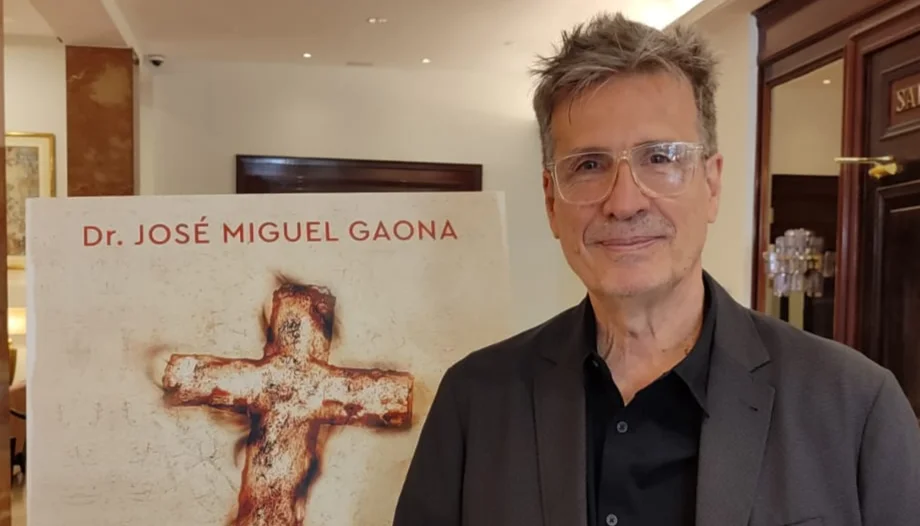
The writer C. S. Lewis once said that the devil’s greatest success was having convinced people of faith not to believe in him. Eighty years later, that statement is even more true, but a scientist has decided to study the subject of demonic possession in depth and put his conclusions in writing.
Dr. José Miguel Gaona is a forensic neuropsychiatrist who has spent more than 20 years exploring that frontier where medicine runs out of answers. He does not set out to tell the reader what to believe, but rather to recount honestly what he has seen. This is not a religious book, but rather a scientist’s honest exploration of these kinds of phenomena.
The Indiana Jones of Neuroscience
A leading specialist in brain research described Gaona as the «Indiana Jones of neuroscience,» and that nickname is hard to dispute once you learn about his track record in fieldwork.
A member of the European Psychiatric Association and the New York Academy of Sciences, a specialist in noninvasive brain stimulation trained at Harvard University, and one of Spain’s most renowned forensic psychiatrists, Gaona has spent years venturing into territory where few scientists have set foot: he has attended exorcisms with Catholic priests and even nighttime ceremonies in Morocco from which he nearly did not emerge unscathed.
«I was in Casablanca, in a suburb, attending one of these ceremonies when it suddenly turned dangerous,» he says. It was a Gnawa ceremony—music of African origin that has been syncretically absorbed by the Islamic world, whose secret rituals are persecuted by the Moroccan regime. I was the only Westerner there. When one of the participants pulled out a real machete and began cutting himself, splattering blood on the walls, Gaona realized the gravity of his situation: «I’m the only Westerner here, it’s 3 a.m., and no one knows where I am.».
When Gaona began to take a serious interest in these topics, he decided to pursue «a diploma in theology at the University of Navarra so he could understand what goes on in the minds of priests. I’ve always found it to be both a tremendously mysterious and fascinating question.».
But the hardest part was getting the Vatican to admit him to the course for exorcists at the Regina Apostolorum—a pontifical university in Rome—which is highly unusual for a layperson. «It took some effort because they didn’t admit anyone who wasn’t a member of a religious order,» he explains. Once admitted, he spent days living alongside priests from the United States, the Philippines, and Peru, and formed friendships that opened doors for him to attend numerous actual exorcisms.
A book for believers, skeptics, and those in between
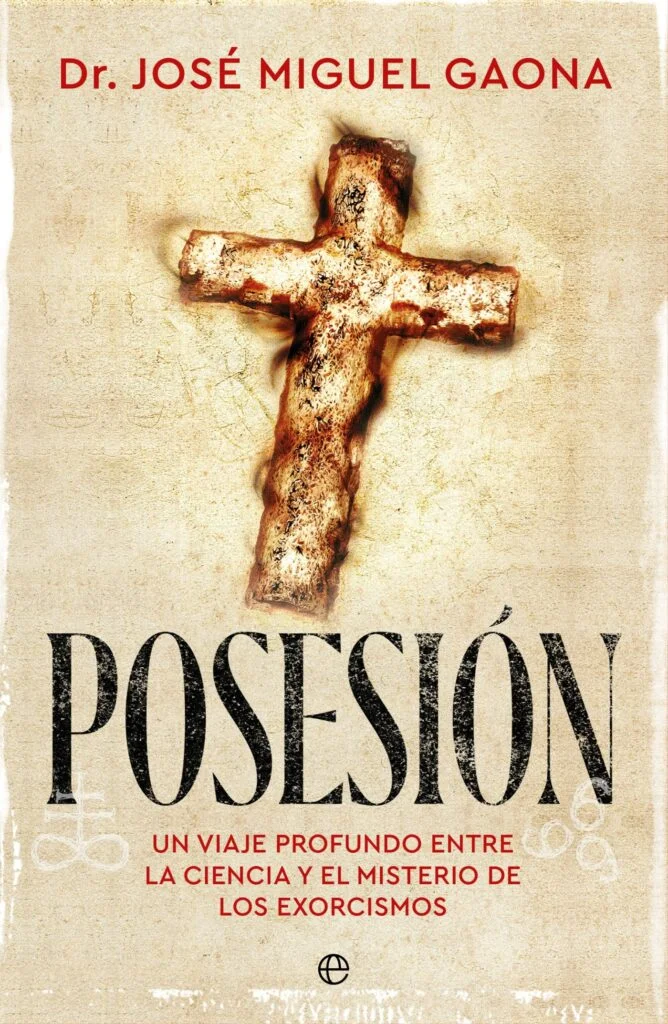
Possession It stems from a question that few scientists dare to ask aloud: Where does disease end and the inexplicable begin? «The book does not aim to settle the debate over the existence of the devil»—that, says the author, is beyond the scope of any reproducible scientific method—«but rather to explore what happens in that small but unsettling percentage of cases that do not fit into any known psychiatric classification.».
Gaona’s work may appeal to deeply religious people as well as skeptics or those interested in science or spirituality. Its pages blend neuroscience, theology, forensic cases, and firsthand accounts from some of the world’s most prominent exorcists. The result, according to the author himself, is «interdisciplinary.».
Gaona clarifies that the book «isn’t scary to read. Everything is seen from the perspective of good. It is good that observes and looks at evil. Therefore, I think anyone could read it.» Sensationalist language and gory anecdotes are completely absent from the text.
Amorth, Gallagher, Sudano, Luzón, or Randazzo
Four key figures form the backbone of the book’s testimonial section. Father Gabriele Amorth, the most famous exorcist of the 20th century and founder of the International Association of Exorcists, appears in an interview that Gaona conducted with him during his lifetime and that is now being published posthumously.
Amorth, who performed thousands of exorcisms throughout his life—although, as Gaona points out, «many of them were actually prayers of deliverance, not the formal exorcism ritual»—had numerous enemies for decades, even within the Vatican. «There is no worse thing than denying the existence of the devil. Ultimately, it is denying the existence of evil as a force,» says Gaona when discussing the resistance Father Amorth encountered during his lifetime.
Richard Gallagher, a psychiatrist and professor at Columbia University, writes the foreword to the book and wholeheartedly recommends it. Gallagher is no ordinary figure in the world of paranormal phenomena; he is possibly the therapist who has treated the most possessed individuals worldwide, having documented cases that defy medical explanation: patients who speak fluently in languages they have never learned, reveal information they could not possibly know, or display physical strength far exceeding their build.
Glenn Sudano, an exorcist for the Archdiocese of New York, is another of the people with whom Gaona has spoken at greatest length, and to whom he devotes 15 pages of the book. The choice of New York as the setting is no coincidence: «It’s a global icon of modernity, of the avant-garde, of what’s most current. And at the same time, it’s paradoxical that Glenn Sudano, the exorcist, is swamped with work,» explains Gaona.
And finally, there is Pietro Randazzo, to whom Gaona dedicates an entire chapter: “He is considered the world’s most famous exterminator; he lives in a small Italian village and spends his time traveling halfway around the world to treat houses that their inhabitants describe as haunted.” Gaona precisely defines what a possession is and what it is not, rigorously explains exorcism rituals, and delves deeply into the phenomenon of infestations—those places and objects that, according to tradition, may harbor malevolent presences—with a seriousness that contrasts with the sensationalism surrounding the topic in other contexts.
The Unicorns of Science
The Catholic Church, Gaona clarifies, is much more rigorous about exorcism than the movies would have us believe: «I would venture to say that in 95 %, if not 98–99 %, of cases, the Church itself refers the supposedly possessed person to a psychiatrist. A large proportion of cases, without a doubt, have a psychiatric root.».
Exorcism is a last resort; it is free, discreet, performed only by priests appointed by their bishops, and preceded by a period of preparation that Gaona compares to that of an elite athlete: fasting, confession, and deep prayer.
But what interests Gaona as a scientist is that residual margin that defies all of the above. «What we might call the unicorns of science. These are situations in which a rational explanation is very difficult to find. It occurs in all fields of science; for example, in quantum physics, it’s an accepted fact that sometimes 2 plus 2 does not equal 4,» he explains.
This occurs, for example, when one observes xenoglossy—people with no formal training who speak fluently in languages they have never learned—the levitation of objects, and knowledge that those supposedly possessed would have no way of possessing. «How is it possible that during an exorcism, someone would have knowledge of something happening elsewhere or of something that happened long ago to one of those present who are accompanying the priest with their prayers?» he asks.
As a forensic neuropsychiatrist who has served as an expert witness in some of Spain’s most extreme criminal cases—including that of Patrick Nogueira, the young man who dismembered his in-laws—Gaona has reached an uncomfortable conclusion: «There comes a point when you start pulling at the thread, pulling at the thread, and I can only explain it as evil. And it’s a force that drives us against one another.».
That’s not a theological statement. It’s the acknowledgment of a limit. «Science must study everything. I think we have a license—in quotes—to kill like James Bond, in the sense that we can study anything. If science has prejudices, that’s the height of not being open-minded,» says Gaona.
For believers and non-believers alike, Gaona’s message points in the same direction: it’s worth focusing on that one or two percent. We’re a group of people trying to snap a photo of the unicorn.
Possession






 Español
  English
  Italiano