



- Gina Christian, OSV News
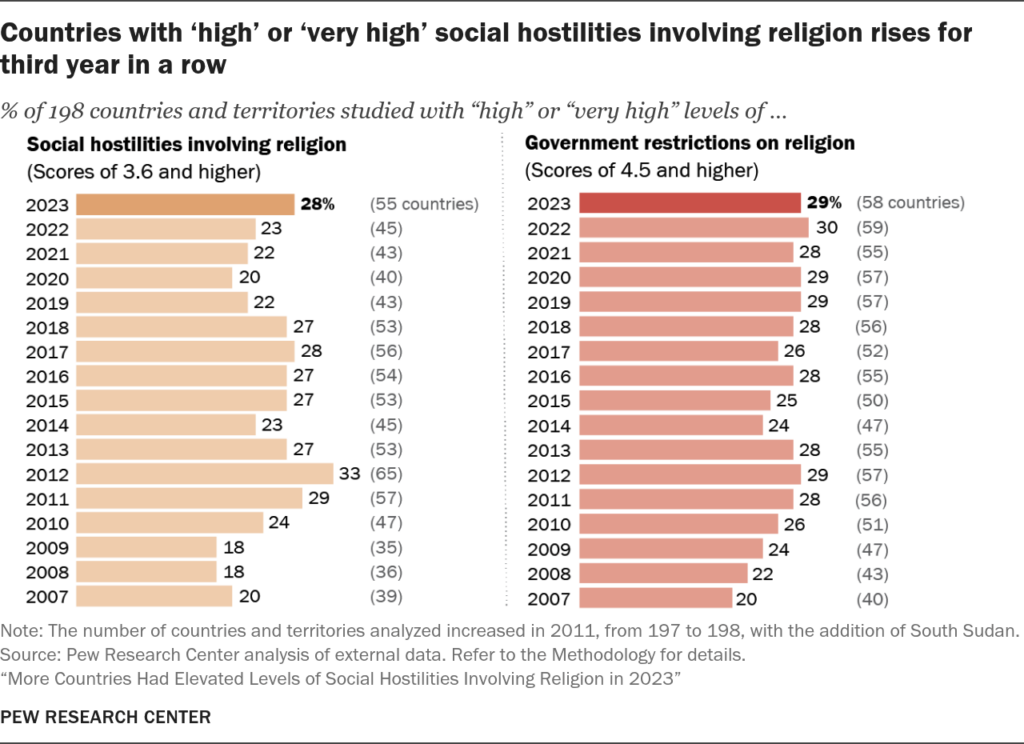
Religious and social hostility is on the rise, and at the same time, since 2007, an increasing number of governments have stepped up their crackdown on religious beliefs and expressions.
The findings were published on June 15 by the Pew Research Center in its 16th annual report on levels of religious restriction worldwide.
Pew researchers Samirah Majumdar and Vivian Jacobs analyzed data from 198 countries and territories—representing “nearly the entire world population”—drawn from 19 key sources, including national constitutions, the U.S. State Department, the United Nations, the European Union, the FBI, Human Rights Watch, and Amnesty International.
Pew and ACN Agree: Religious Freedom Is on the Decline
The Pew Report refers to 2023, the most recent full year for which data is available, while the figure for Aid to the Church in Need (ACN), released in late 2025, analyzed the period from January 2023 to December 2024—one more year.
According to Pew, 55 of the 198 countries studied recorded “high (high or very high) levels of religion-related social hostilities in 2023,” compared with 45 the previous year—a clear increase.
And ACN was diagnosed with that in 62 of the 196 countries analyzed, religious freedom is severely violated, and only two—Kazakhstan and Sri Lanka—showed some improvement. In his view, nearly two-thirds of humanity (more than 5.4 billion people) lives in countries without religious freedom.
Two indicators: restrictions and hostilities
The Pew Research data has been categorized according to two indicators: a Government Restrictions Index, which tracked officially imposed religious restrictions; and a Social Hostility Index, which measured acts perpetrated by individuals, groups, and organizations, such as vandalism and physical attacks.
Pew noted that its summary statistics were not intended to determine which specific religious group suffered the most religious persecution, since even a single incident of harassment in a given country was counted.
Currently, there is no internationally accepted definition of religious persecution, as it can take various forms.
Radiography: the case of Norway, and others.
According to the research center, Ethiopia and the Philippines saw a decline in religiously motivated social hostilities that same year, moving from the "high" to the "moderate" category on the Pew Index.
Belgium, Norway, Russia, Spain, and Sweden, for their part, fell into the “high” category of Pew’s social hostilities index in 2023, along with the Democratic Republic of the Congo, Guatemala, Sierra Leone, Sudan, Tanzania, Thailand, and Turkey.
According to Pew, individual and collective harassment of Muslims, Jews, and Jehovah's Witnesses raised Spain's score on the index in 2023.
Norway also witnessed, according to Pew, “repeated attacks” against Jehovah’s Witnesses, as well as an “increase in hate speech” against Jews and Muslims, following Hamas’s attack on Israel on October 7, 2023, and the subsequent war between Israel and Hamas.
Cases of violence
Collective violence in Russia against Jews and Muslims contributed to that country's higher score on the Pew Social Hostility Index in 2023.
In one incident, “several Russian women attacked a Muslim woman wearing a hijab and her children at a playground” on the outskirts of Moscow; according to Pew, “the attackers allegedly set their dogs on the family and assaulted them.”.
The research firm stated that in 2023, «government harassment of religious groups (whether verbal or physical) was one of the most common types of restrictions on religion,» continuing a trend seen in recent years.
According to Pew, this type of harassment «occurred in 185 countries»—that is, in 98% of the total number of countries studied in 2023—a figure that is nearly the same as the previous year’s total of 186.
Furthermore, according to Pew, interference with religious worship «was a very common type of government restriction,» observed in 175 (88%) of the 198 countries and territories examined, «marking a new high for the study.».
Countries with severe restrictions and lowers
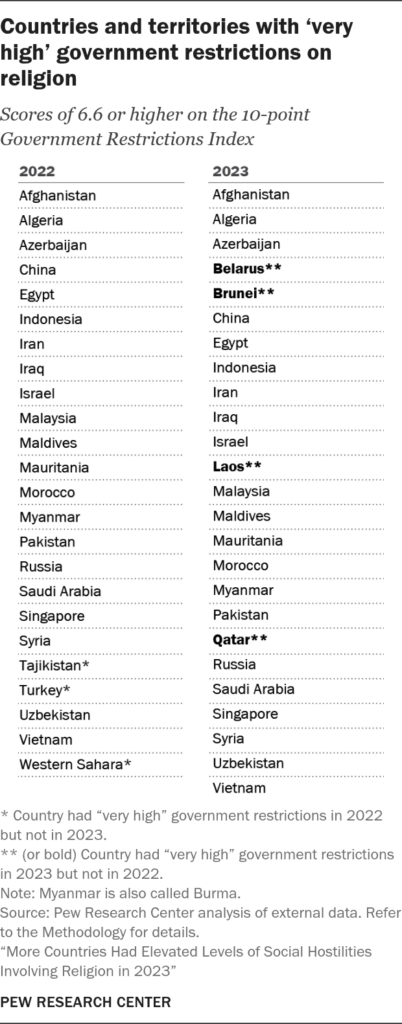
According to Pew, among the world's 25 largest nations, those with the highest levels of government restrictions on religion were China, Iran, Indonesia, Egypt, and Russia.
According to Pew, among that same group of nations, “South Africa, the United States, Japan, the Philippines, and the United Kingdom had the lowest levels” of government restrictions on religion.
North Korea is not included in the study, despite its severe repression
It is important to note that Pew clarified that North Korea was not included in the study, although “sources clearly indicate that the North Korean government is among the most repressive in the world with regard to religion, as well as other civil and political freedoms.”.
Pew explained that «North Korean society is virtually closed to foreigners” and that “independent observers lack regular access to the country,” making it impossible to collect data from that nation.
Countries with the most social hostility, and with the least
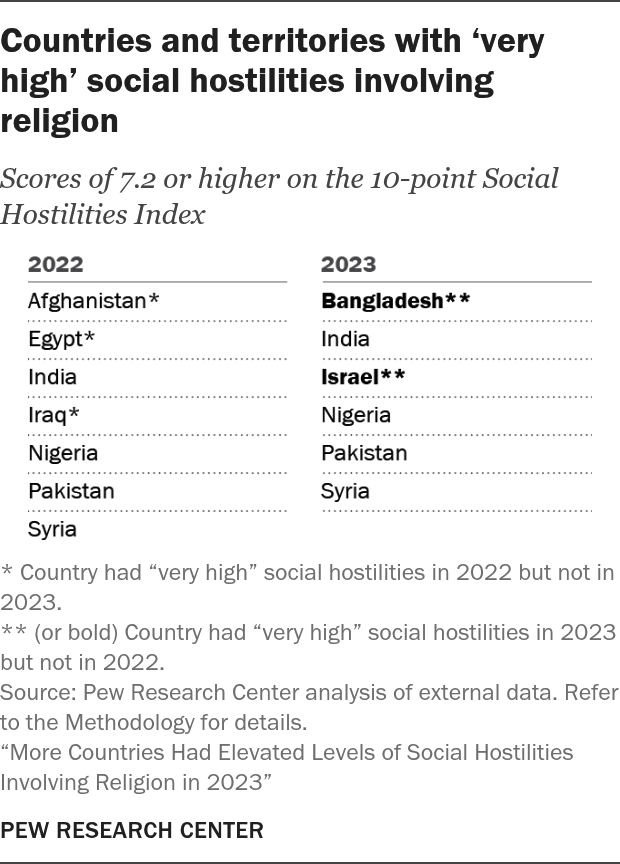
Among the 25 most populous nations, “Nigeria, India, Bangladesh, Pakistan, and Egypt recorded the highest levels of religion-related social hostilities,” Pew states, noting that, with the exception of Egypt, those countries scored “very high” on that index.
In contrast, according to Pew, “China, the United States, South Africa, Japan, and Vietnam” had “the lowest scores for social hostility” among the 25 most populous countries in 2023.
Pew noted that, over the years the study has been conducted, the average score for government restrictions “has risen fairly steadily,” while the average score for social hostility has “fluctuated.”.
According to the research center, this trend “suggests that governments have been cracking down on religious beliefs and practices more severely than in 2007,” while “the number of countries experiencing social hostilities has tended to rise and fall depending on current events.”.
—————–
Gina Christian is a multimedia reporter for OSV News. Follow her on X @GinaJesseReina.






 Español
  English
  Italiano
  Français
  Deutsch
  Polski
  简体中文
简体中文