



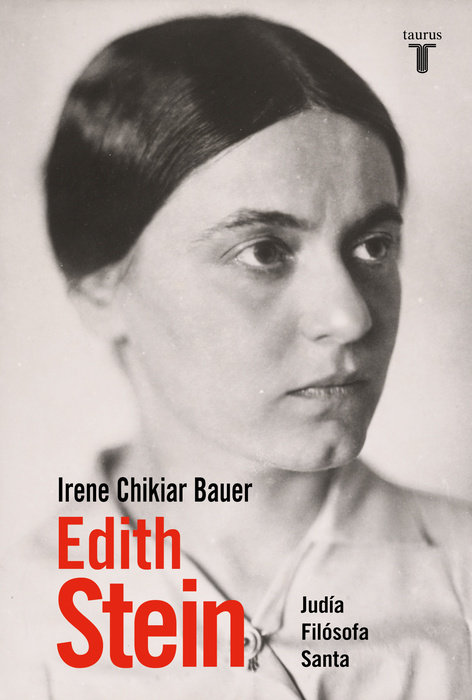
August 9 marks the feast day of one of Europe’s greatest contemporary saints: Saint Teresa Benedicta of the Cross, Edith Stein. An outstanding philosopher and disciple of Husserl, she was Jewish, converted to Catholicism, became a Carmelite, and was martyred during the Nazi persecution at the Birkenau concentration camp. She is one of the patron saints of Europe. Possibly the best biographical account ever written about her can be found in the monumental biography Edith Stein. Jewish. Philosopher. Saint, Published by Taurus in 2025 and written by the Argentine author Irene Chikiar Bauer.
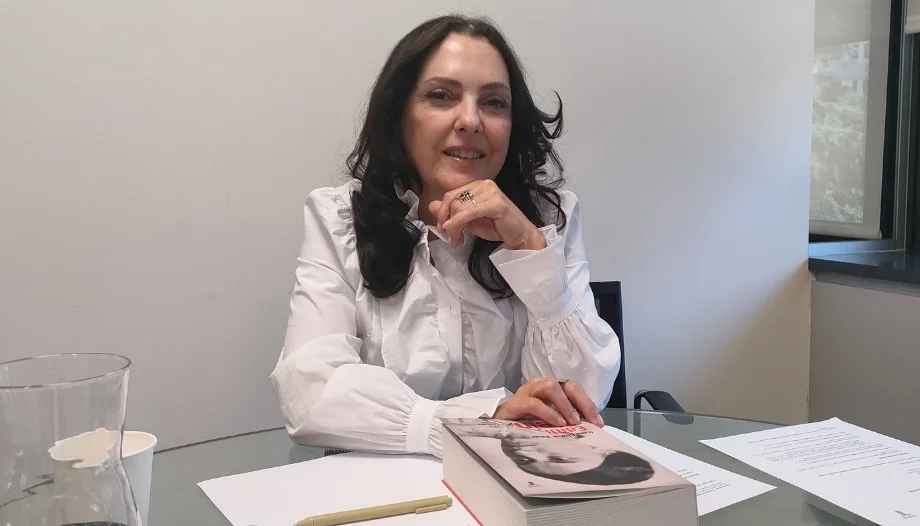
The author of the book holds a Ph.D. in Literature from the National University of La Plata in Argentina, a master’s degree in Sociology of Culture and Cultural Analysis, and is a professor at the University of San Martín and the University of San Antonio de Areco; she is also the author of another comprehensive biography of Virginia Woolf. She is in charge of Omnes in Madrid to promote the book about a leading philosophical and religious figure.
What attracts you to Edith Stein's profile? Why did you become interested in her?
–When John Paul II canonized her in 1998, I first learned about this woman. I find her journey—from Judaism to her departure from her parents’ faith at age 13—truly remarkable. She considered herself an agnostic, devoted herself to her studies, and loved literature and history. Then she discovered philosophy and began asking herself the great questions of human existence—which are the great philosophical questions—but ones focused more on experience, on understanding the world, and on understanding oneself. Through this process, she came to conversion.
I believe he is a key figure for our times—times in which reason and religion are often seen as separate, at least among the general public.
And she chose the religious path when they wouldn't let her be a teacher or lecturer, despite her success; she had always wanted to be a Carmelite, and when that path was cut off, she felt it was time to do what she had always wanted: to enter the Carmelite Order.
She has many qualities that make her special. In the book, for example, her pioneering feminism is highlighted.
–Virginia Woolf, who is the subject of my other, earlier, voluminous biography, is also a pioneer and a forerunner of feminism, but she did not define herself as such. And she was born in 1882. Edith was born nine years later, but unlike Virginia Woolf, she did go to college, and there she discovered she was a feminist, because she believed that women should have the same rights as men. Some of her friends were studying at the university, but they were grappling with their “double vocation”: What if they got married? Would they have to give it all up? Many didn’t see having a family as compatible with having a career. She firmly believed that it was possible to do both. In that sense, she considered herself a feminist and said so.
She is also a political activist, because she was active in the Weimar Republic. Of course, she soon became disillusioned, because she says that to be in politics, you need a strong conscience and a thick skin.
From that moment on, he devoted himself entirely to philosophy—and through philosophy. It was during this phase of phenomenology that his path to conversion took shape. She was not the only one, because Husserl had also converted to Christianity, and Adolf Reinach—an exceptional figure who was Husserl’s chief assistant—also converted. Some conversions stem from a deep, personal conviction, occurring during truly tragic moments. This is extremely striking to us today—to people who lack religious experience. We see people going through truly horrific experiences, and instead of resenting life and giving up on everything, they find this religious experience and the search for the transcendent.
As a nurse
Edith Stein worked as a nurse during World War I. How did this work influence her?
–It’s essential. She can’t stand the fact that while Reinach and all her male friends are at war, she can’t do anything. She volunteers to be a nurse. First, she goes to the clinic where her sister Erna is a doctor, gets trained, and then leaves.
This is extremely important for nurses. In fact, she devotes the longest section of her autobiography to her time as a nurse, and she does so with great precision. She writes with a deep commitment to what the work entails. She has such empathy for the sick that I believe that experience served her well when she wrote her thesis on empathy. Because of what she experienced there—she had to care for patients who couldn’t even speak, who had to communicate with their eyes, or who didn’t speak the language—,
The theme of empathy in Stein is a very modern one, in the sense that it’s highly relevant today, isn’t it?
–Empathy is a word that is often used but rarely put into practice. Edith Stein contrasts with earlier views that claimed empathy was simply feeling for someone; she says that is not the case, but rather feeling what the other person feels, while recognizing that those feelings belong to the other person. That is true communication; anything else is mere contagion. That empathy also requires an ethical decision, and in that regard, Edith Stein was a master.
She always made ethical decisions with regard to others, and she asserts that “the purpose of humanity is for one’s voice to resonate with those of others.”.
There is also something very interesting about how she never renounced her Judaism, at a time when there was tremendous anti-Jewish propaganda in Germany. As a professor and lecturer—and already a Catholic—she said this: “The Lord chose a people to be born among them; during his earthly life he spoke the language of this people, thought in their metaphors and images, observed their customs, devoted all his energies to them, and has given each people a mission on this earth and for eternity, and to each individual, a mission within this people.” She is an ecumenical, forward-thinking, incredible woman.
He is a leading figure, but I'm not sure if he is well enough known.
–She is little known, except in Catholic circles—especially among Carmelites—because once she entered the Carmelite Order, she was no longer interested in being a renowned philosopher. Then the Nazis came, they killed her, and no one wanted to remember her.
I'm very pleased to have brought in a publisher like Penguin (Taurus)—which is a global publisher and not a religious imprint—to publish this author.
A book by Alasdair MacIntyre has been tremendously helpful to me, because he, too, from a philosophical perspective, writes about the importance of Stein and many of her insights—which, had she been able to continue working within philosophy, who knows where they might have led—and which were later developed by phenomenology as well. She made some remarkable contributions, such as her attempt to reconcile phenomenology with St. Thomas Aquinas.
It's also a bridge between faith and reason, isn't it?
–That’s what struck me so much. A person who turns her back on her parents’ faith, who declares herself an agnostic, who throws herself into her studies like a madwoman—brilliant—and values reason above all else, eventually finds her way to religion and that reconciliation between knowledge and spirituality, which are not mutually exclusive. That’s really striking.
To Faith Through Reason
She comes to faith through reason…
–Yes, it stems from agnosticism. So how did she come to have such a profound religious experience? When Edith Stein wrote her autobiography, Nazism was already at the height of its power, and her confessors, within the Catholic community, asked her to write her story because they saw it as a way to counter the horrific Nazi propaganda.
So she writes to portray the reality of Jewish family life, which had nothing to do with what Nazi propaganda depicted. But since she was writing within that context as well, there are also many things she likely left unsaid.
Why did she convert while reading St. Teresa?
–When she begins to think about a transcendent figure—about God—she says, “My path will lead me to Christianity,” but she doesn’t know whether she’ll become Lutheran, like most Germans, or Catholic. Like Edith Stein, she doesn’t just sit around waiting to see what happens; instead, she starts reading everything she can: Lutheran theology, Catholic theology… At one point, she comes across the book by Teresa of Ávila, The Book of Life. And she realizes that this is her path, and she wants to become a Carmelite. Why? One thing Teresa doesn't mention is that her grandfather was Jewish. When you read the Book of Life, it's clear that Teresa is always saying that what matters is how you act in the world—your actions—not where you come from.
To me, Edith Stein is the Saint Teresa of our time, although the context is different, because we don’t live in a religious society. Saint Teresa and Saint John lived in a very religious society; they had many enemies, but they also had many followers, which is why they were able to bring about reform and found convents. Edith Stein came along in the 20th century, at a time characterized—following positivism—by the reign of reason.
It's truly incredible that, even so, she would return to the path of spirituality.
It should also be noted that St. John of the Cross and St. Teresa, even though they had many enemies, were surrounded by people who loved them at the end of their lives. Edith Stein died alone in a concentration camp, surrounded by victims like herself.
Could he have avoided his martyrdom?
–She could have escaped. At one point, the Carmelites in Germany, in order to protect her, proposed sending her to the Netherlands, but when the war broke out and the Nazis invaded the Netherlands, they tried to get her out of there. They tried to take her to Switzerland, but one of her sisters, who had also converted, was working as a gatekeeper at the convent, and Edith Stein refused to leave without her sister. Amid these delays, the Nazis finally took her away in retaliation for the Dutch bishops’ letter against Nazism, as part of a campaign of vengeance aimed at rounding up all Jews who had converted, as well as many people who had married Jews. These were the first deportations of Jews to concentration camps. That is where she was killed—in Birkenau.
What is his most notable trait?
–The name she chose when she entered religious life is telling. She chose Teresa, obviously after Teresa of Ávila; Benedicta, because she spent a lot of time with the Benedictines (many wondered why she didn’t become a Benedictine); and de la Cruz. Her name says it all—it embodies that consistency and those values.
What is striking about Edith Stein, what is moving about her, is that search for meaning. Many Catholic biographies have described her as a seeker of truth. But from a more secular perspective, she is a seeker of the meaning of life.
Edith Stein. Jewish. Philosopher. Saint





 Español
  English
  Italiano
  Français
  Deutsch
  Polski
  简体中文
简体中文