


If the Galindo Brothers were known for anything up to this point, it was undoubtedly for their original Christmas carols, with their unmistakable style. Sung and cherished by many families, these carols mark the beginning of Advent each year and herald the arrival of Christmas. These carols can be heard on platforms such as Youtube and in Spotify, it's worth it.
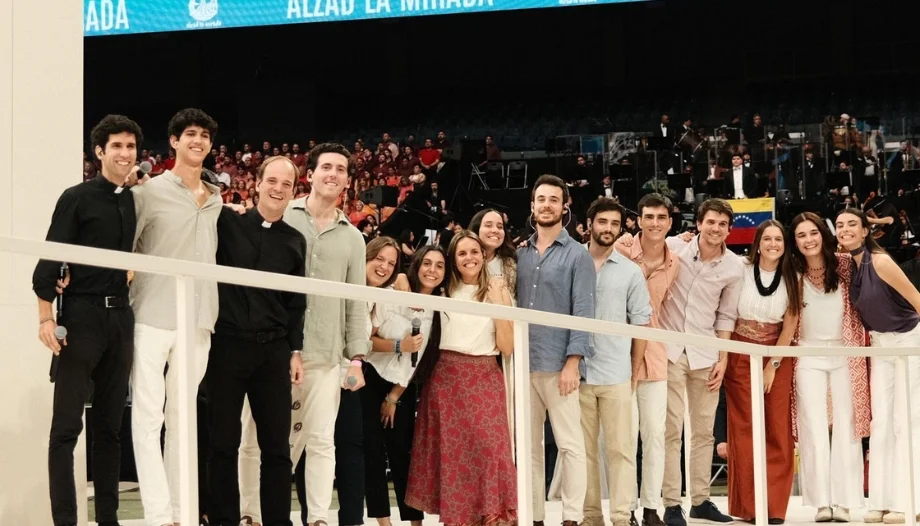
But for the past few days, they have been known for something even more significant, if that’s possible—for having sung the song “PETRUS (In Illo uno unum)” before Pope Leo XIV at the Bernabéu, alongside Luispo and Ignacio Ozores and a few other young singers.
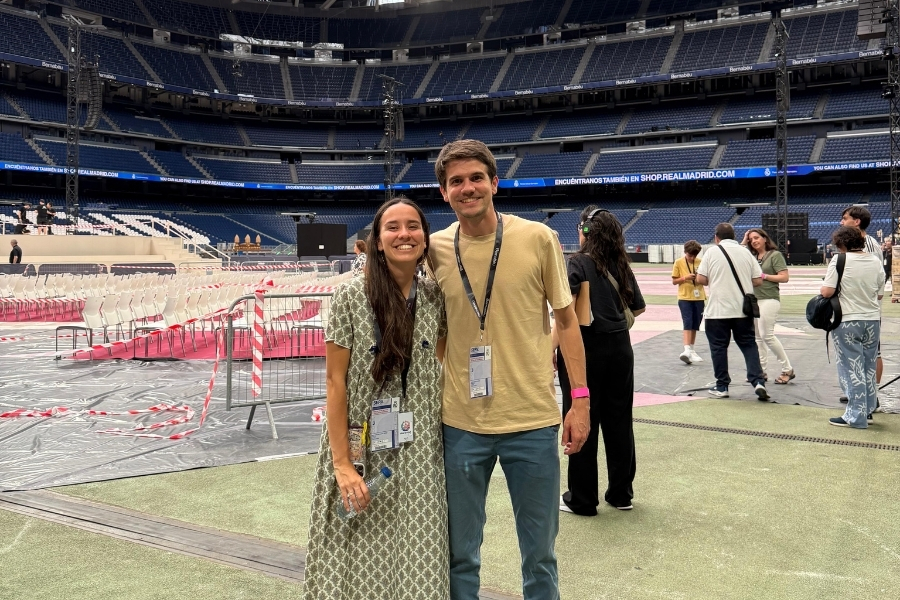
Álvaro and Catalina (Cati) Galindo Jiménez are the members of Hermanos Galindo who performed before the Papa. They are part of a family of nine siblings, which has largely shaped who they are as people. Álvaro is a composer, singer, pianist, developer, and producer, and a huge fan of *The Lord of the Rings*, *Harry Potter*, board games, and many other worlds. Cati is a singer, violinist, designer, and teacher, and she recently got married.
Today we have the opportunity to hear him tell us about his latest adventure, what his past adventures have been like, and what his future ones will be.
Cati, how did the opportunity to sing “PETRUS (In Illo uno unum)” in front of the Pope come about? Why do you think you were chosen to help give voice and music to this song?
–It’s all thanks to Luispo and Ozores, the song’s composers. They wanted the song to be a symbol of unity among Christian music groups, just as Pope Leo XIV’s motto conveys. So we teamed up with Hermanas Pobres, Tuyo, Hakuna, Servus Mariae, and many other groups and singers. And since we’ve been friends with Luispo for years, he wanted us to be part of it.
Álvaro, what's the story behind this song? What was Luispo and Ozores' intention in writing it?
–As they mentioned in an interview, a year ago, when Pope Francis was hospitalized, Ozores came up with the first line of the song: “A man dressed in white prays in the Eternal City.” He said it was very beautiful that the whole Church was praying for the Holy Father. Months later, they finished the song, and I believe—if I recall correctly—that it was recorded on the very day Leo XIV was elected.
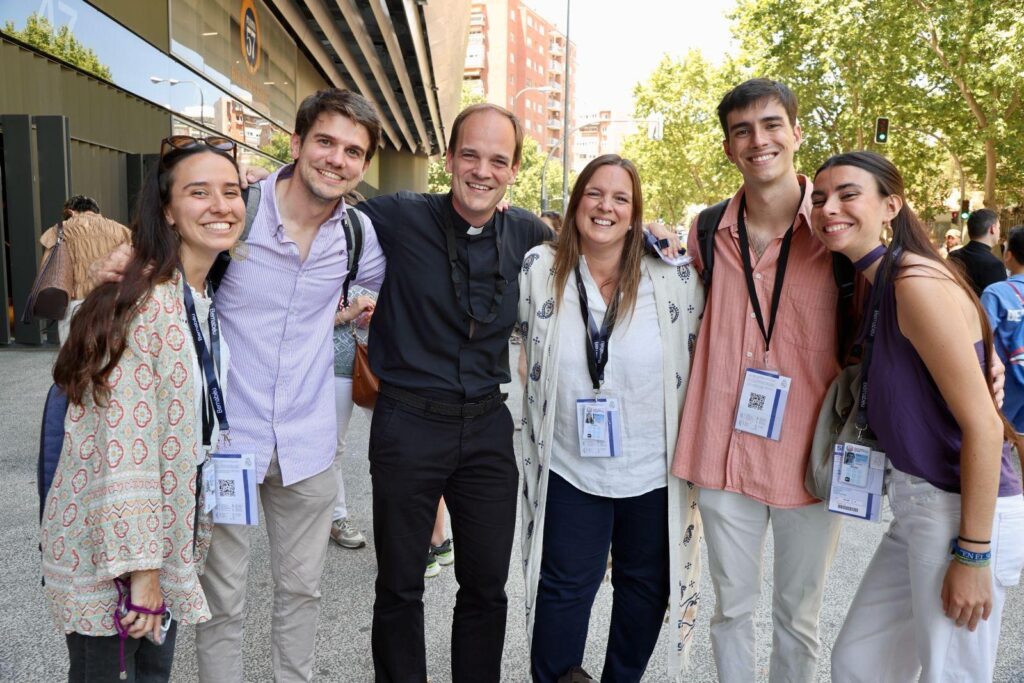
Cati, it’s clear that the experience you’ve had isn’t limited to its climax—performing for León XIV—but also includes the many enjoyable moments and anecdotes you’ve shared, both before and after that “big moment.” Which of them stand out to you? Have you formed bonds among all the members of this group?
–The truth is, it’s been an incredible experience—we were talking about it when it ended—and no words can do it justice. It’s been wonderful to meet so many good people along the way, who ultimately see in music the same mission that we do: to bring people closer to God. To name just a few: the Catela brothers, Ozores, Beltrán Quinto…
In addition to singing at the Santiago Bernabéu Stadium, Álvaro, you also sang in the choir at the Vigil. What was that experience like? What took away from that performance?
–What struck me most was how involved everyone was. From day one, the entire choir—all 150 people—already knew their parts. This might seem normal, but it’s not at all. Right from the very first day, we were fine-tuning things. And what struck me most was being able to sing for the Pope; two moments in particular stand out for me: when we sang “Tarde te amé” (the choir included a good number of Augustinian nuns who added important nuances to this piece based on a text by St. Augustine) and the song “Tú, el único Rey.” It was truly impressive to hear hundreds of thousands of people singing from our vantage point in the choir.
But let's talk about your specialty: Christmas carols. How did this interest come about? How much has your family influenced it? What are you hoping to achieve with this project? Is it a calling?
–We started with a YouTube channel where we covered various songs. When Christmas came around, we released our first Christmas carol, and another one the following year. With the pandemic, we decided to put out an album and launch a four-year project—releasing one album per year. In total, we’ve released around 50 Christmas carols so far, though we’ve also recorded other types of songs, of course. This group was formed within our family, through singing together as a family. There’s a strong tradition of Christmas carols, and we decided to share this passion of ours with the world. The Pope recently spoke about the mission musicians have to serve the faith; we try to convey that within a family setting, and we believe that Christmas carols are a very powerful tool.
Álvaro, Cati, so you don't get typecast as a Christmas song duo, you've started branching out into other genres. What are they? What are you hoping to achieve? How's it going?
–We don’t take on projects “just to avoid being pigeonholed”—let me explain—each project arises from a need to tell a story. It tends to come in waves. Everyone evolves over the years; I’d even say from day to day. Relatively recently, we discovered the potential of the Psalms, and we’ve already released our first album of Psalms; now we’re working on the second. We’ve also recorded an album about Spanish culture, which will be released shortly. Speaking of the Pope, I’ve found all the Holy Father’s references to our homeland to be very enlightening; he had to come to remind us of who we are and the responsibility we bear in history.
To some, it may seem like just a hobby—albeit one practiced well. How much training, talent, creativity, and practice go into any song?
–Is there anyone who thinks that? Hahaha, that’s news to me. Fourteen years at the conservatory, a conservatory professor… What does it take to be a professional musician? It’s another matter entirely that we’ve decided to put our gifts to use. That doesn’t make it any less professional. Behind every song there’s a process of study, prayer, hard work, trying out different versions, asking for feedback… All so that it can serve its purpose in the best possible way. For Psalm 51, for example, it took us practically a month to fit the entire text into the music without altering a single word.
What does music mean to you? What does culture mean to you? What other artistic fields do you work in?
–For us, music—and especially song—is the most direct and sincere way for human beings to speak with God, for it is where prayer, voice, and emotion come together. Furthermore, we can sing in a group, creating—as the Pope recently remarked—a polyphonic truth in the harmony of unity. Few art forms possess this capacity. Culture, therefore, broadens one’s ability to connect with the transcendent—with something greater than oneself—and to “lift one’s gaze.” We are particularly fond of painting, though we find all art forms appealing.
Looking ahead, what are your plans? What are your dreams?
–We'd like to perform our repertoire with a symphony orchestra and record an album of collaborations.
From your perspective, what does the Holy Father’s visit to Spain mean?
–In my personal opinion, I believe this marks the beginning of Pope Leo XIV’s pontificate, and I think it has been a very special blessing that he took his first major step in our country. As I mentioned earlier, the Holy Father’s words have served to remind us of who we have been and what we can still accomplish. He has come to unite us and help us set aside our differences so that we can build a shared vision.
To wrap up, do you think there’s a Catholic revival? Is there a resurgence of faith? What role is music playing? What other factors are influencing this, if this resurgence is real?
–I’ve never been much of a fan of trends. I think we’re truly experiencing a very special moment in which—especially artists and young people—we can express ourselves and need to do so without holding anything back. Because we’re searching for answers in a world that hasn’t given them to us. More and more artists are openly expressing their faith—the most recent example being Antonio Banderas with his statement, “I have been touched by God”—and I think this is very positive, since 20 years ago there was an atmosphere of self-consciousness surrounding belief in God. That intellectual superiority with which “atheism” used to be viewed is becoming increasingly evident, because it offers no answers to humanity’s true, transcendental questions.






 Español
  English
  Italiano
  Français
  Deutsch
  Polski
  简体中文
简体中文