


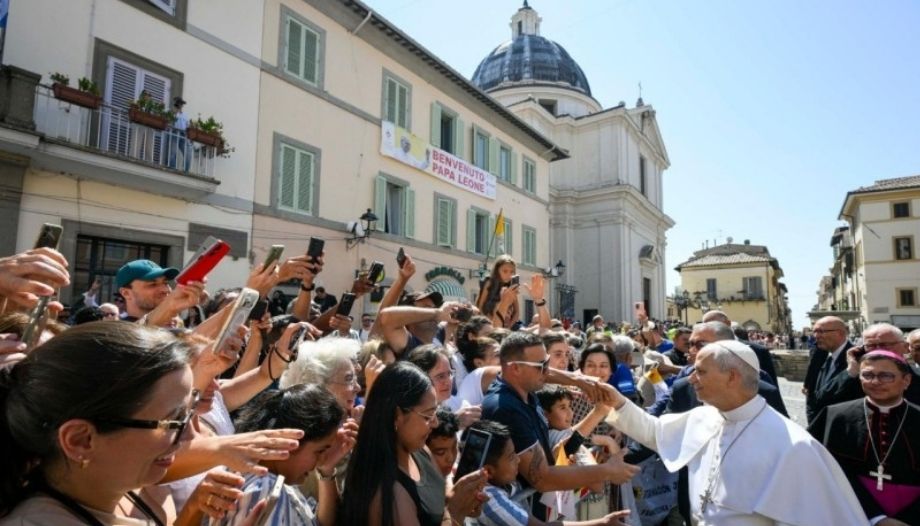
During the Mass for the Assumption of the Virgin Mary at the Pontifical Parish of St. Thomas of Villanueva in Castel Gandolfo, the Holy Father Leo XIV offered a hymn to the love and purity of the soul of the Mother of God and our Mother. The Mass was concelebrated with the Bishop of Albano and the Augustinian parish priest, and concluded with a Marian antiphon.
In its homily, has invited us to follow the light of the Risen One by looking to Mary, whom “God crowned with glory in soul and body, and whom He has given to us as Mother, guide, companion on our journey, and protector on the path to Heaven.”.
Assumed into heavenly glory, body and soul
"It is with great joy that I celebrate the Solemnity of the Assumption with you again this year," the Pope began in his homily during the Mass, in which he explained the Church's teaching on today's feast.
That “Mary, having completed the course of her earthly life, was assumed body and soul into heavenly glory” (Pius XII, Apostolic Constitution *Munificentissimus Deus*, November 1, 1950), and this Mystery reveals to us the fulfillment of the fullness of grace that God bestowed upon her at her Immaculate Conception.”.
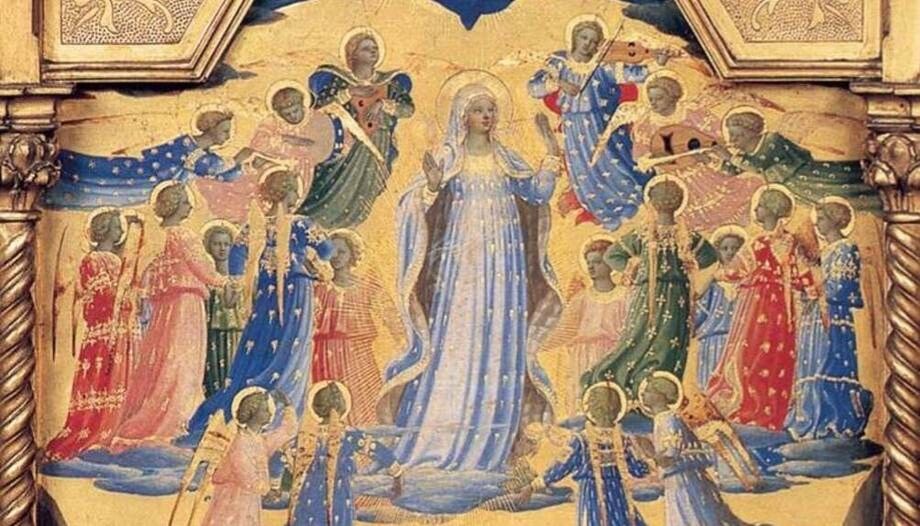
"That is why many works of art depict her, at the end of her earthly life, as a beautiful young woman who is physically rising from the earth toward heaven," the Pontiff continued.
“They are inspired by the scene described in the passage from Revelation that we heard in the first reading: ‘A woman clothed with the sun, with the moon under her feet” (Rev 12:1), to signify that in Mary’s heart are found heaven and earth, time and eternity.”.
In this way, the Pope has begun a profound and beautiful reflection on love. “What do we have in common with the wonderful young woman we see depicted in our altarpieces?” he asked.
True beauty shows the signs of love
“To understand this, we must hold together the two signs we have mentioned: the incorrupt body of the Mother of God and her immaculate heart. It is the purity of the soul, in fact, that in Mary—as in us—by God’s grace illuminates and transfigures the whole person, leading her to the glory of Heaven,” the Pope noted.
“The glorification of Mary in soul and body teaches us that our true beauty does not lie in hiding the signs of the passing of time, but in revealing, even in our flesh, the signs of love that never ends.” (cf. 1 Cor. 13:8).”.
Reexamine hedonistic and consumerist values
The Holy Father then invited us to reexamine many of the aesthetic standards—predominantly hedonistic and consumerist in nature—that the world imposes on us. And to encounter “people whose faces are marked by the years and by suffering, yet who are capable of radiating serenity, kindness, and peace to those around them; just as one might encounter others who are perhaps outwardly attractive, yet hard and cold on the inside.”.
"It is easy to understand where true beauty lies and where, on the other hand, there is still a need for conversion, forgiveness, and healing," said Leo XIV.
Where to Find Divine Beauty
The Successor of Peter, also following in the footsteps of St. Augustine, has shown us the way: “If we truly wish to discover and cultivate the divine beauty that surrounds us and for which we were created, as well as to spread it around us, we must learn to read it both in the tender face of a child and in the wrinkles of an elderly person. In the liveliness of a young person as well as in the composure of an adult, in festive decorations as well as in everyday clothing and work tools.”.
Listening to love stories, “man’s most beautiful adornment”
"We must listen to the unique love stories that each of these realities tells us, recognizing them as little flashes in the sky," he urged.
“Love is man’s most beautiful adornment: the love that transfigures, transforms, ennobles, and lifts us up; that makes us light, free, and close to God, even through life’s ups and downs,” the Holy Father said.
The miracle that Maria experienced in her heart
The miracle that Mary, the virgin of Nazareth, experienced in her innocent heart—and which led her to the glory of Heaven—is the meeting of opposites, as she herself testifies in the inspired words of the Magnificat, which we have heard in the Gospel (cf. Lk 1:46–55).
In this canticle, the Pope emphasized, “through the humble expressions of her faith, the Mother of Heaven speaks to us in simple terms about great mysteries. God, who becomes man in her to save humanity, (…), her status as «humble servant», the “small dimension” in which we, too, can encounter the Lord, as St. Paul VI said.
Today's Mystery: True Charity: family scenes
We need not look far to find the sublimity of the Mystery we celebrate. We can find it wherever there is true charity, as Leo XIV emphasized, describing scenes familiar to us all:
“In the eyes of a father and mother returning home after a day’s work, tired but happy to be with their children. In the faces of grandfathers and grandmothers who, despite the difficulties of old age, find unexpected energy when caring for their grandchildren. Or even in the commitment of young people who strive to grow up pure and honest, ready also to go against the grain when it comes to “what everyone else is doing.” Finally, in the work of so many men and women who, day after day, with faith and dedication, help bring a little bit of Heaven to earth and the earth to Heaven.”.
The beautiful face of the Assumption—the faces of the people who are by our side
The Pope has further clarified his words: “The most beautiful face of the Assumption is unique; it transcends any possible representation, and yet, at the same time, it is familiar to us: it is the face of the people who are by our side, even at this very moment—the brothers and sisters with whom we share, in faith, the daily offering of our lives.”.
For this reason, the Pontiff concluded, the community of believers sees itself reflected in the woman of Revelation, and the Second Vatican Council describes Mary as ‘the image and beginning of the Church, […] a sign of certain hope and comfort’ (Dogmatic Constitution Lumen gentium, 68). In her holy humanity, by the grace of God, lies ours as well; we are called to live her same fullness of life and to share in her same glory.”.
Angelus: The Assumption, a feast day of great importance
Following the celebration of Holy Mass, Leo XIV led the congregation in reciting the Marian prayer of the Angelus from Liberty Square in Castel Gandolfo, before a large crowd of faithful from Italy and other countries
At the beginning of his address, the Pope noted that the Assumption of the Blessed Virgin Mary is “a feast of great importance, both for Catholic theology and for popular piety; indeed, it is a celebration that is deeply cherished in many communities, especially where the cathedral or parish church is dedicated to Our Lady of the Assumption.”.
Two iconographic depictions: the ‘Dormition’ of the Mother of God and the Virgin in Heaven
To contemplate this mystery of the faith, we can turn to the two iconographic models that artists have used over the centuries to depict it, he explained.
The first, the oldest—and the only one for nearly a millennium—depicts the “Dormition” of the Mother of God: she is shown reclining on a coffin, asleep in death; surrounding her are the apostles, who venerate her, deeply moved, in prayer; standing in the center is the risen Jesus, who holds Mary’s soul in his arms, as if she were a newborn child.
Second, the more recent iconography, which developed later in the West, shows us, by contrast, the Virgin Mary in full figure, in heaven, surrounded by light, often with angels and saints around her.
The fullness of life “awaits us as well, at the end of time”
Some artists have combined both depictions, the Holy Father explained, portraying the glorious Virgin above and her empty tomb below—often filled with flowers of various colors—with the apostles gazing up at her in heaven. This second model highlights the truth that Mary was assumed into heaven body and soul—that is, in the entirety of her person.
“The fullness of life, which we joyfully admire today in Mary, ‘also awaits us at the end of time,’ as Leo XIV emphasized, when—as St. Paul says—the Risen Christ ”will transform our humble body, in the likeness of his glorious body’ (Phil 3:21), clothing what is corruptible with incorruptibility and what is mortal with immortality (cf. 1 Cor 15:54).”.





 Español
  English
  Italiano
  Français
  Deutsch
  Polski
  简体中文
简体中文