



 Spain excludes anti-Christian hatred from its official statistics, an international report denounces.
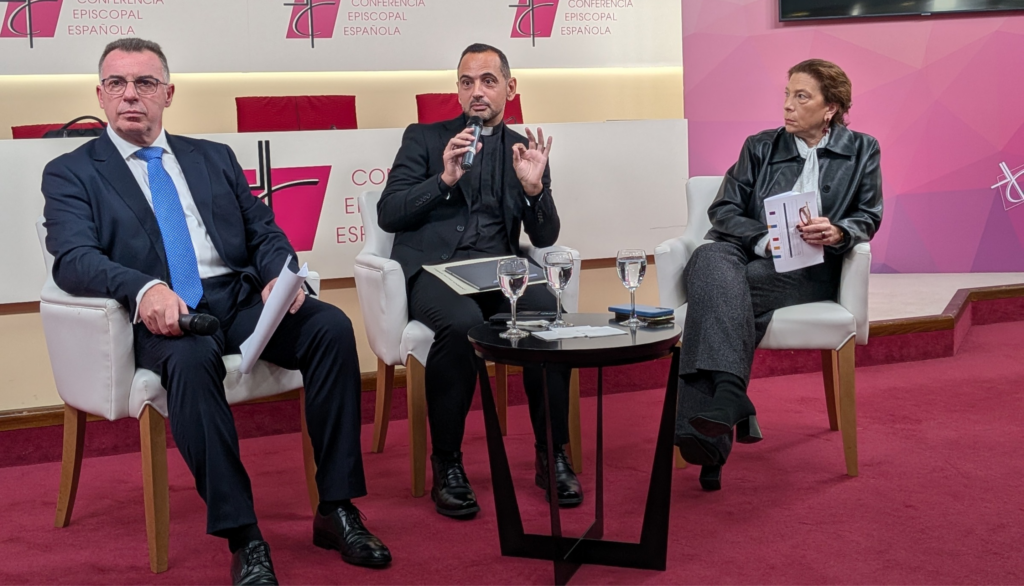
Up to 131 crimes against the Catholic religion were recorded in Spain in 2025, according to a report Presented by the new Office of Religious Freedom created a year ago by the Episcopal Conference. These criminal acts include acts that appear to be crimes, regardless of whether there is a court ruling or even a formal complaint.
This first report was presented by Rafael Vázquez and Ricardo García, two of the four people who work at the Office, which was created a year ago. It compiles information from media reports and reports released by dioceses. Vázquez clarified that “this is not about alarmism, nor about portraying a persecuted Church, far from it. It is about raising awareness.”.
Vázquez stressed that, although he is not in favor of speaking of Christianophobia, it is evident that “offenses against Christians exist.”.
The Interior Ministry ignores the crimes
Ricardo García has referred to the recent report from the Observatory of Intolerance and Discrimination against Christians in Europe (OIDAC Europe) presented this week. The The study alleged that Spain It does not record specific attacks against Christians. Along these lines, García lamented that the Ministry of the Interior does not have individualized records of hate crimes against Catholics, something that is done for Islam or Jews. “This should be reviewed in line with what the European Parliament has requested,” he warned.
He insisted that, beyond the brilliant work carried out by the security forces, “neither the public prosecutor's office nor the Ministry of the Interior makes any explicit reference to crimes against Catholics.”.
Most frequently, robberies
The report presents incidents against organized Catholics categorized into eleven different types. Theft is by far the most frequent: 56 cases were recorded in 2025.
Next, other forms of vandalism (12), defamation from freedom of expression (11) and others with 9 cases each: threats, attacks against the place of worship and desecration of graves or religious images.
Other types of incidents include: defamation of Catholics under the guise of artistic freedom (6), physical assault (7), and desecration of tabernacles (7).
In this last area, there have been reports of attacks on tabernacles in some hospital chapels.
Unclear boundaries
Although the report has followed certain consistent criteria, the distinction between simple criminal offenses such as theft or vandalism and the added element of hatred against Catholics is not entirely clear. This is an issue that future reports should define more clearly, as the Jewish community, for example, does. Furthermore, a detailed report on each of the 131 criminal acts has not been provided, something the Jewish community does.
Ricardo García clarified that the events documented in this report are not necessarily crimes: “For an act to be considered a crime, a judge must declare it as such. These events are based on ‘polarization criteria’ used by the security forces.” In fact, the report is titled “Hate Crimes Against Catholics in Spain,” although it actually covers events that appear to be crimes.
In this regard, Rafael Vázquez added that, sometimes, these types of incidents are not reported, “out of a kind of naiveté, but the idea is to raise awareness.”.
For his part, García reflected that police effectiveness in attacks against religious sites in general (not just Catholic ones) is reduced to 10 percent, so it is difficult for a judge to determine whether or not there was a crime against religious freedom.






 Español
 English
 Italiano
 Français
 Deutsch
 Polski