


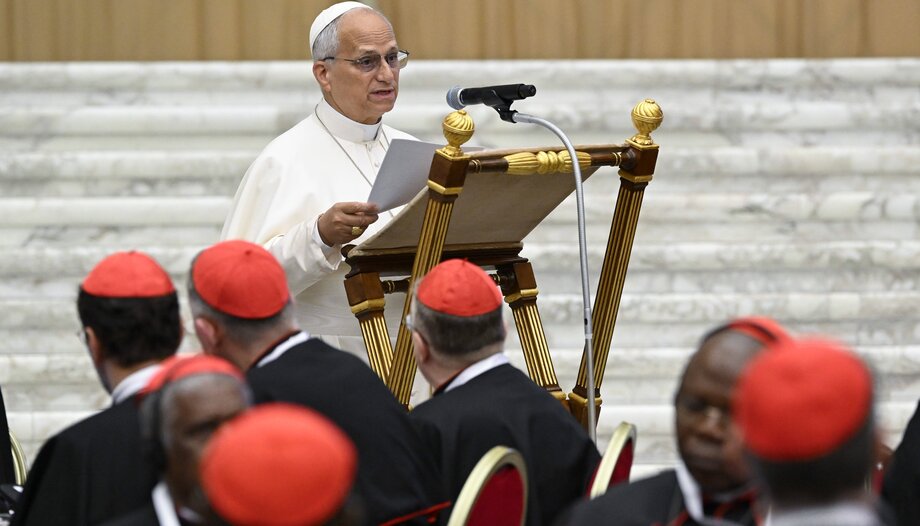
On June 27, cardinals from around the world concluded a two-day extraordinary consistory, stating that the initiative of the Leo XIV Convening the College of Cardinals twice in six months has already been a clear success: it has helped the cardinals get to know one another.
“For years and years, the cardinals didn’t know one another,” Cardinal Jean-Paul Vesco, Archbishop of Algiers (Algeria), told OSV News on June 27. “It is a very good initiative by the Pope and very helpful both for him and for the unity of the Church.”.
The format of the meeting held on June 26 and 27 brought the cardinals together in roundtable discussions, allowing them to hear the views of their fellow cardinals from every continent.
“Now, although I can’t say I know all the cardinals, we now smile at each other, talk, and chat,” said Cardinal Vesco. “And this is very important. I think it’s very important to the Pope himself.”.
“We’re starting to get to know each other. That’s what he wants. He wants us to get to know each other… I think it’s working,” the cardinal added.
Seeking God's Will Together
In his closing remarks, Pope Leo stated that he hopes the cardinals will continue to meet annually, adding: “What matters is not increasing the number of meetings, but learning to have meetings in which, by listening to one another, we learn together to listen to the Lord.” He announced that he would announce the date of the next consistory later this year.
“Over the past few days, we have sought the Lord’s will together, convinced that Christ continues to act in his Church: it is He who goes before us, brings us together, speaks to us through our brothers and sisters, and guides us in our mission. Everything comes from Him and everything returns to Him,” he told the cardinals on June 27.
“Seeing cardinals from such diverse churches, cultures, and backgrounds listening to one another and seeking together what best serves the Gospel has been a source of comfort and hope for me,” the Pope added.
Pope Leo highlighted the topics discussed over the course of the two days—war, poverty, young people, the family, synodality, the Church’s social doctrine, and his recent encyclical “Magnifica Humanitas”— and entrusted the cardinals with the task of putting the synod’s teachings into practice.
“Synodality is not a series of meetings, nor is it a working method. It is a spiritual way of life. It arises from encounter, grows through listening, and matures through discernment. The real question is not how many conversations we will be able to organize, but what evangelical quality our encounters will have,” he said.
The Return of the Special City Council Meeting
Before the election of Pope Leo XIV, the last extraordinary consistory of cardinals was held in February 2014—a full decade before Cardinal Vesco even received his cardinal’s biretta. For him, as for many of the cardinals appointed by Pope Francis from more than 60 different countries, the experience of the extraordinary consistory with Pope Leo XIV is a first.
St. John Paul II held six extraordinary consistories during his pontificate; Pope Francis held one at the beginning of his pontificate, and Benedict XVI did not convene any, although he did gather the cardinals for closed-door discussions during several ordinary consistories.
Pope Leo has already held two such events—in January and June of this year—in which he has combined roundtable discussions, similar to those held during the Synod on Synodality, with a traditional open-forum structure, and has given each cardinal the opportunity to speak with him directly.
Cardinal Vesco took that opportunity to reflect on the Pope’s recent apostolic visit to Algeria. “This morning I told him how deeply he had moved the Muslim people,” he said on June 27. “A woman told me that when she saw the Pope leaving Algeria, she felt as if a friend were leaving.”.
Cardinal Gerhard Ludwig Müller, former prefect of the Congregation for the Doctrine of the Faith, told reporters outside the Paul VI Hall on June 26 that the discussions had focused on the current situation of the Church, and added that “this does not concern only the College of Cardinals, but the mission of the Church in general.”.
Cardinals Debate “Just War” and Global Crises
Cardinal Pierbattista Pizzaballa, Latin Patriarch of Jerusalem, noted that during the consistory the cardinals discussed numerous crises around the world, and that one session was devoted to a chapter of Pope Leo’s recent encyclical, “Magnifica Humanitas,” which addresses artificial intelligence and war.
When asked if the cardinals had discussed the war in Gaza, Cardinal Pizzaballa replied to reporters, “We talked about everything,” as he was leaving the Paul VI Hall during the lunch break. “But it’s not just about Gaza. There are many crises around the world. We’ve talked a little about everything.”.
Cardinal Víctor Manuel Fernández, prefect of the Dicastery for the Doctrine of the Faith, spoke at length to the cardinals about Pope Leo’s treatment of “just war” in the encyclical. The cardinal referred specifically to the conflicts in Gaza and southern Lebanon, stating that the scale of civilian casualties, the disproportionate number of children killed, and the widespread destruction of homes amounted to “total destruction.” Cardinal Fernández also expressly criticized both Russia and the United States for invoking justifications of self-defense for their involvement in the Middle East conflicts.
“What the encyclical now adds with regard to the Catechism’s teachings on just war is that not only the application but also the very concept of self-defense must be defined more clearly so that it can be understood in its strictest sense,” Cardinal Fernández stated. “Therefore, the very concept of just war must be revised and refined to prevent the classical criteria for a just war from becoming useless and ineffective in today’s world.”.
On both days, the cardinals prayed together for the victims of the earthquakes that struck Venezuela earlier in the week. Pope Leo began his closing address by expressing his solidarity. «We offer our prayers to the victims, their families, and all those suffering the consequences of this tragedy,» he said, and called for the international community’s solidarity with Venezuela to remain steadfast.
Saturday's Discussions on Synodality
The morning session on the second day, presented by Cardinal Stephen Brislin, Archbishop of Johannesburg, drew on “Magnifica Humanitas” to frame a discussion on what he called “the building works of our time.” Cardinal Brislin explained to the cardinals that the encyclical was a call “to rediscover and value synodality as a specific way of building together as a Church.”.
According to a summary from the Holy See Press Office, most of the groups focused on “the deep divisions of our time—between peoples, nations, within societies, and even within families themselves,” and on how these divisions cause particular suffering among the poorest, the weakest, and young people. The cardinals also raised the challenge of artificial intelligence, warning that it reinforces the need to ensure that human beings are not reduced to “numbers and statistics.”.
The final session of the consistory, held on Saturday afternoon, focused on the three-year implementation process of the Synod of Bishops on synodality—a process approved by Pope Francis just ten days before his death in March and subsequently confirmed by Pope Leo. The plan calls for assessments of progress at the diocesan, national, and continental levels beginning in 2027, culminating in an assembly at the Vatican in October of that year.
Cardinal Mario Grech, secretary general of the Synod of Bishops, opened the session by defining synodality as “a missionary resource.”.
“It helps the Church to listen more attentively to the questions of humanity, to recognize the signs of the times, to value the gifts of all, and to discern together the steps that need to be taken,” Cardinal Grech said. “In this way, the implementation phase becomes a new stage in the reception of the Second Vatican Council and in the missionary renewal of the Church within the context of the concrete realities of ecclesial life.”.
Cardinal Joseph Tobin, Archbishop of Newark, presided over the final session, after which the cardinals made brief personal remarks before the Pope delivered his closing address.
Ahead of the October meeting on the family
Pope Leo also referred to a meeting scheduled for October with the presidents of the episcopal conferences and the leaders of the Eastern Churches to discuss marriage and the family, and added that “some families will also participate to share their experiences” and that he hopes “all attendees will prepare by listening attentively and sharing the experiences of families from their own Churches.”.
“This Synod has been a very valuable experience, but it must not remain an isolated event,” Pope Leo said. “Throughout the Church, we want to foster spaces where the People of God can listen to one another, pray, discern, and walk together. This is the very essence of the process of putting the Synod into practice.”.
“This will also be the spirit of the upcoming gathering dedicated to ‘Amoris laetitia’ and of many other initiatives that the Lord may call us to undertake,” he added.
At the end of two days of discussions, Pope Leo met with the cardinals for dinner in the Paul VI Hall. The cardinals are also invited to accompany the Pope at the Mass on June 29, on the feast of Saints Peter and Paul, during which the newly appointed archbishops—including four from the United States—will receive the pallium.
This article was first published in English on OSV News. It is reprinted here with permission. You can access the original article HERE.





 Español
  English
  Italiano
  Français
  Deutsch
  Polski
  简体中文
简体中文