



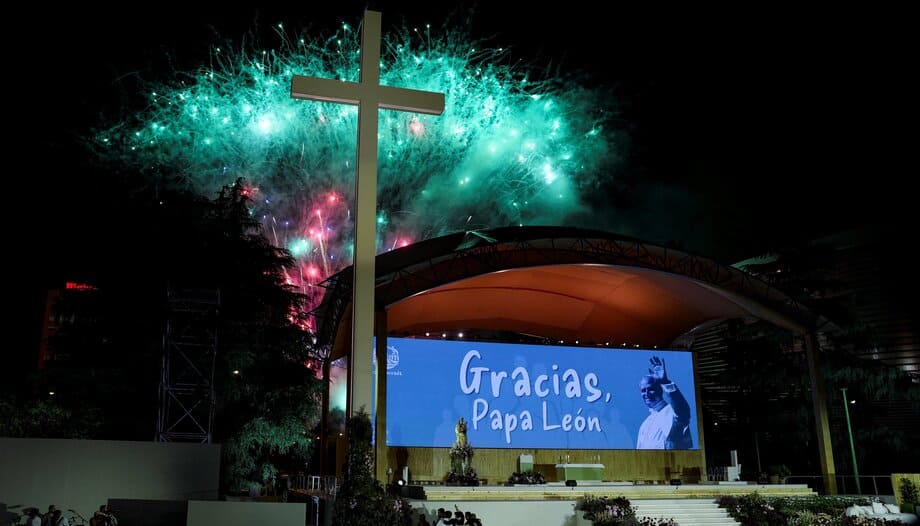
The performance of “Godspell”during the vigil The performance of *With Pope Leo XIV* in Madrid left a question hanging in the air amid the applause and criticism. What was it that really bothered people? Was it the musical, its aesthetic, its language, or the fact that the Gospel was presented in a way that some did not expect?
The controversy was nothing new. The people involved changed, but the human reaction remained the same.
Norman Rockwell seemed to have anticipated that reaction decades earlier. In one of his paintings, he juxtaposed a classical portrait by John Singer Sargent with an abstract one by Picasso. In front of them, he placed three female viewers. A mother and her daughter correspond to Sargent’s figurative portrait. The third, with her back turned, focuses all her attention on the Picasso. Each stands in front of the work in which she recognizes herself. None of them seems curious about the other.
Rockwell does not depict a conflict between artistic styles; he depicts the ease with which we seek out what confirms our way of understanding the world. He contrasts two ways of seeing: one that seeks to confirm what it already knows, and one that accepts standing before what it does not yet understand.
Knowing How to Look
Looking is not merely a matter of directing one’s eyes toward something. Looking involves taking the time, setting aside judgment, and allowing what is before us to transform us. When we give up that possibility, we cease to encounter the work of art, the person, or the Gospel. We encounter only our own expectations.
The theme of Pope Leo XIV’s visit to Madrid was “Lift Up Your Eyes.” This expression invites us to turn our gaze toward Christ, but also to reexamine the way we view reality. Because lifting up our eyes is not just about looking upward. It also means looking beyond our categories, our prejudices, and what we expect to find.
That was precisely what Rockwell painted: three people looking at the same works of art, yet unable to see the same thing. Perhaps he didn’t paint a museum. He painted a vigil. Not because he was anticipating a specific musical, but because he understood that every truly new proposition forces us to choose between two attitudes: protecting our certainties or letting reality broaden our perspective. Even when that reality comes with a gospel twist.
Languages
During the vigil, “Godspell” took the place of Rockwell’s Picasso. Not because the two works are comparable, but because they raised a similar question. Some stood in front of it with curiosity; others reacted with suspicion before even allowing themselves to be challenged.
While some people felt comfortable with pop music, rock, and ballads and saw in them creativity, joy, and a new way to proclaim the Gospel, others saw them as a break from what they consider to be characteristic of the religious sphere.
This wasn’t the first time gospel music had faced such rejection. When Thomas A. Dorsey began incorporating the blues and jazz into Christian music, many felt those rhythms had no place in worship. Today, it is difficult to understand the history of gospel music without that initial break. Each generation seems to need to be reminded that the Gospel endures, even as its forms of expression may be renewed.
The vigil, in a way, echoed Rockwell’s scene. Each person found a language in which to recognize themselves. The question is how many of us also reached out to a language that was not our own. The Gospel itself is full of surprises that throw off those who think they know in advance how God should act.
Let ourselves be surprised
Every work of art presents something to our eyes. What we discover depends less on the work itself than on the heart of the viewer.
Perhaps the question raised by “Godspell” is not whether that musical had a place in a vigil’s program. The question might rather be: Are we still capable of looking up before we judge? Because only those who are willing to truly look can allow themselves to be surprised by the Gospel.
Peca Macher is an architect and art curator, founder of Präsenz, a project that integrates art, education and conscious leadership through pausing, looking and listening. With more than 25 years of experience in cultural management and reflection, she writes and researches about memory, aesthetic experience and art as a tool for personal and social transformation. She is the author of the book Präsenz. Art as a tool for human and educational transformation.






 Español
  English
  Italiano
  Français
  Deutsch
  Polski
  简体中文
简体中文