



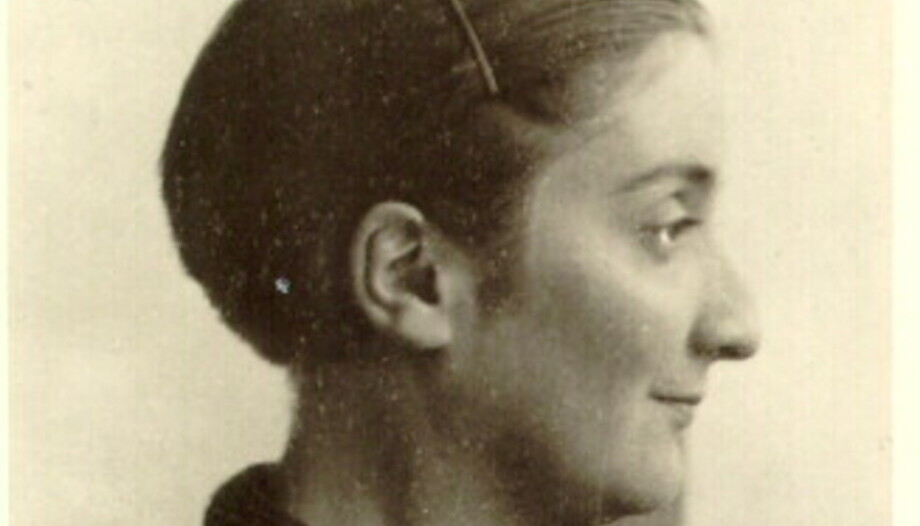
 France, mission land? The impact of a proposal (1943)
They say the French are Italians in a bad mood. Since I’m Italian and often in a bad mood, I guess I could call myself French! Joking aside, I’ve always loved the culture, language, way of thinking, and spiritual legacy of this great country, France, and of its people, whom we Italians call “our cousins on the other side of the Alps.” That’s why I want to dedicate an article to a great Frenchwoman: Madeleine Delbrêl.
Madeleine, just like Dorothy Day —with whom she has often been compared— and Flannery O'Connor, she was not a nun, a founder, or a theologian, but a laywoman, an artist, and an activist immersed in difficult realities, who found her mission (and God) on the street—literally: the street, with its “existential peripheries,” was her “territory of the devil”—that place where, as O’Connor would say, grace bursts in where it is least expected.
Madeleine has often inspired me with her reflections, which are echoed in the messages of the last two popes. That is why, in this article, I would like to share some of her writings, accompanying her story with the lyrics of “Dio è morto” (God Is Dead) by the great Francesco Guccini.
God is dead…
I've been told that my generation no longer believes in what has often been disguised as faith—in the timeless myths of the homeland or the hero.
Because the time has come to reject everything that is false: beliefs based on custom and fear, politics that is nothing more than a means to advance one’s career, self-serving hypocrisy, empty dignity, the hypocrisy of those who are always right and never wrong…
And a god who has died. In the extermination camps, God has died. With the myths of race, God has died. With partisan hatred, God has died. (F. Guccini)
Madeleine Delbrêl was born on October 24, 1904, in Mussidan, France, into a family that we would today describe as “dysfunctional.” Her father, Jules, was a stationmaster—a frustrated intellectual, anticlerical, proud, and temperamental—who frequently changed jobs, forcing the family to move constantly. Her mother, Lucile, was the complete opposite: conformist, conventional, and from a bourgeois family.
Family tensions had a profound impact on the young Madeleine, who, influenced by her father and a stifling environment, sought refuge in the intellectual world of the capital when the family moved to Paris. At the age of fifteen, she declared herself “strictly atheist,” going so far as to write, two years later: “God is dead; long live death.”.
But “the populated desert they call Paris” (as defined in *La Traviata*), where Madeleine studied philosophy and art at the Sorbonne, balancing her studies with poetry (in 1926 she won the Sully Prudhomme Prize from the French Academy), the piano, and the nonconformity of a free spirit, had something else in store for her: two “happy encounters.”.
The first was Jean Maydieu, with whom she fell in love. A devout Christian, he left her in 1924 to enter the Jesuit novitiate. Madeleine’s reaction was one of deep despair. However, a doubt began to take root within her: she felt deep respect for Jean; they were united by an intellectual journey; and she knew he could not have gone mad. And so she began to read and search, until she, too, experienced her second encounter—the encounter with God—which was no longer, as she herself stated, a hypothesis to be refuted, but a Presence that overwhelmed her.
Along the sides of the roads
I’ve seen people my age drift away down paths that never lead anywhere, chasing the dream that leads to madness in search of something they can’t find in the world they already have, on nights drenched in wine, down paths transformed by pills, amid the clouds of smoke from a world made of cities, refusing to swallow our weary civilization. And a god who has died. On the margins of the streets, God has died. (Guccini).
After her conversion, Madeleine felt a profound need that became the central focus of her life, as she herself wrote:
It has been clearly explained to us that on earth we must love God. And so that we have no doubts, nor think that we don’t know where to begin, Jesus has told us that the only way, the only recipe, the only path is to love one another. Perhaps we might be satisfied with achieving extraordinary humility, or unsurpassed poverty, or unwavering obedience, or unshakable purity; but if that humility, poverty, purity, and obedience have not led us to discover goodness—if those in our homes, on the streets, and in our cities continue to go hungry and cold, and if, moreover, they remain alone—then perhaps we are heroes, but we will not be among those who love God.
In 1933, she moved, along with some fellow women, to Ivry-sur-Seine, on the working-class outskirts of Paris—an industrial neighborhood marked by class struggle and governed by a Communist council. She trained to become a social worker and was hired by that very same anticlerical administration, which held her in high regard. Her home on Rue Raspail became a shelter for the poor, the homeless, and—during the Resistance—for Jews and refugees.
He lived like that, on the outskirts of Ivry, until October 13, 1964, when he died of a sudden brain hemorrhage. He was working at his desk.
In 2018, the Pope Francis’ He granted him the title of Venerable.
God has risen
But I believe my generation is ready for a new world and a newly born hope, for a future that is already in its hands; for an unarmed rebellion, because we all know by now that, if God dies, it is only for three days, and then He rises again. In what we believe, God has risen. In what we desire, God has risen. In the world we will build, God has risen (F. Guccini)
Madeleine’s spirituality is imbued with mysticism and pragmatism. Her writings are collected in several volumes, including “La joie de croire” (“The Joy of Believing”) and “Nous autres, gens des rues” (“We, the People of the Streets”): the compassion and wisdom of a woman who knew that true devotion is lived out every day through work, relationships, and respect for oneself and others.
For example, write:
A Christian cannot love God without loving humanity; and one cannot love humanity without loving all people; furthermore, one cannot love all people without loving those one knows—but with a concrete love, with an active love. This is the only law of good and evil, the law that allows humanity to choose between good and evil.
Or also:
Let us open our hearts to the small moments of solitude in our day. For our small moments of solitude are vast, moving, and holy, just like all the deserts of the world; they are inhabited by God Himself, the God who sanctifies solitude.
The loneliness of the black asphalt that separates our house from the tram stop; the loneliness of the long hallways through which flows the continuous stream of all the lives heading toward a new day; the solitude of the kitchen as I stand over the pot of beans; the small moments of solitude on the staircase that I climb up and down a hundred times a day; the solitude of the long hours spent washing clothes, mending, and ironing.
Lonelinesses we might fear, which empty our hearts: loved ones who leave and whom we wish were by our side; friends we wait for but who never come; things we’d like to say but that no one hears; the feeling of alienation in our hearts amidst other people.
Within each of us there is something that no one will ever fully understand. That something is the very cause of our loneliness—the loneliness that is innate to us. It is this primal loneliness that we must accept above all else.
There are various ways of not accepting it. For some, it will be withdrawing into themselves, silence (but not the good kind), the classic «misunderstood» attitude. For others, on the contrary, it will be the determination to explain it to themselves or, more often, to make others understand even the slightest nuance of their way of thinking. In both cases, each person will crystallize—whether in silence or in speech—which will give them the impression of a discord; in reality, it is a note from within ourselves that no human ear will ever be able to understand.
The day we realize that the unbridgeable gap between us and others is—through all our loves, all our influences, all our trials—the very place where what makes us who we are lies; when we have understood that it is in that very place that God speaks to us, calling us by name, we will have brought about the great transformation that turns painful loneliness into a blessed solitude.
And I'll conclude with another passage of his that, to me, is monumental:
Sometimes, throughout the day, we eagerly look forward to our passions—our greatest passions…
Those people will be called heroes—and that makes it worth sacrificing one's life…
Instead, tests of patience lie ahead.
Patience—those crumbs of passion, whose purpose is to kill us slowly for your glory, O God, to kill us without our glory.
First thing in the morning, they’re already there: our nerves—either too jittery or too sluggish; the crowded bus passing by, the spilled milk, the chimney sweeps arriving, the kids who ruin everything.
They are the guests our husband brings home and that friend who—ironically—doesn't show up; it's the phone that won't stop ringing; they are the ones we love but who no longer love us.
It is the desire to remain silent and the need to speak,
It is the desire to speak and the need to remain silent;
It's wanting to go out when we're cooped up,
is staying home when we should be going out;
He's the kind of husband we'd like to lean on
and who becomes the most fragile of all the children;
it's the disgust we feel toward our daily lives,
It is the feverish desire for what does not belong to us.
That's how our tests come—in tight rows or single file—and they always forget to tell us that they're the ordeal that awaits us.
And we let them pass us by with disdain, waiting—
to give our lives—an occasion worth living for.
Because we have forgotten that, just as there are branches
that are destroyed by fire; there are also boards that
Footsteps slowly wear them down until they eventually turn into sawdust.
Because we have forgotten that, although there are strands of wool
Cut off at the root by the scissors, there are strands of yarn that, day
Day after day, they take their toll on the backs of those who carry them.
All redemption is a form of martyrdom, but not all martyrdom is bloody:
There are some whose lives fray from one end to the other.






 Español
  English
  Italiano
  Français
  Deutsch
  Polski
  简体中文
简体中文