



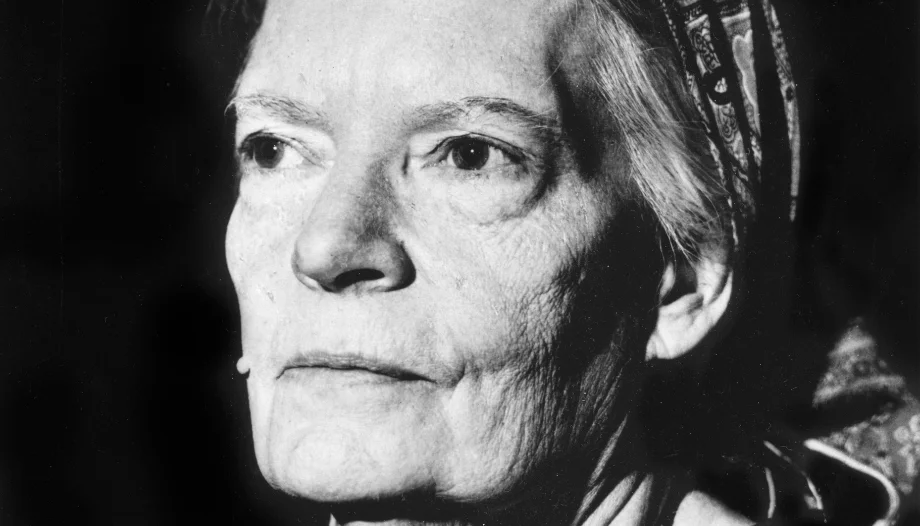
 Dorothy Day. The long loneliness
Some time ago, we dedicated an article to the figure of Flannery O'Connor, who has always been a great inspiration to me. Later, while reading the works of Thomas Merton, I stumbled upon an essay by Paul Elie entitled The Life You Save May Be Your Own: An American Pilgrimage. In it, Elie draws a parallel between four central figures in 20th century American “Catholic” culture: O'Connor, precisely, Merton, Walker Percy and Dorothy Day.
I wrote “Catholic” in quotation marks because Flannery O'Connor, as well as the other authors cited, including Dorothy Day, would be better suited to the literal meaning of the term: “universal”. They present themselves, in fact, as artists and thinkers who speak to all men and women of this world, and they do so as simple men and women endowed with genius and talent, free from any other label of religious or political affiliation.
In his essay, Elie highlights how, although they did not form a group or a school among themselves (as was the case with Chesterton, Belloc, Lewis and others in England), they shared four fundamental aspects:
- Consider life as a pilgrimage.
- The vision of a faith that does not simplify but unsettles, that wounds before liberating (the grace that breaks into the flesh).
- The juvenile reading of Jacques Maritain.
- To be “apostles” of this grace in a secularized culture, each in his own way: Day with social commitment, O'Connor with literature, Merton with contemplation and Percy with philosophy.
A life full of contrasts
Dorothy Day used to repeat to those who defined her as a saint: “Don't call me a saint. I don't want to be dismissed so easily”, that is, “Don't call me a saint. I don't want to be dismissed so easily”. It is a phrase that encapsulates not only all its complexity, but also the saints“ view of sainthood. It also represents a certain ”embarrassment" with which she is spoken of in ecclesiastical circles.
Dorothy Day was born in New York in 1897, in a bourgeois Protestant family. From a young age she embraced atheism and radical socialism, frequenting anarchist environments and writing for left-wing newspapers, in a path very similar to that of her French counterpart Madeleine Delbrêl.
Her private life was marked by experiences that many would define as disordered, some traumatic such as an abortion. From her relationship with Forster Batterham her daughter, Tamar, was born in 1926.
Conversion to Catholicism
That grace that bursts «into the devil's territory» burst into Day's life precisely with the birth of this child, which confronted her with great existential doubts. Dorothy wanted Tamar to be baptized and realized that she too wanted a «home» to return to. In 1927 she received Catholic baptism. That decision led her to break with Batterham, hostile to any form of religiosity, a separation that Day described as «the most painful thing she had ever done.».
Dorothy Day's conversion is a complex and controversial issue, but isn't every human life with its myriad facets?
Undoubtedly, the birth of her daughter was the existential casus belli. Dorothy claimed that she could not keep her daughter away from God, but her path of drawing closer to the Christian faith, and to Catholicism in particular, had already begun. In particular, even before the child's birth, Day frequented the Catholic churches in the poor neighborhoods of New York, not so much for faith as for the atmosphere there. The sense of the sacred, the incense, the dim light, the candles and the liturgy with Gregorian chant impressed her so much that she even wrote that at that time she knelt and prayed without knowing to whom.
Those same churches were, unlike those of the Protestant bourgeoisie, in the front line when it came to helping the poor and the many Irish and Italian immigrants in the Big Apple, in that social commitment that mattered so much to him, but which was no longer enough to soothe his sense of «long loneliness», a loneliness that not even friends, romantic love or political activism had been able to fill.
In addition to the beauty of the liturgy and the closeness to the masses, what influenced Dorothy most in her choice of Catholicism was its sacramental tradition, especially the Eucharist as a real presence and not a mere symbol.
Pope Catholic Worker and the influence of Maritain
In 1933, Dorothy Day founded, together with Peter Maurin, the Catholic Worker, a newspaper that was sold symbolically at a penny a copy, which still exists and which, at the same symbolic price as then, sells 80,000 copies today.
The objective was already clear from the name of the newspaper: the defense of the interests of all workers, not as a Marxist invention, but as an evangelical idea.
In this, Day and Maurin were deeply influenced by Jacques Maritain (1882-1973), a French philosopher converted to Catholicism and leading Thomistic thinker of the twentieth century, whose work focused on personalism.
Maritain, in fact, was Dorothy's contemporary and befriended her during the long period he spent in the United States.
In Integral Humanism (1936), Maritain argued that modern humanism had erroneously separated man from God and proposed a third alternative way to socialism and capitalism, for a just society based neither on the State nor on the individual as consumer, but on the person, understood as a free being open to transcendence.
In addition to founding the newspaper, Day and Maurin created the Houses of Hospitality, shelters for the poor, unemployed and homeless in large American cities, precisely in that spirit of corporal mercy that is not welfarism, but fraternity.
Peter Maurin, for his part, was also deeply influenced by distributism, the socioeconomic theory developed by Gilbert Keith Chesterton and Hilaire Belloc, to which we devoted an article in this issue. previous article.
The Catholic Worker Movement, a movement that arose precisely from the commitment of Day and Maurin, was later characterized by its absolute pacifism. Dorothy Day, in fact, was strongly opposed to World War II and, for this reason, earned the antipathy of many, including Catholics, and was even arrested on several occasions for her non-violent protests.
Her position remains difficult to classify politically: anarchist but Catholic; radical but not Marxist; pro-poor but against abortion, which she herself had experienced firsthand.
Literary works: writing as an act of faith
Dorothy Day was not only an activist: she was a writer, and her writing was inseparable from her faith and commitment. Among her major works is the spiritual autobiography The Long Loneliness (1952), in which she narrates the existential drama of her own life, marked first by the loneliness of a man without God and then by that of a man who has found God, but whose path must sometimes continue even in the dark, as John Henry Newman would say.
Also worth mentioning Loaves and Fishes (1963), a history of the Catholic Worker Movement told from the inside, and the posthumously published diaries, which are valuable for understanding the inner life of a woman who never separated thought, faith and action.
A highly topical figure
Dorothy Day is, paradoxically, an American response to the current debate. President Trump and Catholic politicians such as Vice President Vance have found themselves in open opposition to Pope Leo XIV, the first American-born pontiff in history, on issues such as migrants, war and rights, but above all on two concepts: «unarmed and disarming» peace, at the center of the new pontiff's preaching, and hope understood as «taking a stand.».
Precisely in this regard, Leo XIV defined Dorothy Day as «a great little American woman who [...] saw that her country's development model did not create equal opportunities for all. She understood that the dream was a nightmare for too many people, that as a Christian she had to commit herself to the workers, to the migrants, to those marginalized by an economy that kills. She wrote and served: it is important to unite mind, heart and hands».
The cause for the beatification of Dorothy Day was initiated by John Paul II, but it is advancing extremely slowly precisely because of those vicissitudes that marked Day's life, from abortion to cohabitations and the «irregular» life prior to her conversion.
Perhaps, however, all these stages are precisely the sign of that grace that breaks into the territory of the devil, so dear to Flannery O'Connor, and that leads not to disavow darkness, mistakes and pain, but to integrate them into one's spiritual narrative as part of a path common to all human beings: a concept that, at times, is not easy to propose and understand when one desires an immaculate Christianity and a Church composed only of the pure.






 Español
  English
  Italiano