


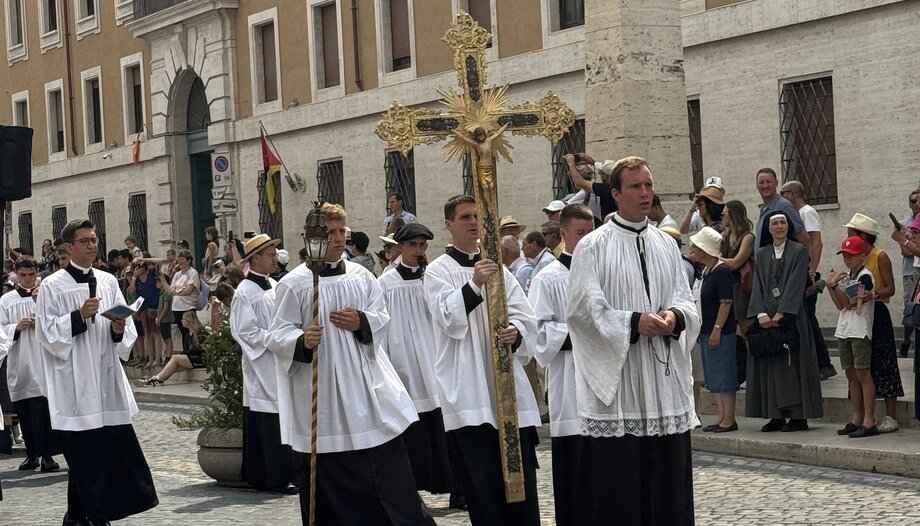
Pope The Pontiff has sent a letter to Davide Pagliarani, Superior General of the Priestly Fraternity of St. Pius X, in which, «with a heavy heart, yet still full of hope,» he asks the bishops, priests, seminarians, and faithful associated with this Fraternity to reconsider the «schismatic act» that this institution would carry out through the episcopal consecrations without a papal mandate announced by the Fraternity.
In this letter, dated on the Solemnity of Saints Peter and Paul, the Pope emphasizes that «the Church recognizes the commitment to liturgical life, the commitment to priestly formation, the apostolic zeal, and the desire for fidelity to Tradition that characterize many individuals and communities associated with that Fraternity.».
This appreciation and esteem «has inspired the attitude of care and kindness that my predecessors have consistently shown you.».
A Path of Dialogue and Understanding
The Pope, who has emphasized from the beginning of his pontificate the value and importance of the Church’s unity, while taking into account the diversity of her charisms, strongly urges the members of the Fraternity in this letter to reconsider this «challenge» issued to Rome, taking into account «the spiritual good of the faithful, for the schismatic act you would commit would deprive them of the lawful—and, in some cases, even valid—reception of the sacraments they love and seek for their sanctification.».
Leo XIV—«With a heavy heart, but still full of hope, I feel it is my duty to ask you to abandon your plan»—made this final gesture of reconciliation just a few hours before the schism was consummated.
The Pope has expressed the Church’s willingness to «embark on a path of dialogue and understanding that the Holy Spirit may make possible and fruitful,» with the aim of avoiding an act that would not only wound the Church but also set back this institution’s talks and union with Rome.
A Complex History: The FSSPX and the Holy See
Relations between the Priestly Fraternity of St. Pius X and the Holy See have been marked by complexity practically from the very beginning.
Born within the Catholic Church and founded by Marcel Lefebvre, the Priestly Fraternity of St. Pius X (FSSPX) was canonically established in 1970 in the Diocese of Fribourg.
Shortly thereafter, its founder expressed his opposition to key tenets of the Second Vatican Council, not only regarding liturgy but also in other areas such as the concept of religious freedom, ecumenism, and collegiality as a form of governance in the Church.
In 1975, the Holy See withdrew its approval of the Society (which had been granted on a temporary basis for six years) and ordered Lefebvre to close the Society’s seminary. Lefebvre did not close the seminary; instead, he even ordained a group of priests without authorization, which led to Marcel Lefebvre’s suspension «a divinis.».
Relationship with John Paul II
During the pontificate of John Paul II, the ups and downs with the Fraternity continued. In 1984, the Congregation for Divine Worship published Four Years Ago through which it permitted the celebration of Mass according to the Tridentine Rite, provided that «it is unequivocally established that such priests and faithful do not associate with those who doubt the legitimacy and doctrinal correctness of the Roman Missal promulgated by Pope Paul VI in 1970” (that is, they accept the legitimacy of the Novus Ordo Mass) and always with the approval of the diocesan bishop.
Lefébvre criticized this directive, although in the years that followed, he held several meetings and engaged in a series of overtures with the Holy See.
In fact, in 1988, the talks seemed to have reached a point of understanding, but, surprisingly, one day before the signing that would have marked the Fraternity’s return to the Church, its founder backed out and escalated tensions by announcing the episcopal ordination—without an apostolic mandate—of four of his followers.
Marcel Lefebvre died in 1991 without expressing his allegiance to the Holy See, despite the efforts of St. John Paul II.
The Ecclesia Dei Commission
That same year, 1988, the Holy See established the Pontifical Commission Ecclesia Dei, “with the task of collaborating with the bishops, the dicasteries of the Roman Curia, and the relevant groups, to facilitate full ecclesial communion for priests, seminarians, communities, and men and women religious who until now were linked in various ways to the Fraternity founded by Archbishop Lefebvre and who wish to remain united to the Successor of Peter in the Catholic Church.”.
Through this initiative, various Lefebvrian groups entered into communion with the Catholic Church, such as the Priestly Fraternity of St. Peter, the Institute of the Good Shepherd, and the Priestly Union of St. John Mary Vianney.
Benedict XVI, in 2009, llifted the excommunication of these four bishops of the Fraternity with the desire to «strengthen mutual trust and to deepen and stabilize the relationship between the Society of St. Pius X and the Apostolic See.» The Pope, who had led the unsuccessful talks with the founder until 1988, was encouraging, with this step, «the full communion of the entire Society of St. Pius X with the Church.».
In a an explanatory letter addressed to the bishops, explaining this decision, Benedict XVI also recalled that «excommunication affects individuals, not institutions. An episcopal ordination without papal mandate carries the risk of a schism, because it calls into question the unity of the episcopal college with the Pope.» Furthermore, the Pope explained that until «the Fraternity has a canonical status within the Church, its ministers do not exercise legitimate ministries within the Church either.”.
Although various attempts at rapprochement have been made over the years, the FSSPX’s refusal to recognize the Catechism of the Catholic Church, the Magisterium of the Second Vatican Council, and the legitimacy of the Novus Ordo Mass has persisted throughout this period.
Stagnation and Rising Tensions
During Pope Francis’s pontificate, the Pope recognized the validity of certain sacraments administered by priests of the Society (such as confessions and weddings), for the sake of the souls of the faithful. However, there has been no progress whatsoever—quite the contrary—in the FSSPX’s acceptance of the Second Vatican Council.
In 2019, the Ecclesia Dei Commission was absorbed into the Dicastery for the Doctrine of the Faith, and Cardinal Víctor Manuel Fernández took over the leadership of the talks with the traditionalist group.
The Latest Disagreement and the Danger of a Schism
The past few years have been particularly turbulent with regard to the relationship of the Priestly Fraternity of St. Pius X
On February 12, 2026, following a meeting with the Superior General of the Priestly Fraternity of St. Pius X, the prefect of the Dicastery for the Doctrine of the Faith, Monsignor Víctor Manuel Fernández, proposed «a specifically theological process of dialogue, with a well-defined methodology, on topics that have not yet been sufficiently clarified, such as: the difference between the act of faith and ‘religious respect of the mind and will,’ or the varying degrees of adherence required by the various texts of the Second Vatican Ecumenical Council and their interpretation.».
The prefect also asked the Fraternity to suspend the episcopal ordinations announced on February 2, since this «would entail a decisive break in ecclesial communion (schism) with serious consequences for the Fraternity as a whole.».
Pagliarani responded with a refusal, arguing «that we cannot reach an agreement on doctrine,» and maintained that the episcopal ordination was illicit. The Prefect for the Doctrine of the Faith recalled, in a brief press release dated May 13, 2026, that the consummation of this unlawful ordination «will constitute a «schismatic act»” (John Paul II, Ecclesia Dei, no. 3) and «formal adherence to the schism constitutes a grave offense against God and entails excommunication»
A situation that has continued to this day, in which the Pope has reached out «at the last minute» to prevent a situation that would lead to a breakup de facto of ecclesial communion.






 Español
  English
  Italiano
  Français
  Deutsch
  Polski
  简体中文
简体中文