


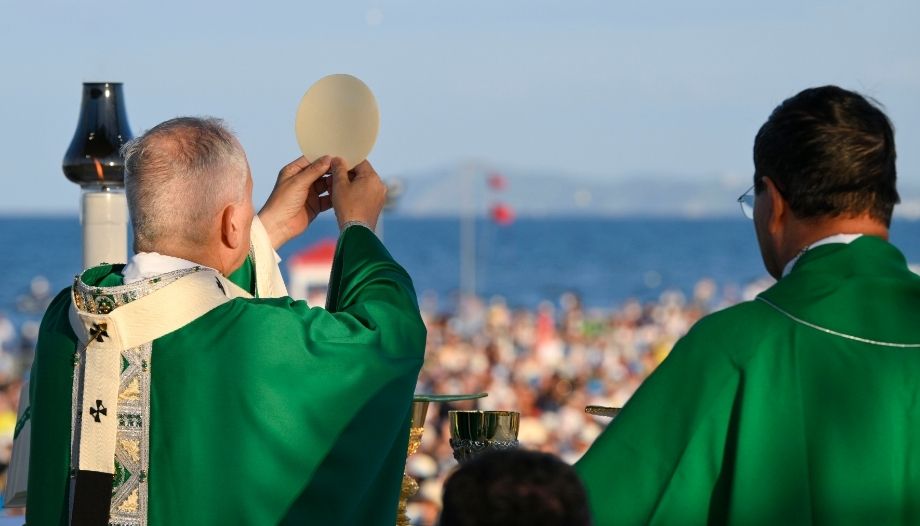
The Holy Father Leo XIV emphasized, in the last catechesis on the Constitution Sacrosanctum Concilium, two aspects: the need for more conscious and active participation by the faithful in the liturgy, a key reason for the liturgical reform carried out by the Second Vatican Council.
And the rejection of “the abuses that have been documented in some sectors of the Church in the postconciliar period, and which, unfortunately, sometimes even today ”are being tested, with some of the principles underlying the reform itself being taken to extremes or misunderstood.".
Throughout his remarks and greetings addressed specifically to the pilgrims and faithful in various languages—which were met with enthusiastic applause in St. Peter’s Basilica—the Pope highlighted key points of his message and recalled several holidays and events.
The example of Saint Monica and Saint Augustine, yesterday and the day before
For example, the liturgy commemorates two great saints tomorrow and the day after—Saint Monica and Saint Augustine—“united on earth by family ties and in heaven by the same destiny of glory. ”May their example inspire in each of us a sincere and passionate search for the Truth of the Gospel, so that we may bear joyful witness to it in our daily lives,” he said.
Jasna Góra, Poland: Human Life, Marriage, and Family
Pope Leo XIV has joined “in spirit with those gathered in Częstochowa, where today, 70 years later, the ‘Jasna Góra Vows of the Polish Nation’—drafted by Cardinal Stefan Wyszyński during his captivity—are being renewed. May the program for the moral renewal of society contained therein—through the protection of human life, the care of marriage and the family, and the education of children and young people—continue to inspire a commitment to justice and fraternity.”.
St. Teresa of Jesus Jornet e Ibars, patron saint of the elderly, and directors of OMP
He reminded the Spanish-speaking pilgrims that “today we celebrate the feast day of Saint Teresa of Jesus Jornet e Ibars, a Spanish nun and patron saint of the elderly. Through her intercession, let us ask the Lord to bless all the elderly, as well as those who care for and accompany them”—
The Pope extended a special greeting to the diocesan directors of the Pontifical Mission Societies and to those participating in summer gatherings for seminarians.
As he greeted pilgrims from various countries, he made special mention of those from Malta, Senegal, and Canada, extending a special greeting, once again, to those who serve in the national offices of the Pontifical Mission Societies.
Third letter from the then-Cardinal of Milan, later Pope Saint Paul VI, to his diocesan faithful
Returning to the central theme of the catechesis on the Liturgy, the Holy Father took the time to explain the reasons why the Council Fathers sought to promote a reform of the liturgy.
In this regard, he cited and commented on the third letter from the Council that Cardinal Giovanni Battista Montini, then Archbishop of Milan, sent on October 28, 1962, to the faithful of his own diocese.
“The liturgy,” he wrote, “is a sincere expression of both the divine and the human. It is language. It is a vehicle for divine teaching, on the one hand, and a voice for dialogue with God, on the other. It is clear that it cannot renounce its didactic function, nor can it fail to offer faith and piety the possibility of expressing themselves with spontaneous intelligibility,” Leo XIV recalled.
Motivated by these convictions, “the future Pope Saint Paul VI affirmed that the faithful “cannot and must not remain silent and passive. Their physical presence cannot be reconciled with their spiritual absence.””.
“Christians should not witness this mystery of faith as strangers and silent spectators”
The Pontiff has stated that these declarations are clearly in line with those that will appear in No. 48 of the conciliar Constitution:
“The Church, with solicitous care, ensures that Christians do not participate in this mystery of faith as strangers and silent spectators, but rather, by fully understanding it through the rites and prayers, participate consciously, devoutly, and actively in the sacred celebration (…)”.
A renewed awareness of the value of the liturgy can be perceived in these words, the Successor of Peter has noted. “Through the Church’s ritual actions, as the memorial of the work of salvation is celebrated, we are given the opportunity to experience a true relationship with God, entering into contact with the salvific event. Since the gestures and words of the sacred liturgy are essential to this experience, the participation of the faithful cannot be passive.”.
One part that is unchanging, and other parts that are subject to change
The Pope then pointed out that, as a living reality, the liturgy “has always been subject to developments and changes over the centuries,” and that the Second Vatican Council, “with the utmost respect for the heritage of tradition, and precisely in order to make it more accessible, deemed it necessary to revise the liturgical books.”.
And as stated in No. 21 of the Constitution *Sacrosanctum Concilium*, “the Liturgy consists of a part that is immutable because it is a divine institution, and of other parts subject to change, which over time may or even must vary if elements have been introduced into them that do not correspond well to the intrinsic nature of the Liturgy itself or have become less appropriate.”.
A liturgy that shines with its “noble simplicity”
The Holy Father also quoted Pius XI, Pius XII, and St. John XXIII, and urged “the primary responsibility of pastors, of bishops, but also of each priest individually” to “safeguard and promote a liturgy that, while respecting liturgical norms, shines with noble simplicity (cf. no. 34) and thus manifests the one, holy, Catholic, and apostolic Church.».
A liturgy of this kind will also be “a fundamental means of evangelization, the instrument of grace through which, as the Council teaches, we can learn to offer ourselves and, through Christ, be perfected in unity with God and among ourselves (see. ”No. 48)," the Pontiff concluded.





 Español
  English
  Italiano
  Français
  Deutsch
  Polski
  简体中文
简体中文