



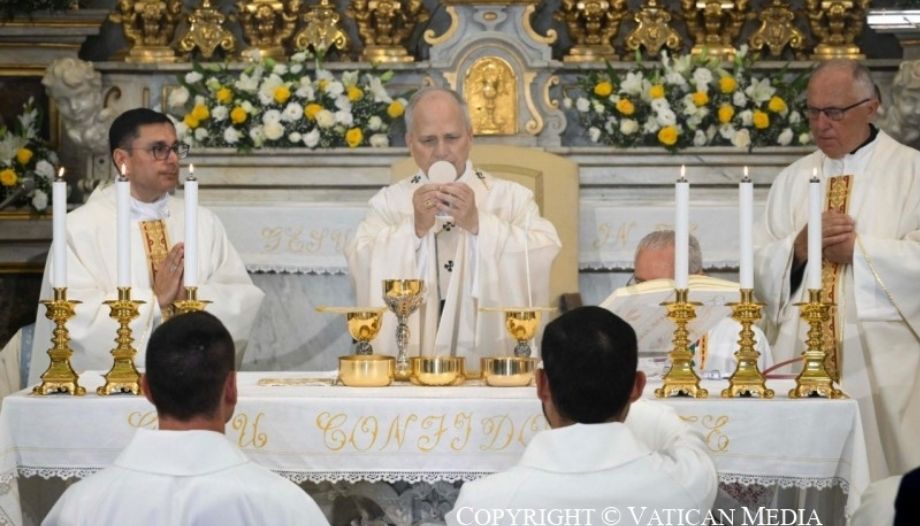
Regardless of other considerations raised by Vatican analysts—such as the consistory of cardinals scheduled for late June, which ultimately did not address the liturgical issue—the fact is that the Pope unexpectedly announced the May 20 marking the beginning of a new series of catechesis at the Audiencias. This time, the topic was the Sacred Liturgy.
The Pope emphasized, among other things, that the liturgy “touches the very heart of this mystery (the mystery of Christ). It is at once the space, the time, and the context in which the Church receives her own life from Christ. In the liturgy, in fact, the work of our Redemption is made present” (SC, 2).
And he quoted St. Augustine—as he did yesterday, August 19—who wrote that in celebrating the Eucharist, the Church “receives the Body of the Lord and becomes what she receives”: it becomes the Body of Christ, “God’s dwelling place in the Spirit” (Eph 2:22). This is “the work of our redemption,” which conforms us to Christ and builds us up in communion.
Three Reflections by the Holy Father in May
The following Wednesday, May 27, the Pontiff addressed, among other things, three topics, and said the following:
1. Elements of divine institution.
“The Council affirmed that legitimate progress in the liturgy must also preserve sound tradition, and that ‘certain elements of the liturgy can never change because they are of divine institution.’”.
2. “Preserving tradition while remaining open to legitimate progress”
“To help the faithful access the wealth of the gifts of grace bestowed by the sacred liturgy, the Constitution *Sacrosanctum Concilium* therefore sets forth, in a very effective way, the path to follow: ‘Preserve tradition and be open to legitimate progress.’” (SC, 23)”.
3. Respect for the texts and norms of the liturgy
“In particular, I encourage all priests to respect the texts and norms of the liturgy with openness, humility, trust in God’s greatness, and sincere fidelity to ecclesial communion.”.
León XIV at the liturgical conference at Mount Angel Abbey (Oregon)
Now that summer is here, in conjunction with his catechesis on the liturgy (yesterday’s session brought the total to seven), Leo XIV has published a letter on the occasion of the liturgical conference taking place at Mount Angel Abbey (Oregon, United States). It is dated June 29, and you can read it here.
In light of what we have been discussing, the Pope has written to Cardinal Arthur Roche, Prefect of the Dicastery for Divine Worship and the Discipline of the Sacraments, and highlights three points.
The Pope's Emphasis: Liturgical Formation
On the one hand, it reflects Pope Francis’s emphasis in his Letter Desiderio Desideravi, on the need for careful and ongoing formation of both the clergy and the laity—the entire People of God—in order to revitalize the liturgical life of the universal Church (cf. no. 38).
León XIV then reminds us that we must not ‘neglect to give priority in formation to those who, by virtue of the sacrament of Holy Orders, are called to be mystagogues—that is, to take the faithful by the hand and accompany them in their understanding of the holy mysteries’ (ibid.).
The Pontiff notes that “the first practical opportunities for liturgical formation arise from our regular practice of gathering each Sunday to celebrate the Eucharist.”.
Another Reminder Regarding Fidelity to Approved Texts and Rites
He adds that “to promote a dignified celebration of the sacred mysteries, we must emphasize the need for fidelity to the approved texts and instructions.”.
At this point, he emphasizes that in his recent catechesis on Sacrosanctum Concilium , “I have drawn attention to the respect that all those called to prepare for the celebration of the divine mysteries—and priests in particular—must show toward the rites promulgated by Pope Saint Paul VI and Pope Saint John Paul II.».
Reasons for the Insistence
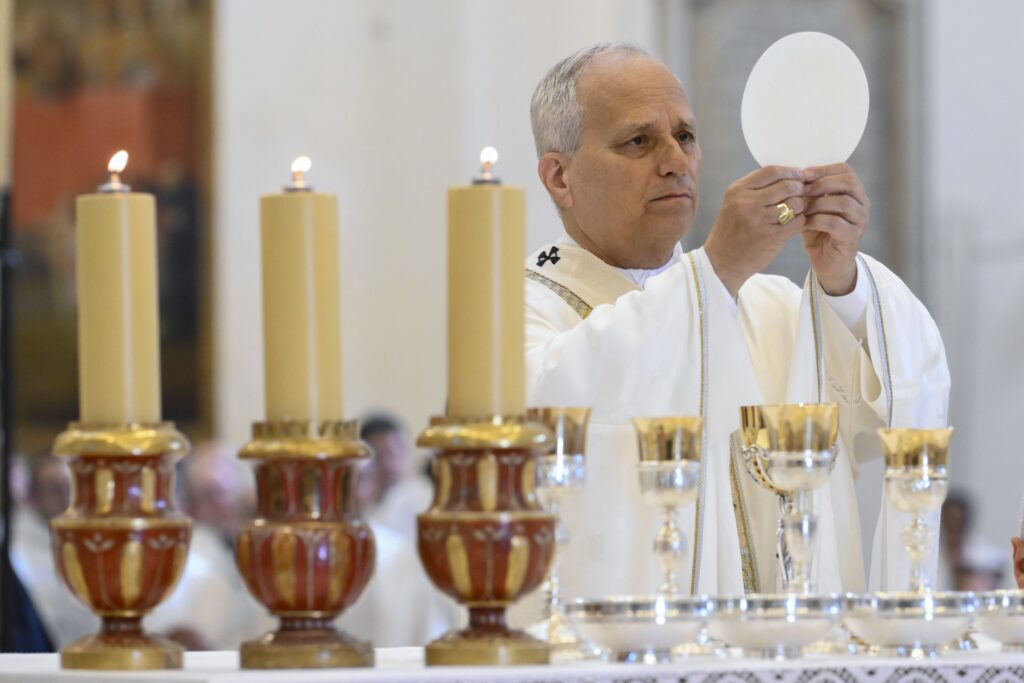
Anyone can surmise that the Pope’s insistence—especially on the part of priests—on respecting the texts, instructions, and rites approved by the Church is not random. If the Vicar of Christ insists on this matter, there must be reasons, and it stands to reason that the Roman Pontiff receives information from all over the world.
For example, it may not be uncommon for the celebrant to add words or omit words or phrases from the texts of the Eucharist, or to introduce unplanned rites. In colloquial terms, we might call these improvisation or creativity, sometimes motivated by tense situations related to migration—such as wars and conflicts—or other factors.
This summer, my family and friends have been observing this phenomenon, particularly in the Eucharistic Prayers of the Mass—especially during the rite of Communion—and, to a lesser extent, in the words of the Consecration.
Does this, then, hinder the celebrant's creativity?
The constitution Sacrosanctum Concilium The Second Vatican Council, as explained by Pope Leo XIV in his catechesis, stipulates that the sacred liturgy is the responsibility of the hierarchy. This pertains to the authority of the Church, as set forth in paragraph 22, according to a liturgy expert speaking to *Omnes*, who highlights paragraph 3:
“Therefore, absolutely no one else—not even a priest—should dare, on his own initiative, to add, remove, or change anything regarding liturgical matters.”.
“That’s a powerful statement,” adds this expert. “The liturgy is not the property of the presiding priest; rather, the regulation of the liturgy falls under the authority of the Church.”.
“It may seem as though a priest can take certain liberties, but that is not the case. In this matter, he must conform to what the Church teaches.”.
These changes destabilize the Liturgy, and not infrequently distort it
The same sources refer to Article 59 of the Directive Redemptionis sacramentum, dated 2004, approved by Pope John Paul II and signed by Cardinal Francis Arinze, Prefect Emeritus of the Congregation for Divine Worship (2002–2008).
The text states: “Let there be an end to the reprehensible practice whereby priests, deacons, or lay faithful change and alter at their own discretion, here and there, the texts of the sacred Liturgy that they recite. When they do this, they destabilize the celebration of the sacred Liturgy and not infrequently distort the authentic meaning of the Liturgy.”.
Finally, the liturgist also mentions number 51 of the Instruction. This point states that “only the Eucharistic Prayers found in the Roman Missal or those that have been legitimately approved by the Apostolic See may be used (…). He adds, “It cannot be tolerated that some priests assume the right to compose Eucharistic prayers,” nor to change the text approved by the Church, nor to use others composed by private individuals.”.
Priests have creative freedom
“The Church does not forbid priests from being creative, but priestly creativity—which has its place—does not consist in altering what the Church has received and established for the celebration of the Eucharist.”.
“The priest has a great deal of leeway to prepare a good homily, choose from the options provided in the Missal for the type of Mass to be celebrated, select the music, and so on,” notes the expert consulted, “but when it comes to the text established by the Church—especially the Eucharistic Prayer—he cannot become the author of that text.”.
“Faithfulness to liturgical norms is not a matter of rubricism or obsession, but rather faithfulness to the ministry we have received,” he concludes.






 Español
  English
  Italiano
  Français
  Deutsch
  Polski
  简体中文
简体中文